Song Jung Hoon, Jeong Sohee
Nano-Convergence Systems Research Division, Korea Institute of Machinery and Materials (KIMM), Daejeon, 34113 Republic of Korea.
Department of Nanomechatronics, University of Science and Technology (UST), Daejeon, 34113 Republic of Korea.
Nano Converg. 2017;4(1):21. doi: 10.1186/s40580-017-0115-0. Epub 2017 Aug 7.
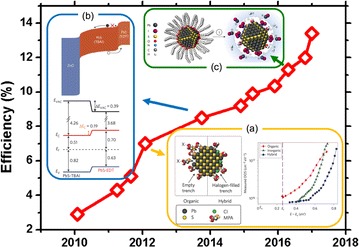
Colloidal quantum dots (CQDs) have attracted attention as a next-generation of photovoltaics (PVs) capable of a tunable band gap and low-cost solution process. Understanding and controlling the surface of CQDs lead to the significant development in the performance of CQD PVs. Here we review recent progress in the realization of low-cost, efficient lead chalcogenide CQD PVs based on the surface investigation of CQDs. We focus on improving the electrical properties and air stability of the CQD achieved by material approaches and growing the power conversion efficiency (PCE) of the CQD PV obtained by structural approaches. Finally, we summarize the manners to improve the PCE of CQD PVs through optical design. The various issues mentioned in this review may provide insight into the commercialization of CQD PVs in the near future.
胶体量子点(CQDs)作为下一代具有可调带隙和低成本溶液处理工艺的光伏器件(PVs),已引起人们的关注。对CQDs表面的理解和控制导致了CQD PVs性能的显著发展。在此,我们基于对CQDs的表面研究,综述了低成本、高效的硫属铅化物CQD PVs实现方面的最新进展。我们专注于通过材料方法改善CQDs的电学性能和空气稳定性,以及通过结构方法提高CQD PVs的功率转换效率(PCE)。最后,我们总结了通过光学设计提高CQD PVs的PCE的方法。本综述中提到的各种问题可能为CQD PVs在不久的将来实现商业化提供见解。