Department of Transplantation, Jagiellonian University Medical College, Krakow, Poland.
Department of Cardiac & Vascular Diseases, John Paul II Hospital, Jagiellonian University, Krakow, Poland.
Stem Cells Transl Med. 2017 Oct;6(10):1859-1867. doi: 10.1002/sctm.16-0484. Epub 2017 Aug 24.
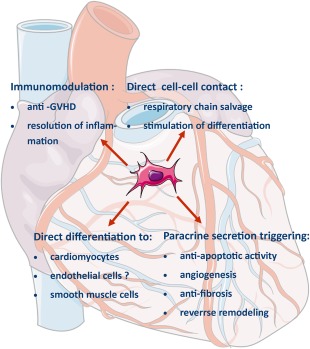
Experimental and early clinical data suggest that, due to several unique properties, mesenchymal stem cells (MSCs) may be more effective than other cell types for diseases that are difficult to treat or untreatable. Owing to their ease of isolation and culture as well as their secretory and immunomodulatory abilities, MSCs are the most promising option in the field of cell-based therapies. Although MSCs from various sources share several common characteristics, they also exhibit several important differences. These variations may reflect, in part, specific regional properties of the niches from which the cells originate. Moreover, morphological and functional features of MSCs are susceptible to variations across isolation protocols and cell culture conditions. These observations suggest that careful preparation of manufacturing protocols will be necessary for the most efficient use of MSCs in future clinical trials. A typical human myocardial infarct involves the loss of approximately 1 billion cardiomyocytes and 2-3 billion other (mostly endothelial) myocardial cells, leading (despite maximized medical therapy) to a significant negative impact on the length and quality of life. Despite more than a decade of intensive research, search for the "best" (safe and maximally effective) cell type to drive myocardial regeneration continues. In this review, we summarize information about the most important features of MSCs and recent discoveries in the field of MSCs research, and describe current data from preclinical and early clinical studies on the use of MSCs in cardiovascular regeneration. Stem Cells Translational Medicine 2017;6:1859-1867.
实验和早期临床数据表明,由于一些独特的特性,间充质干细胞(MSCs)可能比其他细胞类型更能有效治疗或治疗那些难以治疗的疾病。由于其易于分离和培养,以及其分泌和免疫调节能力,MSCs 是细胞治疗领域最有前途的选择。尽管来自不同来源的 MSCs 具有一些共同的特征,但它们也表现出一些重要的差异。这些差异可能部分反映了细胞起源的生态位的特定区域特性。此外,MSCs 的形态和功能特征容易受到分离方案和细胞培养条件的变化的影响。这些观察结果表明,在未来的临床试验中,为了最有效地利用 MSCs,需要仔细制定制造方案。典型的人类心肌梗死涉及大约 10 亿心肌细胞和 2-30 亿其他(主要是内皮)心肌细胞的丧失,尽管采用了最大程度的药物治疗,但仍对生活的长度和质量产生了重大的负面影响。尽管经过了十多年的密集研究,但仍在寻找“最佳”(安全且效果最大化)的细胞类型来促进心肌再生。在这篇综述中,我们总结了 MSCs 的最重要特征以及 MSCs 研究领域的最新发现的信息,并描述了在心血管再生中使用 MSCs 的临床前和早期临床研究的当前数据。转化医学干细胞 2017;6:1859-1867.