Chiu Chih-Hui, Ko Ming-Chen, Wu Long-Shan, Yeh Ding-Peng, Kan Nai-Wen, Lee Po-Fu, Hsieh Jenn-Woei, Tseng Ching-Yu, Ho Chien-Chang
Department of Exercise Health Science, National Taiwan University of Sport, Taichung City, 40404, Taiwan.
Department of Physical Education, Fu Jen Catholic University, New Taipei City, 24205, Taiwan.
Health Qual Life Outcomes. 2017 Aug 24;15(1):168. doi: 10.1186/s12955-017-0743-4.
The aim of present study was to compare the effects of different aerobic exercise intensities and energy expenditures on the body composition of sedentary obese college students in Taiwan.
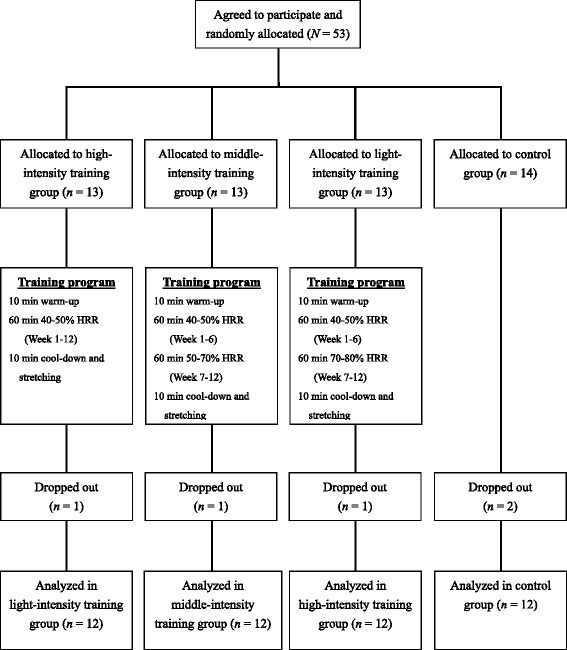
Forty-eight obese participants [body mass index (BMI) ≥ 27 kg/m, age 18-26 years] were randomized into four equal groups (n = 12): light-intensity training group (LITG), 40%-50% heart rate reserve (HRR); middle-intensity training group (MITG), 50%-70% HRR; high-intensity training group (HITG), 70%-80% HRR; and control group (CG). The aerobic exercise training program was conducted for 60 min per day on a treadmill 3 days per week for 12 weeks. All participant anthropometric data, blood biochemical parameters, and health-related physical fitness components were measured at baseline and after 12 weeks.
At baseline, the anthropometric indices did not differ significantly among the four groups (p > 0.05). After 12-week exercise intervention, the HITG and MITG had significantly more changes in body weight, waist circumference (WC), waist-to-hip ratio (WHR), and waist-to-height ratio (WHtR) than the LITG. The changes in BMI and body fat percentage differed among all four groups (p < 0.05).
A 12-week high-intensity exercise intervention with high energy expenditure can considerably reduce body weight, body fat, WC, WHR, and WHtR, whereas a light-intensity exercise intervention can significantly reduce body weight and body fat.
Current Controlled Trials TPECTR09831410900 , registered on 24 Dec 2009.
本研究旨在比较不同有氧运动强度和能量消耗对台湾久坐不动的肥胖大学生身体成分的影响。
48名肥胖参与者[体重指数(BMI)≥27kg/m,年龄18 - 26岁]被随机分为四组,每组12人:低强度训练组(LITG),心率储备(HRR)的40% - 50%;中等强度训练组(MITG),HRR的50% - 70%;高强度训练组(HITG),HRR的70% - 80%;以及对照组(CG)。有氧运动训练计划每周进行3天,每天在跑步机上进行60分钟,共12周。在基线和12周后测量所有参与者的人体测量数据、血液生化参数和与健康相关的身体素质成分。
在基线时,四组之间的人体测量指标无显著差异(p>0.05)。经过12周的运动干预后,HITG和MITG在体重、腰围(WC)、腰臀比(WHR)和腰高比(WHtR)方面的变化明显大于LITG。四组之间的BMI和体脂百分比变化存在差异(p<0.05)。
为期12周的高能量消耗高强度运动干预可显著降低体重、体脂、WC、WHR和WHtR,而低强度运动干预可显著降低体重和体脂。
当前对照试验TPECTR09831410900,于2