Hellyer Peter John, Clopath Claudia, Kehagia Angie A, Turkheimer Federico E, Leech Robert
Department of Bioengineering, Imperial College London, London, United Kingdom.
Centre for Neuroimaging Sciences, Institute of Psychiatry, Psychology and Neuroscience, King's College London, London, United Kingdom.
PLoS Comput Biol. 2017 Aug 24;13(8):e1005721. doi: 10.1371/journal.pcbi.1005721. eCollection 2017 Aug.
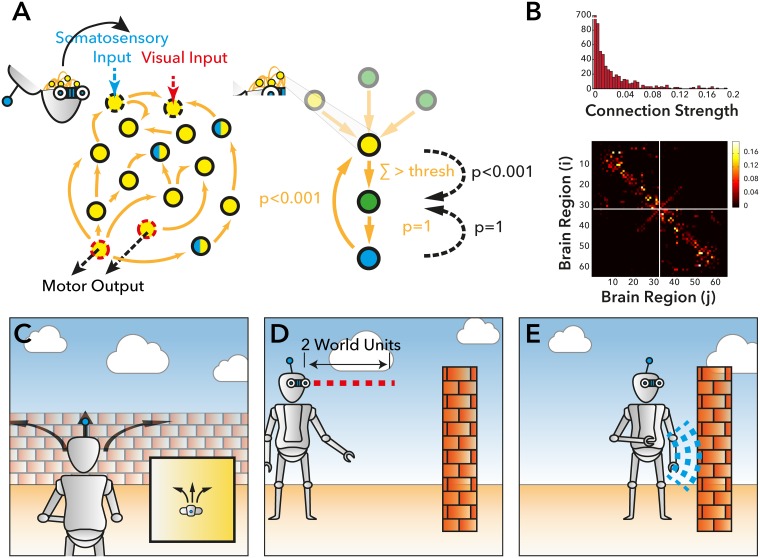
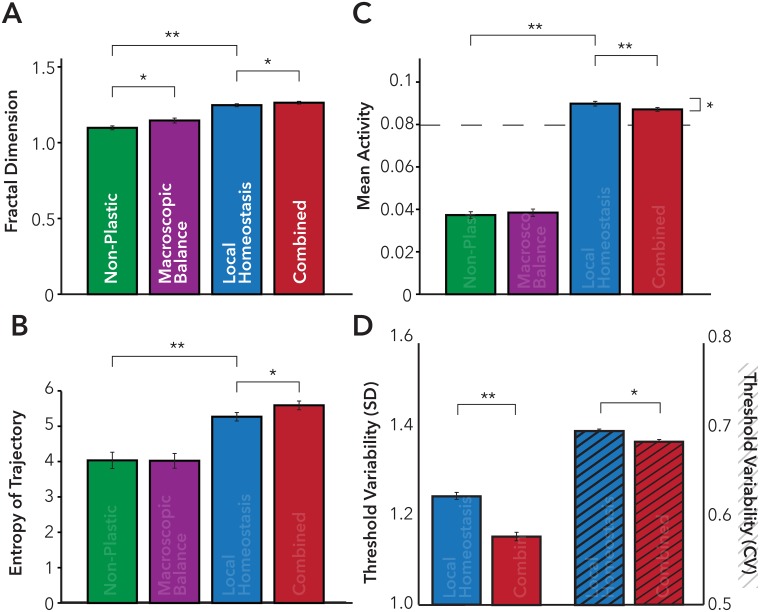
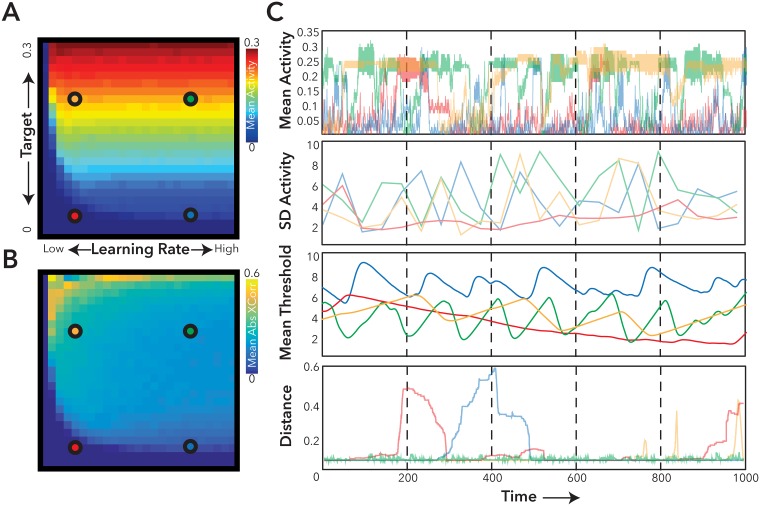
In recent years, there have been many computational simulations of spontaneous neural dynamics. Here, we describe a simple model of spontaneous neural dynamics that controls an agent moving in a simple virtual environment. These dynamics generate interesting brain-environment feedback interactions that rapidly destabilize neural and behavioral dynamics demonstrating the need for homeostatic mechanisms. We investigate roles for homeostatic plasticity both locally (local inhibition adjusting to balance excitatory input) as well as more globally (regional "task negative" activity that compensates for "task positive", sensory input in another region) balancing neural activity and leading to more stable behavior (trajectories through the environment). Our results suggest complementary functional roles for both local and macroscale mechanisms in maintaining neural and behavioral dynamics and a novel functional role for macroscopic "task-negative" patterns of activity (e.g., the default mode network).
近年来,已经有许多关于自发神经动力学的计算模拟。在这里,我们描述了一个自发神经动力学的简单模型,该模型控制一个在简单虚拟环境中移动的智能体。这些动力学产生了有趣的脑-环境反馈相互作用,这种相互作用会迅速破坏神经和行为动力学,表明需要稳态机制。我们研究了稳态可塑性在局部(局部抑制调节以平衡兴奋性输入)以及更全局(区域“任务负性”活动,其补偿另一区域的“任务正性”感觉输入)层面的作用,以平衡神经活动并导致更稳定的行为(在环境中的轨迹)。我们的结果表明,局部和宏观尺度机制在维持神经和行为动力学方面具有互补的功能作用,并且宏观“任务负性”活动模式(例如默认模式网络)具有新的功能作用。