Lee Ji Young, McMurtry Sarah A, Stevens Troy
1 5557 Department of Physiology and Cell Biology, University of South Alabama, Mobile, AL, USA.
2 Department of Internal Medicine, University of South Alabama, Mobile, AL, USA.
Pulm Circ. 2017 Oct-Dec;7(4):777-792. doi: 10.1177/2045893217731295. Epub 2017 Sep 12.
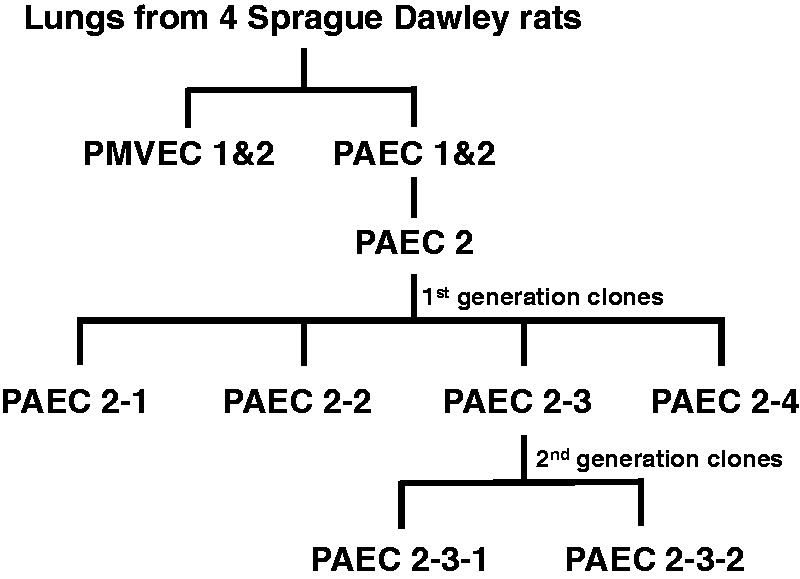
Pulmonary artery, capillary, and vein endothelial cells possess distinctive structures and functions, which represent a form of vascular segment specific macroheterogeneity. However, within each of these segmental populations, individual cell functional variability represents a poorly characterized microheterogeneity. Here, we hypothesized that single cell clonogenic assays would reveal microheterogeneity among the parent cell population and enable isolation of highly representative cells with committed parental characteristics. To test this hypothesis, pulmonary microvascular endothelial cells (PMVECs) and pulmonary arterial endothelial cells (PAECs) were isolated from different Sprague Dawley rats. Serum stimulated proliferation of endothelial populations and single cell clonogenic potential were evaluated. In vitro Matrigel assays were utilized to analyze angiogenic potential and the Seahorse assay was used to evaluate bioenergetic profiles. PMVEC populations grew faster and had a higher proliferative potential than PAEC populations. Fewer PMVECs were needed to form networks on Matrigel when compared with PAECs. PMVECs primarily utilized aerobic glycolysis, while PAECs relied more heavily on oxidative phosphorylation, to support bioenergetic demands. Repeated single cell cloning and expansion of PAEC colonies generated homogeneous first-generation clones that were highly reflective of the parental population in terms of growth, angiogenic potential, and bioenergetic profiles. Repeated single cell cloning of the first-generation clones generated second-generation clones with increased proliferative potential while maintaining other parental characteristics. Second-generation clones were highly homogeneous populations. Thus, single cell cloning reveals microheterogeneity among the parent cell population and enables isolation of highly representative cells with parental characteristics.
肺动脉、毛细血管和静脉内皮细胞具有独特的结构和功能,这代表了血管节段特异性宏观异质性的一种形式。然而,在这些节段性细胞群体中的每一个群体内,单个细胞的功能变异性代表了一种特征尚不明确的微观异质性。在此,我们假设单细胞克隆分析将揭示亲代细胞群体中的微观异质性,并能够分离出具有亲代特征的高度代表性细胞。为了验证这一假设,从不同的斯普拉格-道利大鼠中分离出肺微血管内皮细胞(PMVECs)和肺动脉内皮细胞(PAECs)。评估了血清刺激下内皮细胞群体的增殖以及单细胞克隆潜力。利用体外基质胶实验分析血管生成潜力,并使用海马实验评估生物能量谱。PMVEC群体比PAEC群体生长更快且具有更高的增殖潜力。与PAECs相比,在基质胶上形成网络所需的PMVECs更少。PMVECs主要利用有氧糖酵解,而PAECs更依赖氧化磷酸化来支持生物能量需求。对PAEC集落进行重复单细胞克隆和扩增产生了第一代同质克隆,这些克隆在生长、血管生成潜力和生物能量谱方面高度反映了亲代群体。对第一代克隆进行重复单细胞克隆产生了具有更高增殖潜力同时保持其他亲代特征的第二代克隆。第二代克隆是高度同质的群体。因此,单细胞克隆揭示了亲代细胞群体中的微观异质性,并能够分离出具有亲代特征的高度代表性细胞。