Pajon Melanie, Febres Vicente J, Moore Gloria A
Horticultural Sciences Department, Institute of Food and Agricultural Sciences, University of Florida, 2550 Hull Road, Gainesville, FL, 32611, USA.
Plant Molecular and Cellular Biology Program, University of Florida, Gainesville, FL, 32611, USA.
BMC Plant Biol. 2017 Aug 30;17(1):146. doi: 10.1186/s12870-017-1094-3.
In citrus the transition from juvenility to mature phase is marked by the capability of a tree to flower and fruit consistently. The long period of juvenility in citrus severely impedes the use of genetic based strategies to improve fruit quality, disease resistance, and responses to abiotic environmental factors. One of the genes whose expression signals flower development in many plant species is FLOWERING LOCUS T (FT).
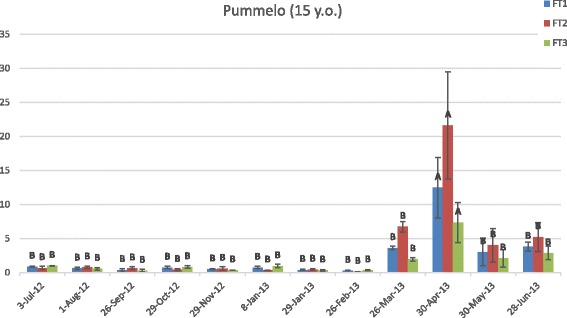
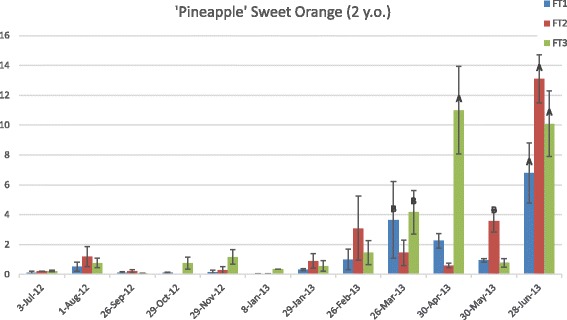
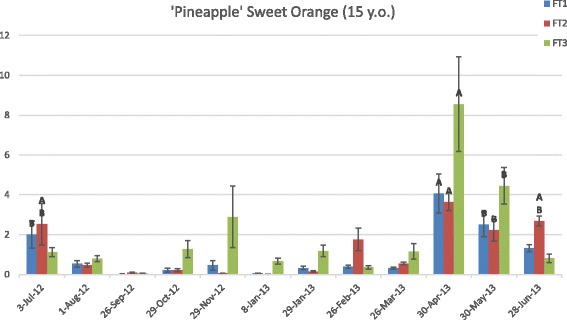
In this study, gene expression levels of flowering genes CiFT1, CiFT2 and CiFT3 were determined using reverse-transcription quantitative real-time PCR in citrus trees over a 1 year period in Florida. Distinct genotypes of citrus trees of different ages were used. In mature trees of pummelo (Citrus grandis Osbeck) and 'Pineapple' sweet orange (Citrus sinensis (L.) Osbeck) the expression of all three CiFT genes was coordinated and significantly higher in April, after flowering was over, regardless of whether they were in the greenhouse or in the field. Interestingly, immature 'Pineapple' seedlings showed significantly high levels of CiFT3 expression in April and June, while CiFT1 and CiFT2 were highest in June, and hence their expression induction was not simultaneous as in mature plants.
In mature citrus trees the induction of CiFTs expression in leaves occurs at the end of spring and after flowering has taken place suggesting it is not associated with dormancy interruption and further flower bud development but is probably involved with shoot apex differentiation and flower bud determination. CiFTs were also seasonally induced in immature seedlings, indicating that additional factors must be suppressing flowering induction and their expression has other functions.
在柑橘中,从幼年期到成年期的转变以树木持续开花结果的能力为标志。柑橘的幼年期较长,严重阻碍了利用基于遗传的策略来改善果实品质、抗病性以及对非生物环境因素的响应。在许多植物物种中,其表达信号指示花发育的基因之一是成花素基因(FT)。
在本研究中,利用逆转录定量实时PCR技术,在佛罗里达州对柑橘树进行了为期1年的监测,测定了开花基因CiFT1、CiFT2和CiFT3的基因表达水平。使用了不同年龄的不同基因型柑橘树。在柚(Citrus grandis Osbeck)和‘菠萝’甜橙(Citrus sinensis (L.) Osbeck)的成年树中,无论处于温室还是田间,在开花结束后的4月,所有三个CiFT基因的表达都是协同的且显著更高。有趣的是,未成熟的‘菠萝’幼苗在4月和6月CiFT3表达水平显著较高,而CiFT1和CiFT2在6月最高,因此它们的表达诱导不像成年植株那样同步。
在成年柑橘树中,叶片中CiFTs表达的诱导发生在春季末且开花之后,这表明它与休眠解除和进一步的花芽发育无关,而可能与茎尖分化和花芽决定有关。CiFTs在未成熟幼苗中也有季节性诱导,这表明还有其他因素在抑制开花诱导,并且它们的表达具有其他功能。