Al-Shahwan I M, Abdalla O A, Al-Saleh M A, Amer M A
Plant Protection Department, College of Food and Agricultural Sciences, King Saud University, Riyadh, Saudi Arabia.
Saudi J Biol Sci. 2017 Sep;24(6):1336-1343. doi: 10.1016/j.sjbs.2016.02.022. Epub 2016 Mar 2.
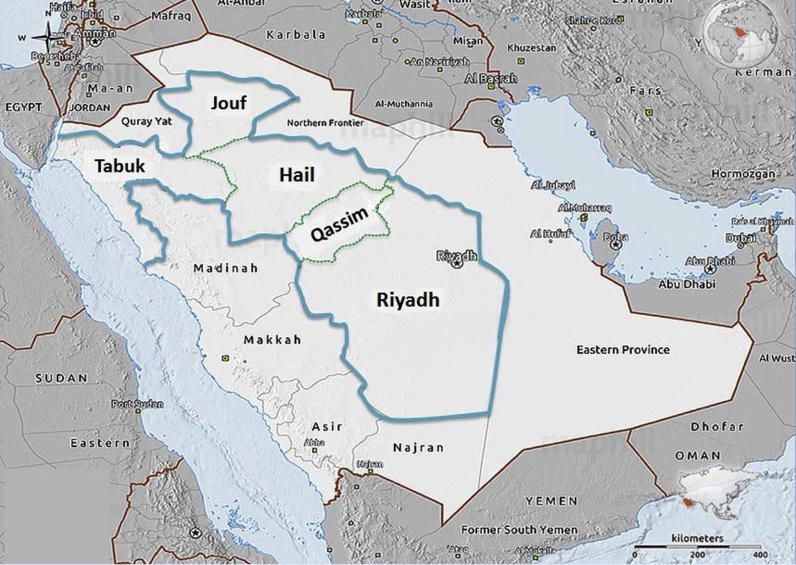
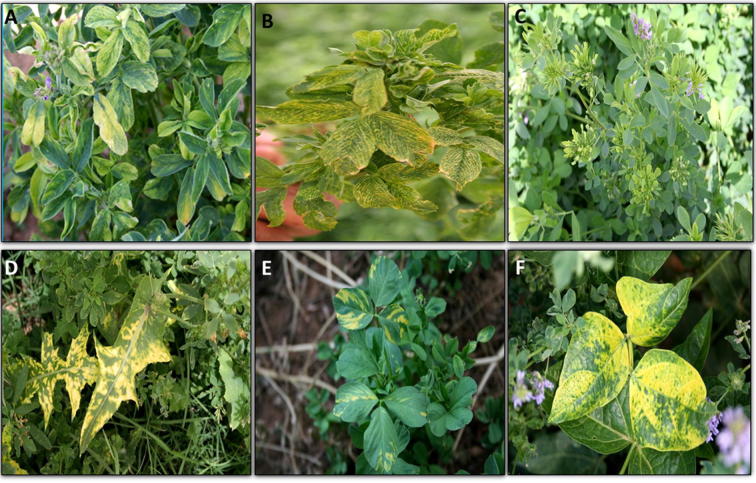
A total of 1368 symptomatic plant samples showing different virus-like symptoms such as mottling, chlorosis, mosaic, yellow mosaic, vein clearing and stunting were collected from alfalfa, weed and cultivated plant species growing in vicinity of alfalfa fields in five principal regions of alfalfa production in Saudi Arabia. DAS-ELISA test indicated occurrence of 11 different viruses in these samples, 10 of which were detected for the first time in Saudi Arabia. Eighty percent of the alfalfa samples and 97.5% of the weed and cultivated plants samples were found to be infected with one or more of these viruses. Nine weed plant species were found to harbor these viruses namely, spp., spp., , , , , , and . These viruses were also detected in seven cultivated crop plants growing adjacent to the alfalfa fields including , , , , , , and . The newly reported viruses together with their respective percent of detection in alfalfa, and in both weeds and cultivated crop plant species together were as follows: Bean leaf roll virus (BLRV) {12.5 and 4.5%}, Lucerne transient streak virus (LTSV) {2.9 and 3.5%}, Bean yellow mosaic virus (BYMV) {1.4 and 4.5%}, Bean common mosaic virus (BCMV) {1.2 and 4.5%}, Red clover vein mosaic virus (RCVMV) {1.2 and 4%}, White clover mosaic virus (WCIMV) {1.0 and 5%}, Cucumber mosaic virus (CMV) {0.8 and 3%}, Pea streak virus (PeSV) {0.4 and 4.5%} and Tobacco streak virus (TSV) {0.3 and 2.5%}. Alfalfa mosaic virus (AMV), the previously reported virus in alfalfa, had the highest percentage of detection in alfalfa accounting for 58.4% and 62.8% in the weeds and cultivated plants. Peanut stunt virus (PSV) was also detected for the first time in Saudi Arabia with a 66.7% of infection in 90 alfalfa samples collected from the surveyed regions during the last visit that tested negative to all the previously detected viruses.
在沙特阿拉伯苜蓿生产的五个主要地区,从苜蓿田附近生长的苜蓿、杂草及栽培植物物种中,共采集了1368份表现出不同病毒样症状(如斑驳、褪绿、花叶、黄色花叶、脉明和矮化)的有症状植物样本。双抗夹心酶联免疫吸附测定(DAS - ELISA)试验表明,这些样本中存在11种不同病毒,其中10种是在沙特阿拉伯首次检测到。发现80%的苜蓿样本以及97.5%的杂草和栽培植物样本感染了这些病毒中的一种或多种。发现9种杂草植物物种携带这些病毒,即 spp.、 spp.、 、 、 、 、 、 和 。在与苜蓿田相邻种植的7种栽培作物中也检测到了这些病毒,包括 、 、 、 、 、 和 。新报道的病毒及其在苜蓿、杂草和栽培作物物种中的各自检测百分比如下:菜豆卷叶病毒(BLRV){12.5%和4.5%}、苜蓿短暂条纹病毒(LTSV){2.9%和3.5%}、菜豆黄花叶病毒(BYMV){1.4%和4.5%}、菜豆普通花叶病毒(BCMV){1.2%和4.5%}、红三叶脉花叶病毒(RCVMV){1.2%和4%}、白三叶草花叶病毒(WCIMV){1.0%和5%}、黄瓜花叶病毒(CMV){0.8%和3%}、豌豆条纹病毒(PeSV){0.4%和4.5%}和烟草条纹病毒(TSV){0.3%和2.