Yang Hsi-Hsing, Lai Chih-Cheng, Wang Ya-Hui, Yang Wei-Chih, Wang Cheng-Yi, Wang Hao-Chien, Chen Likwang, Yu Chong-Jen
Department of Intensive Care Medicine, Chi Mei Medical Center, Tainan.
Department of Biotechnology, Southern Taiwan University of Science and Technology, Tainan.
Int J Chron Obstruct Pulmon Dis. 2017 Aug 21;12:2477-2485. doi: 10.2147/COPD.S139035. eCollection 2017.
It remains unclear whether severe exacerbation and pneumonia of COPD differs between patients treated with budesonide/formoterol and those treated with fluticasone/salmeterol. Therefore, we conducted a comparative study of those who used budesonide/formoterol and those treated with fluticasone/salmeterol for COPD.
Subjects in this population-based cohort study comprised patients with COPD who were treated with a fixed combination of budesonide/formoterol or fluticasone/salmeterol. All patients were recruited from the Taiwan National Health Insurance database. The outcomes including severe exacerbations, pneumonia, and pneumonia requiring mechanical ventilation (MV) were measured.
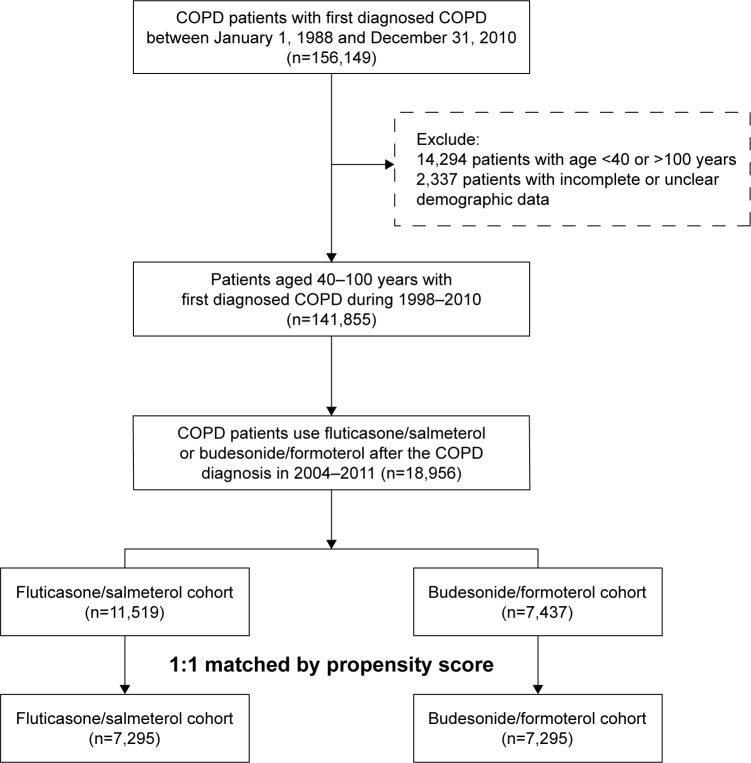
During the study period, 11,519 COPD patients receiving fluticasone/salmeterol and 7,437 patients receiving budesonide/formoterol were enrolled in the study. Pairwise matching (1:1) of fluticasone/salmeterol and budesonide/formoterol populations resulted in to two similar subgroups comprising each 7,295 patients. Patients receiving fluticasone/salmeterol had higher annual rate and higher risk of severe exacerbation than patients receiving budesonide/formoterol (1.2219/year vs 1.1237/year, adjusted rate ratio, 1.08; 95% CI, 1.07-1.10). In addition, patients receiving fluticasone/salmeterol had higher incidence rate and higher risk of pneumonia than patients receiving budesonide/formoterol (12.11 per 100 person-years vs 10.65 per 100 person-years, adjusted hazard ratio [aHR], 1.13; 95% CI, 1.08-1.20). Finally, patients receiving fluticasone/salmeterol had higher incidence rate and higher risk of pneumonia requiring MV than patients receiving budesonide/formoterol (3.94 per 100 person-years vs 3.47 per 100 person-years, aHR, 1.14; 95% CI, 1.05-1.24). A similar trend was seen before and after propensity score matching analysis, intention-to-treat, and as-treated analysis with and without competing risk.
Based on this retrospective observational study, long-term treatment with fixed combination budesonide/formoterol was associated with fewer severe exacerbations, pneumonia, and pneumonia requiring MV than fluticasone/salmeterol in COPD patients.
布地奈德/福莫特罗治疗的慢性阻塞性肺疾病(COPD)患者与氟替卡松/沙美特罗治疗的患者相比,其严重急性加重和肺炎情况是否存在差异仍不明确。因此,我们对使用布地奈德/福莫特罗和氟替卡松/沙美特罗治疗COPD的患者进行了一项对比研究。
在这项基于人群的队列研究中,研究对象为接受布地奈德/福莫特罗或氟替卡松/沙美特罗固定复方制剂治疗的COPD患者。所有患者均来自台湾国民健康保险数据库。测量的结局包括严重急性加重、肺炎以及需要机械通气(MV)的肺炎。
在研究期间,11519例接受氟替卡松/沙美特罗治疗的COPD患者和7437例接受布地奈德/福莫特罗治疗的患者纳入研究。对氟替卡松/沙美特罗组和布地奈德/福莫特罗组进行1:1配对后,形成了两个各有7295例患者的相似亚组。接受氟替卡松/沙美特罗治疗的患者严重急性加重的年发生率和风险高于接受布地奈德/福莫特罗治疗的患者(分别为1.2219/年和1.1237/年,调整后的率比为1.08;95%可信区间为1.07 - 1.10)。此外,接受氟替卡松/沙美特罗治疗的患者肺炎的发生率和风险高于接受布地奈德/福莫特罗治疗的患者(分别为每100人年12.11例和每100人年10.65例,调整后的风险比[aHR]为1.13;95%可信区间为1.08 - 1.20)。最后,接受氟替卡松/沙美特罗治疗的患者需要MV的肺炎的发生率和风险高于接受布地奈德/福莫特罗治疗的患者(分别为每100人年3.94例和每100人年3.47例,aHR为1.14;95%可信区间为1.05 - 1.24)。在倾向评分匹配分析、意向性分析以及有或无竞争风险的实际治疗分析前后均观察到类似趋势。
基于这项回顾性观察研究,与氟替卡松/沙美特罗相比,布地奈德/福莫特罗固定复方制剂长期治疗COPD患者可减少严重急性加重、肺炎以及需要MV的肺炎的发生。