Radwan Mahmoud, Akbari Sari Ali, Rashidian Arash, Takian Amirhossein, Abou-Dagga Sanaa, Elsous Aymen
Department of Health Management and Economics, School of Public Health, International Campus, Tehran University of Medical Sciences, Tehran, Iran.
Department of Research Affairs and Graduates Studies, Islamic University of Gaza, Gaza Strip, Palestine.
Int J Gen Med. 2017 Aug 11;10:239-247. doi: 10.2147/IJGM.S140140. eCollection 2017.
Diabetes mellitus (DM) is a serious chronic disease and an important public health issue. This study aimed to identify the predominant culture within the Palestinian Primary Healthcare Centers of the Ministry of Health (PHC-MoH) and the Primary Healthcare Centers of the United Nations Relief and Works Agency for Palestine Refugees (PHC-UNRWA) by using the competing values framework (CVF) and examining its influence on the adherence to the Clinical Practice Guideline (CPG) for DM.
A cross-sectional design was employed with a census sample of all the Palestinian family doctors and nurses (n=323) who work within 71 PHC clinic. A cross-cultural adaptation framework was followed to develop the Arabic version of the CVF questionnaire.
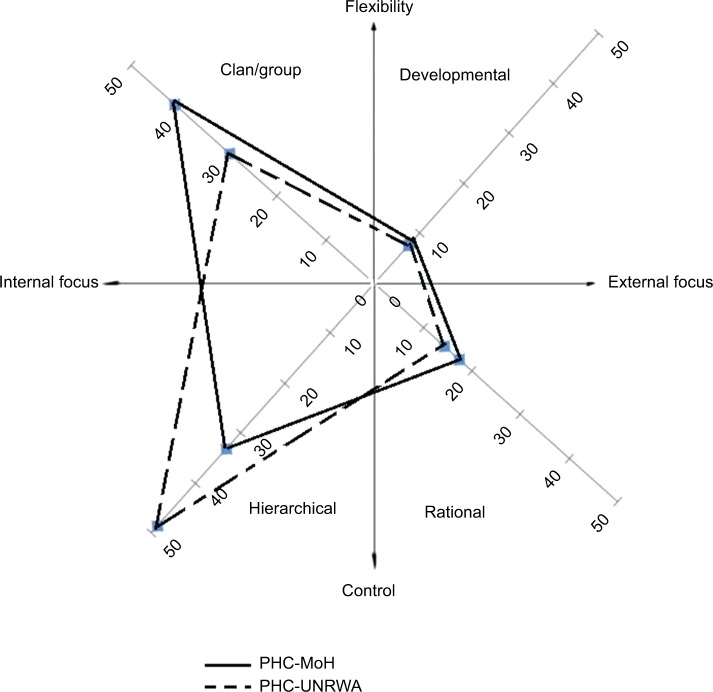
The overall adherence level to the diabetic guideline was disappointingly suboptimal (51.5%, <0.001; 47.3% in the PHC-MoH and 55.5% in the PHC-UNRWA). In the PHC-MoH, the clan/group culture was the most predominant (mean =41.13; standard deviation [SD] =8.92), followed by hierarchical (mean =33.14; SD=5.96), while in the PHC-UNRWA, hierarchical was the prevailing culture (mean =48.43; SD =12.51), followed by clan/group (mean =29.73; SD =8.37). Although a positively significant association between the adherence to CPG and the rational culture and a negatively significant association with the developmental archetype were detected in the PHC-MoH, no significant associations were found in the PHC-UNRWA.
Our study demonstrates that the organizational culture has a marginal influence on the adherence to the diabetic guideline. Future research should preferably mix quantitative and qualitative approaches and explore the use of more sensitive instruments to measure such a complex construct and its effects on guideline adherence in small-sized clinics.
糖尿病(DM)是一种严重的慢性疾病,也是一个重要的公共卫生问题。本研究旨在通过使用竞争价值观框架(CVF),识别巴勒斯坦卫生部初级医疗保健中心(PHC-MoH)和联合国近东巴勒斯坦难民救济和工程处初级医疗保健中心(PHC-UNRWA)内的主导文化,并考察其对糖尿病临床实践指南(CPG)依从性的影响。
采用横断面设计,对在71家初级医疗保健诊所工作的所有巴勒斯坦家庭医生和护士(n = 323)进行普查抽样。遵循跨文化适应框架开发CVF问卷的阿拉伯语版本。
糖尿病指南的总体依从水平令人失望地未达到最佳状态(51.5%,<0.001;PHC-MoH为47.3%,PHC-UNRWA为55.5%)。在PHC-MoH中,宗族/群体文化最为主导(均值 = 41.13;标准差[SD] = 8.92),其次是层级文化(均值 = 33.14;SD = 5.96),而在PHC-UNRWA中,层级文化是主流文化(均值 = 48.43;SD = 12.51),其次是宗族/群体文化(均值 = 29.73;SD = 8.37)。虽然在PHC-MoH中检测到CPG依从性与理性文化之间存在正相关且与发展原型存在负相关,但在PHC-UNRWA中未发现显著关联。
我们的研究表明,组织文化对糖尿病指南的依从性影响甚微。未来的研究最好结合定量和定性方法,并探索使用更敏感的工具来衡量这样一个复杂的结构及其对小型诊所指南依从性的影响。