Kim Yeon-Tae, Lim Gyu-Hyung, Lee Jae-Hong, Jeong Seong-Nyum
Department of Periodontology, Wonkwang University Daejeon Dental Hospital, Wonkwang University College of Dentistry, Daejeon, Korea.
J Periodontal Implant Sci. 2017 Aug;47(4):231-239. doi: 10.5051/jpis.2017.47.4.231. Epub 2017 Aug 14.
To retrospectively evaluate the relationship between the vertical position of the implant-abutment interface and marginal bone loss over 3 years using radiological analysis.
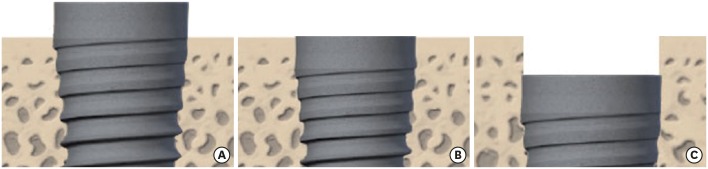
In total, 286 implant surfaces of 143 implants from 61 patients were analyzed. Panoramic radiographic images were taken immediately after implant installation and at 6, 12, and 36 months after loading. The implants were classified into 3 groups based on the vertical position of the implant-abutment interface: group A (above bone level), group B (at bone level), and group C (below bone level). The radiographs were analyzed by a single examiner.
Changes in marginal bone levels of 0.99±1.45, 1.13±0.91, and 1.76±0.78 mm were observed at 36 months after loading in groups A, B, and C, respectively, and bone loss was significantly greater in group C than in groups A and B.
The vertical position of the implant-abutment interface may affect marginal bone level change. Marginal bone loss was significantly greater in cases where the implant-abutment interface was positioned below the marginal bone. Further long-term study is required to validate our results.
采用放射学分析方法,回顾性评估种植体 - 基台界面垂直位置与3年期间边缘骨丢失之间的关系。
共分析了61例患者143颗种植体的286个种植体表面。在种植体植入后即刻以及加载后6、12和36个月拍摄全景X线片。根据种植体 - 基台界面的垂直位置将种植体分为3组:A组(骨水平以上)、B组(骨水平处)和C组(骨水平以下)。由一名检查者对X线片进行分析。
加载后36个月时,A组、B组和C组的边缘骨水平变化分别为0.99±1.45、1.13±0.91和1.76±0.78 mm,C组的骨丢失明显大于A组和B组。
种植体 - 基台界面的垂直位置可能影响边缘骨水平变化。种植体 - 基台界面位于边缘骨下方时,边缘骨丢失明显更大。需要进一步的长期研究来验证我们的结果。