Department of Nutrition, Exercise and Sports, University of Copenhagen, Denmark.
Department of Cardiology, Gentofte Hospital, University of Copenhagen, Denmark.
J Am Heart Assoc. 2017 Aug 18;6(8):e005469. doi: 10.1161/JAHA.117.005469.
We examined the role of menopause on cardiac dimensions and function and assessed the efficacy of exercise training before and after menopause.
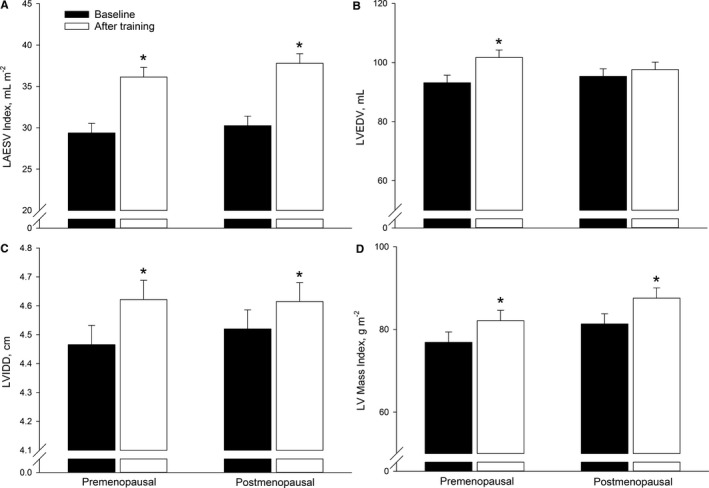
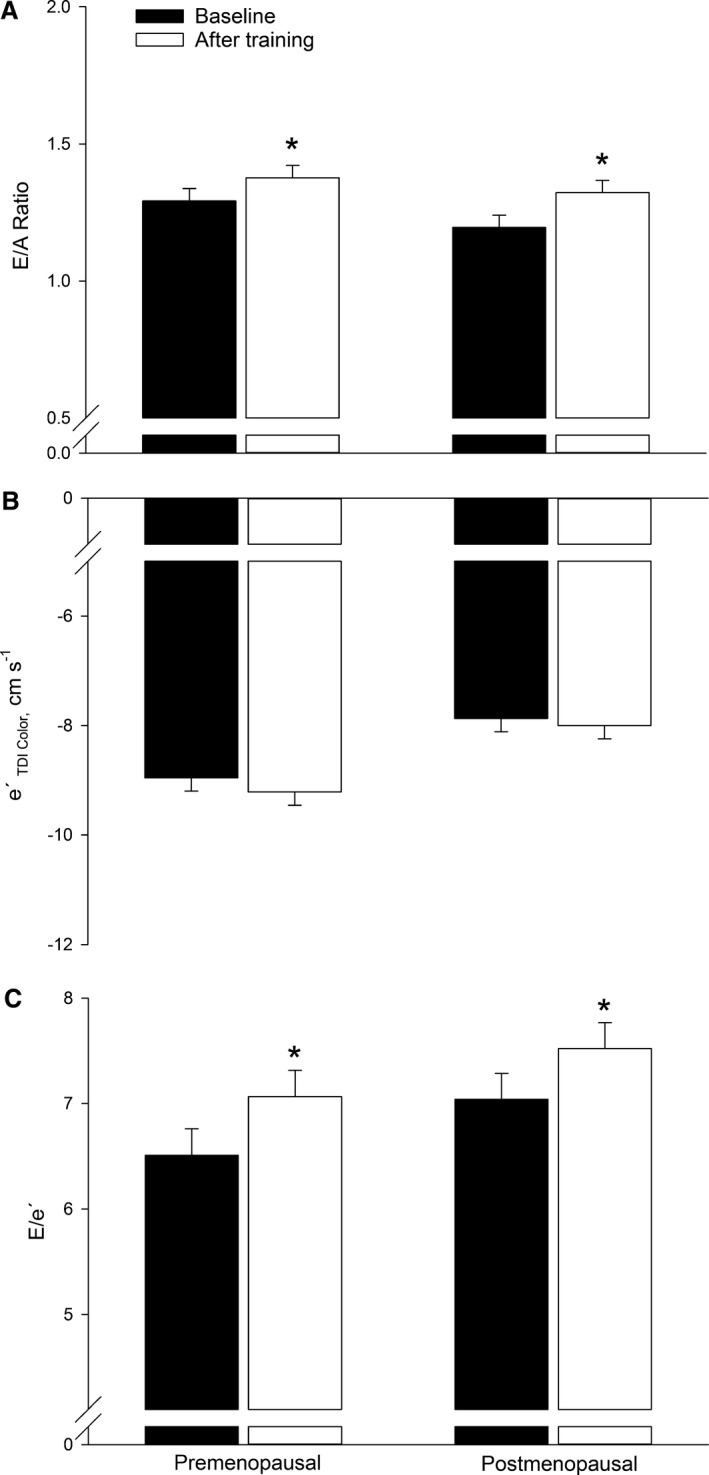
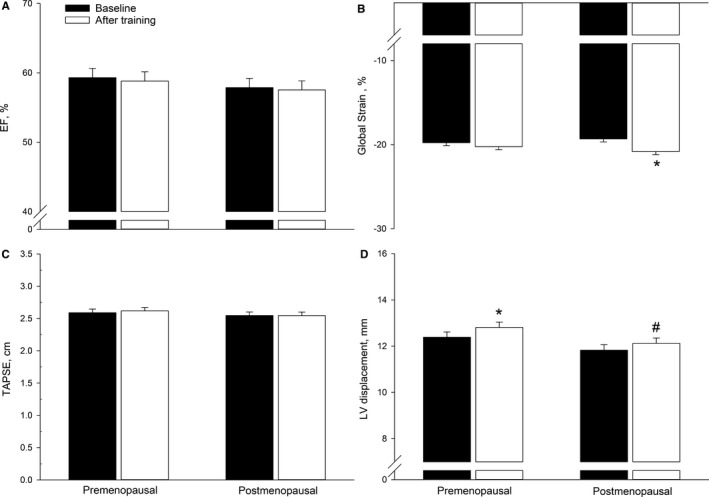
Two groups of healthy premenopausal (n=36, 49.4±0.3 years) and postmenopausal (n=37, 53.5±0.5 years) women with no history of cardiovascular disease and with a mean age difference between groups of only 4 years were studied. Cardiac dimensions and systolic and diastolic function were determined by transthoracic echocardiography with tissue Doppler imaging and 2-dimensional speckle tracking. Measurements were performed at baseline and after a 12-week period of high-intensity aerobic cycle training. LV internal diastolic diameter and LV mass were similar in the 2 groups at baseline and increased by ≈2% to 8% (=0.04-0.0007) with training in both groups. Left atrial end-diastolic and end-systolic volumes were similar for both groups and increased by 23% to 36% (0.0006-0.0001) with training. Systolic function assessed by mean global strain was similar in both groups at baseline and increased by ≈8% (=0.0004) with training in the postmenopausal group. LV displacement increased by ≈3% (=0.04) in the premenopausal women only. Diastolic function assessed by E/A ratio was similar at baseline and increased by ≈7% (=0.01) in the premenopausal group and 11% (=0.0001) in the postmenopausal group with training.
These results suggest that training-induced cardiac adaptations are preserved in the early postmenopausal phase. Furthermore, the hormonal changes associated with the menopausal transition do not appear to affect cardiac dimensions and function.
URL: http://www.clinicaltrials.gov. Unique identifier: NCT02135575.
我们研究了绝经对心脏结构和功能的影响,并评估了绝经前和绝经后进行运动训练的效果。
本研究纳入了两组健康的绝经前(n=36,49.4±0.3 岁)和绝经后(n=37,53.5±0.5 岁)女性,她们均无心血管疾病史,且两组间的平均年龄差异仅为 4 岁。通过经胸超声心动图、组织多普勒成像和二维斑点追踪技术测定心脏结构和收缩及舒张功能。在基线时和 12 周高强度有氧自行车训练后进行测量。LV 舒张末期内径和 LV 质量在两组中基线时相似,两组在训练后均增加了约 2%至 8%(=0.04-0.0007)。左心房舒张末期和收缩末期容积在两组中相似,在训练后增加了 23%至 36%(0.0006-0.0001)。两组基线时的平均整体应变评估的收缩功能相似,绝经后组在训练后增加了约 8%(=0.0004)。仅在绝经前女性中,LV 位移增加了约 3%(=0.04)。E/A 比值评估的舒张功能在基线时相似,绝经前组增加了约 7%(=0.01),绝经后组增加了 11%(=0.0001)。
这些结果表明,运动训练引起的心脏适应性在绝经早期仍得以保留。此外,与绝经过渡相关的激素变化似乎不会影响心脏结构和功能。