Hobbs Charlie, Reid James D, Shepherd Mark
School of Biosciences, University of Kent, Canterbury CT2 7NJ, U.K.
Department of Chemistry, University of Sheffield, Sheffield S3 7HF, U.K.
Biochem J. 2017 Oct 10;474(20):3513-3522. doi: 10.1042/BCJ20170362.
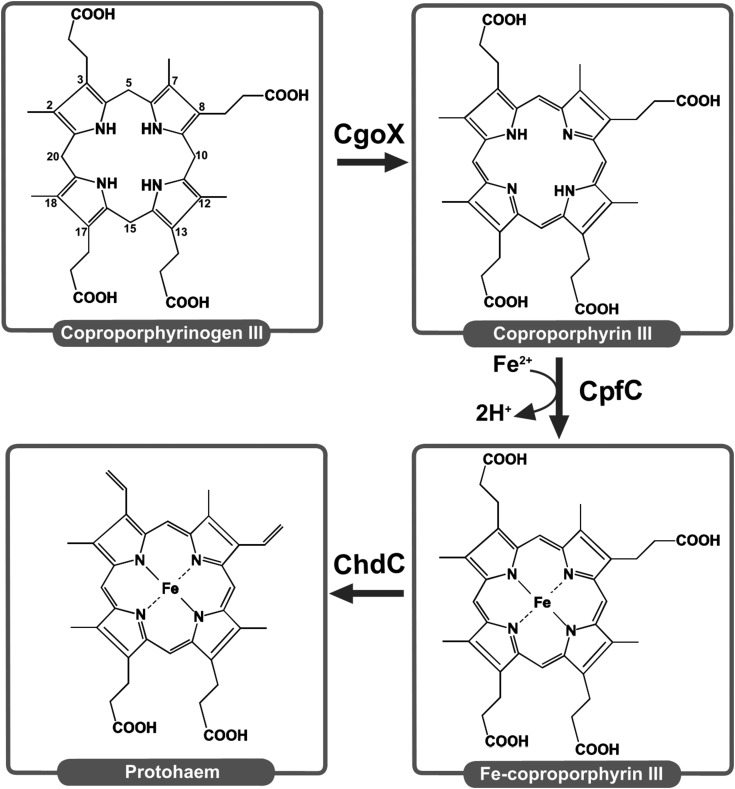
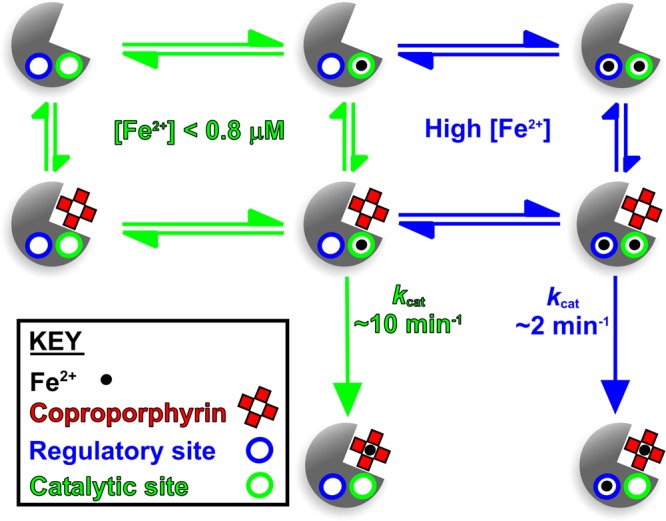
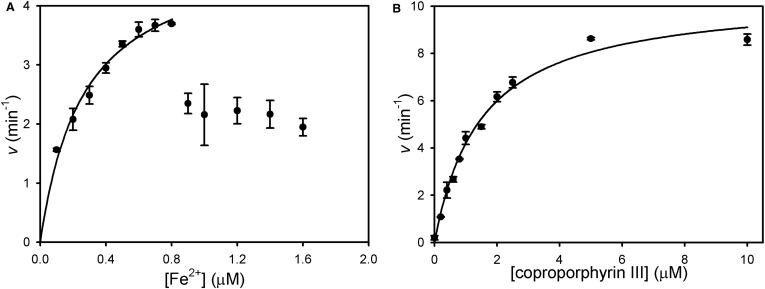
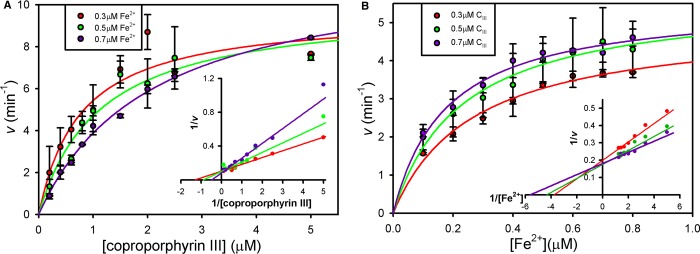
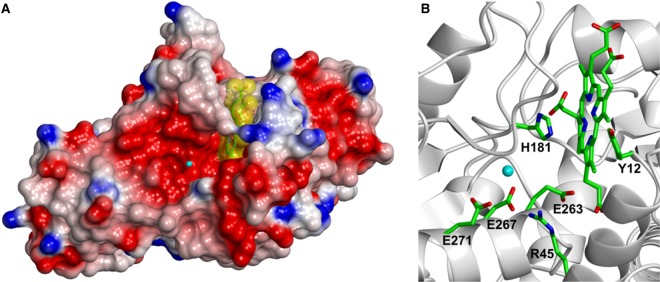
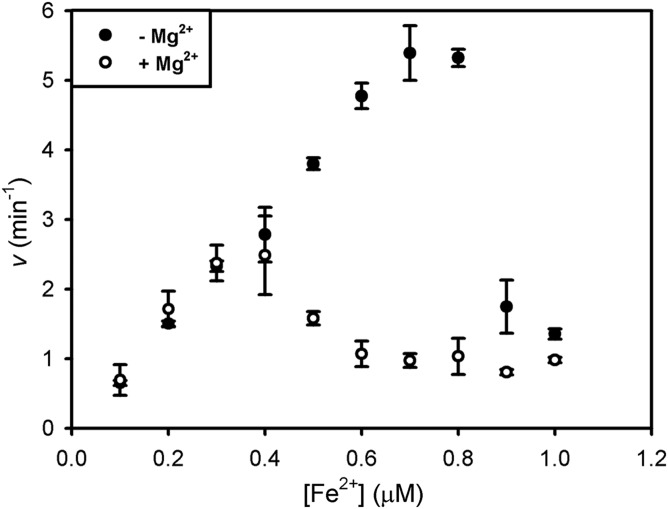
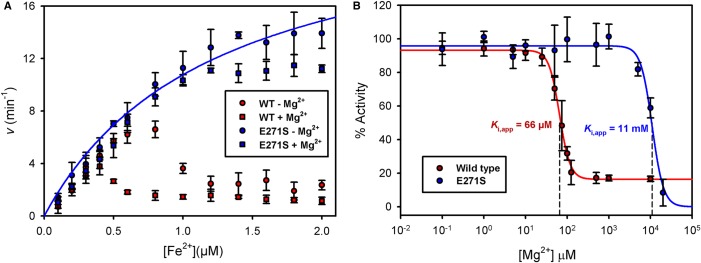
The majority of characterised ferrochelatase enzymes catalyse the final step of classical haem synthesis, inserting ferrous iron into protoporphyrin IX. However, for the recently discovered coproporphyrin-dependent pathway, ferrochelatase catalyses the penultimate reaction where ferrous iron is inserted into coproporphyrin III. Ferrochelatase enzymes from the bacterial phyla Firmicutes and Actinobacteria have previously been shown to insert iron into coproporphyrin, and those from and are known to be inhibited by elevated iron concentrations. The work herein reports a (coproporphyrin III) for ferrochelatase of 1.5 µM and it is shown that elevating the iron concentration increases the for coproporphyrin III, providing a potential explanation for the observed iron-mediated substrate inhibition. Together, structural modelling, site-directed mutagenesis, and kinetic analyses confirm residue Glu271 as being essential for the binding of iron to the inhibitory regulatory site on ferrochelatase, providing a molecular explanation for the observed substrate inhibition patterns. This work therefore has implications for how haem biosynthesis in is regulated by iron availability.
大多数已被表征的亚铁螯合酶催化经典血红素合成的最后一步,即将亚铁插入原卟啉IX中。然而,对于最近发现的依赖粪卟啉的途径,亚铁螯合酶催化的是倒数第二步反应,即将亚铁插入粪卟啉III中。此前已表明,来自厚壁菌门和放线菌门细菌的亚铁螯合酶可将铁插入粪卟啉中,并且已知来自[此处原文缺失相关信息]和[此处原文缺失相关信息]的亚铁螯合酶会受到铁浓度升高的抑制。本文的研究报告了粪肠球菌亚铁螯合酶对粪卟啉III的米氏常数(Km)为1.5 µM,并且表明提高铁浓度会增加对粪卟啉III的Km,这为观察到的铁介导的底物抑制提供了一种可能的解释。综合起来,结构建模、定点诱变和动力学分析证实,残基Glu271对于铁与粪肠球菌亚铁螯合酶上抑制性调节位点的结合至关重要,这为观察到的底物抑制模式提供了分子层面的解释。因此,这项工作对于粪肠球菌中的血红素生物合成如何受铁可用性调节具有重要意义。