Astuti Putu Ayu Swandewi, Freeman Becky
School of Public Health, Sydney Medical School, The University of Sydney, Sydney, New South Wales, Australia.
Preventive Research Collaboration (PRC), Charles Perkins Centre, The University of Sydney, Sydney, New South Wales, Australia.
BMJ Open. 2017 Sep 1;7(9):e016975. doi: 10.1136/bmjopen-2017-016975.
At the end of 2012, the Indonesian government enacted tobacco control regulation (PP 109/2012) that included stricter tobacco advertising, promotion and sponsorship (TAPS) controls. The PP did not ban all forms of TAPS and generated a great deal of media interest from both supporters and detractors. This study aims to analyse stakeholder arguments regarding the adoption and implementation of the regulation as presented through news media converge.
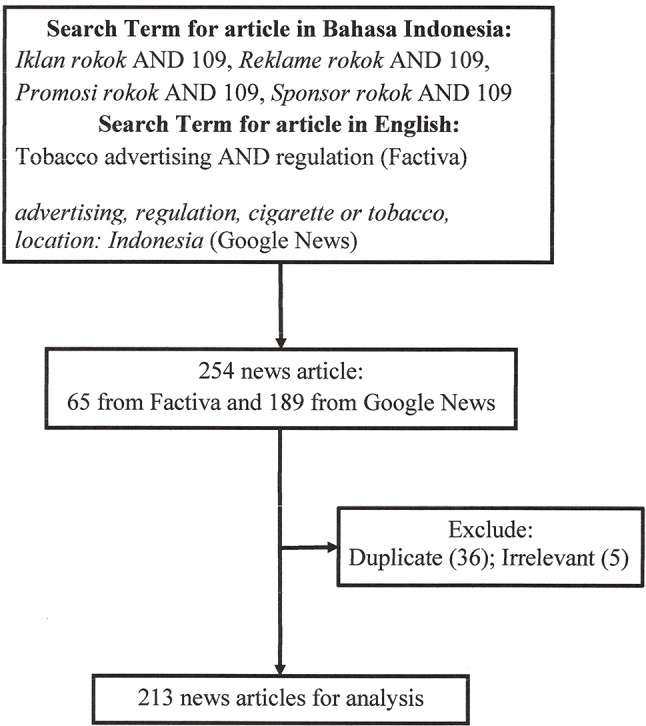
Content analysis of 213 news articles reporting on TAPS and the PP that were available from the Factiva database and the Google News search engine.
Indonesia, 24 December 2012-29 February 2016.
Arguments presented in the news article about the adoption and implementation of the PP were coded into 10 supportive and 9 opposed categories. The news actors presenting the arguments were also recorded. Kappa statistic were calculated for intercoder reliability.
Of the 213 relevant news articles, 202 included stakeholder arguments, with a total of 436 arguments coded across the articles. More than two-thirds, 69% (301) of arguments were in support of the regulation, and of those, 32.6% (98) agreed that the implementation should be enhanced. Of 135 opposed arguments, the three most common were the potential decrease in government revenue at 26.7% (36), disadvantage to the tobacco industry at 18.5% (25) and concern for tobacco farmers and workers welfare at 11.1% (15). The majority of the in support arguments were made by national government, tobacco control advocates and journalists, while the tobacco industry made most opposing arguments.
Analysing the arguments and news actors provides a mapping of support and opposition to an essential tobacco control policy instrument. Advocates, especially in a fragmented and expansive geographic area like Indonesia, can use these findings to enhance local tobacco control efforts.
2012年底,印度尼西亚政府颁布了烟草控制条例(PP 109/2012),其中包括更严格的烟草广告、促销和赞助(TAPS)控制措施。该条例并未禁止所有形式的TAPS,引发了支持者和反对者的大量媒体关注。本研究旨在分析通过新闻媒体报道呈现的利益相关者关于该条例的采纳和实施的论点。
对从Factiva数据库和谷歌新闻搜索引擎获取的213篇关于TAPS和该条例的新闻报道进行内容分析。
印度尼西亚,2012年12月24日至2016年2月29日。
新闻报道中关于该条例采纳和实施的论点被编码为10个支持类别和9个反对类别。提出论点的新闻行为主体也被记录下来。计算编码员间信度的卡帕统计量。
在213篇相关新闻报道中,202篇包含利益相关者的论点,各篇报道共编码了436个论点。超过三分之二,即69%(301个)的论点支持该条例,其中32.6%(98个)认为应加强实施。在135个反对论点中,最常见的三个是政府收入可能减少,占26.7%(36个);对烟草行业不利,占18.5%(25个);以及对烟农和烟草工人福利的担忧,占11.1%(15个)。大多数支持论点由国家政府、烟草控制倡导者和记者提出,而烟草行业提出的反对论点最多。
分析这些论点和新闻行为主体提供了对一项重要烟草控制政策工具的支持和反对情况的映射。倡导者,特别是在像印度尼西亚这样地域分散且广阔的地区,可以利用这些发现来加强当地的烟草控制工作。