Department of Hearing and Speech Sciences, Vanderbilt University Medical Center, Nashville, TN, United States; Department of Speech, Language, and Hearing Sciences, University of Arizona, Tucson, AZ, United States.
Department of Neurology, Reference Center for Rare Dementias, Hôpital Universitaire Pitié-Salpêtrière, Paris, France.
Neuropsychologia. 2017 Nov;106:90-99. doi: 10.1016/j.neuropsychologia.2017.08.032. Epub 2017 Sep 1.
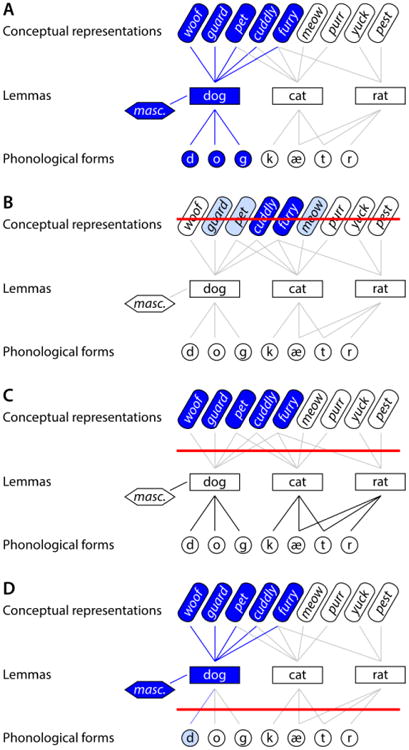
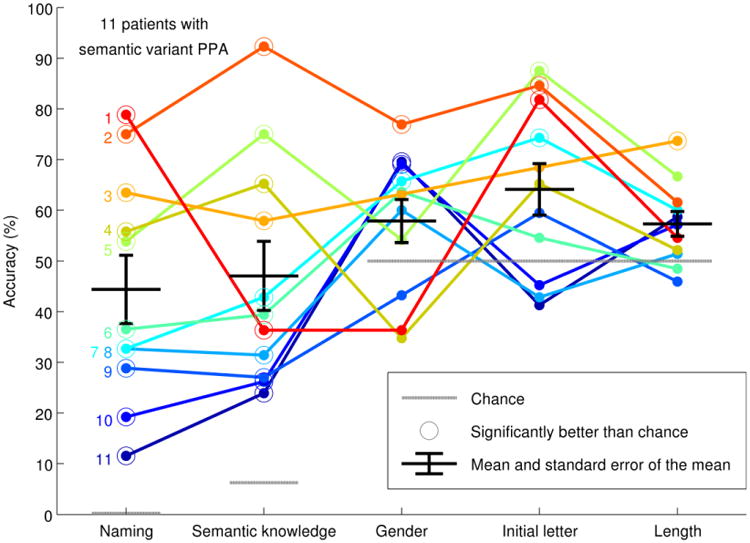
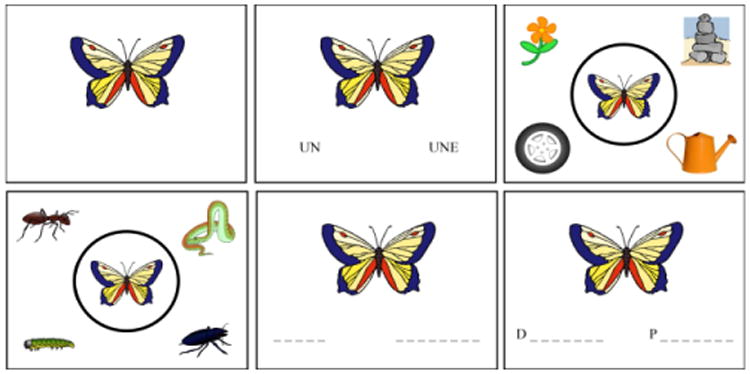
The most salient clinical symptom of semantic variant primary progressive aphasia (PPA) is a profound and pervasive anomia. These patients' naming impairments have been shown to reflect in large part a domain-general deterioration of conceptual knowledge that impacts both linguistic and non-linguistic processing. However, it is possible that post-semantic stages of lexical access may also contribute to naming deficits. To clarify the stages at which lexical access breaks down in semantic variant PPA, eleven French-speaking patients were asked to name objects, and were then queried for semantic, lexical-syntactic, and word form information pertaining to the items they could not name. Specifically, our goal was to determine whether patients can access intermediate representations known as lemmas, which mediate the arbitrary mapping between semantic representations and word forms (phonological and orthographic forms). The French language was chosen for this study because nouns in French are marked for grammatical gender, a prototypical type of lexical-syntactic information, represented at the level of the lemma. Access to word form information is also dependent on lemma access under some theoretical views. We found that six of the eleven patients showed partial access to either lexical-syntactic properties of unnamed items (grammatical gender), word form information (initial letter), or both. Access to these types of information suggests that a lemma has been retrieved, implying a breakdown at the post-semantic stage of word form retrieval. Our results suggest that although degraded conceptual knowledge is the main cause of naming deficits in semantic variant PPA, in some patients, a post-semantic component also contributes to the impairment.
语义变异型进行性失语症(PPA)最突出的临床症状是严重而普遍的命名障碍。这些患者的命名障碍在很大程度上反映了概念知识的领域普遍性恶化,这影响了语言和非语言加工。然而,词汇访问的后语义阶段也可能导致命名缺陷。为了阐明语义变异型 PPA 中词汇访问失败的阶段,我们要求 11 名讲法语的患者命名物体,然后询问他们与无法命名的项目相关的语义、词汇-句法和词形信息。具体来说,我们的目标是确定患者是否可以访问中间表示形式,称为词干,这些词干介导语义表示形式和词形(语音和正字法形式)之间的任意映射。选择法语进行这项研究是因为法语中的名词有语法性别标记,这是词汇-句法信息的典型类型,在词干层面上表示。词形信息的访问也依赖于理论观点下的词干访问。我们发现 11 名患者中有 6 名患者对未命名项目的词汇-句法属性(语法性别)、词形信息(首字母)或两者都有部分访问。对这些类型信息的访问表明已经检索到了词干,这意味着词形检索的后语义阶段出现了故障。我们的结果表明,尽管退化的概念知识是语义变异型 PPA 命名障碍的主要原因,但在某些患者中,后语义成分也会导致损害。