McFarlin Brian K, Henning Andrea L, Bowman Erin M, Gary Melody A, Carbajal Kimberly M
Brian K McFarlin, Andrea L Henning, Erin M Bowman, Melody A Gary, Applied Physiology Laboratory, University of North Texas, Denton, TX 76203, United States.
World J Gastrointest Pathophysiol. 2017 Aug 15;8(3):117-126. doi: 10.4291/wjgp.v8.i3.117.
To determine if 30-d of oral spore-based probiotic supplementation could reduce dietary endotoxemia.
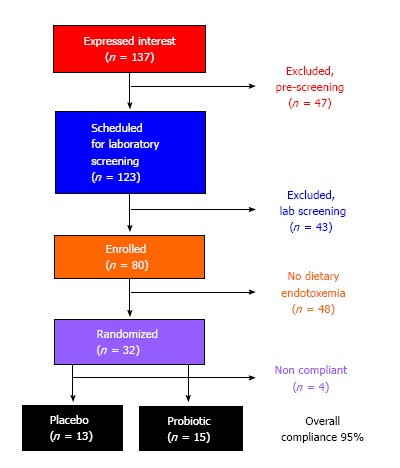
Apparently healthy men and women ( = 75) were screened for post-prandial dietary endotoxemia. Subjects whose serum endotoxin concentration increased by at least 5-fold from pre-meal levels at 5-h post-prandial were considered "responders" and were randomized to receive either placebo (rice flour) or a commercial spore-based probiotic supplement [Bacillus indicus (HU36), Bacillus subtilis (HU58), Bacillus coagulans, and Bacillus licheniformis, and Bacillus clausii] for 30-d. The dietary endotoxemia test was repeated at the conclusion of the supplementation period. Dietary endotoxin (LAL) and triglycerides (enzymatic) were measured using an automated chemistry analyzer. Serum disease risk biomarkers were measured using bead-based multiplex assays (Luminex and Milliplex) as secondary, exploratory measures.
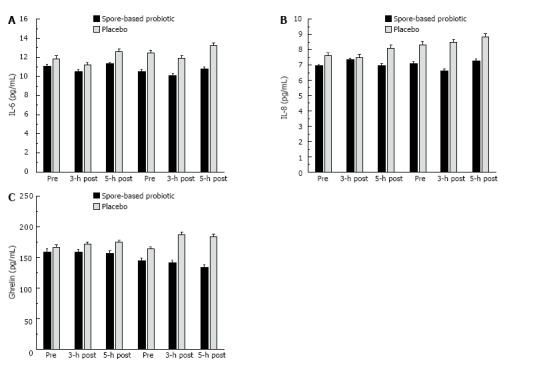
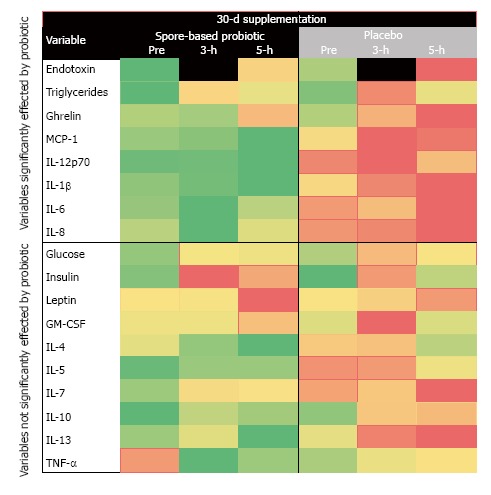
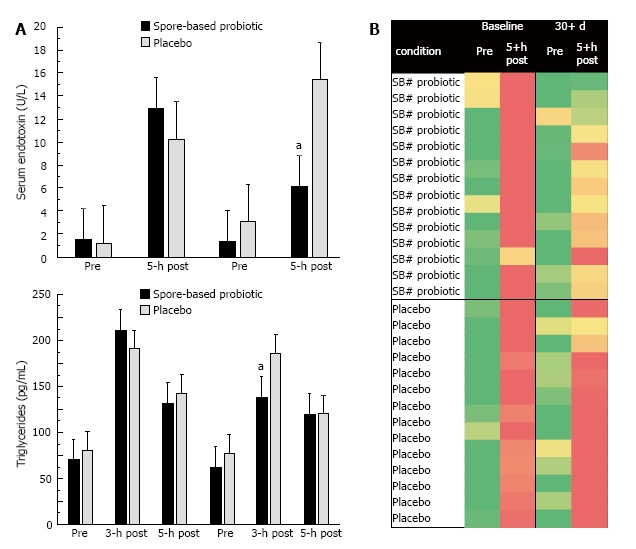
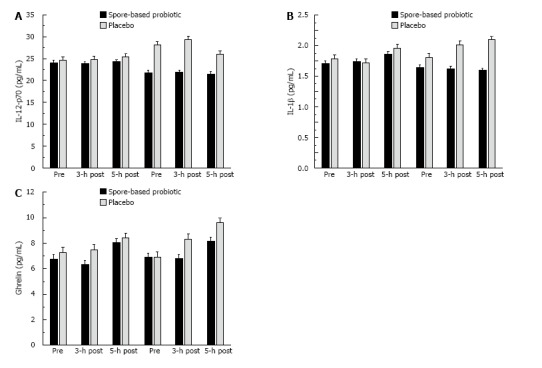
Data were statistically analyzed using repeated measures ANOVA and a < 0.05. We found that spore-based probiotic supplementation was associated with a 42% reduction in endotoxin (12.9 ± 3.5 6.1 ± 2.6, = 0.011) and 24% reduction in triglyceride (212 ± 28 138 ± 12, = 0.004) in the post-prandial period Placebo subjects presented with a 36% increase in endotoxin (10.3 ± 3.4 15.4 ± 4.1, = 0.011) and 5% decrease in triglycerides (191 ± 24 186 ± 28, = 0.004) over the same post-prandial period. We also found that spore-based probiotic supplementation was associated with significant post-prandial reductions in IL-12p70 (24.3 ± 2.2 21.5 ± 1.7, = 0.017) and IL-1β (1.9 ± 0.2 1.6 ± 0.1, = 0.020). Compared to placebo post supplementation, probiotic subject had less ghrelin (6.8 ± 0.4 8.3 ± 1.1, = 0.017) compared to placebo subjects.
The key findings of the present study is that oral spore-based probiotic supplementation reduced symptoms indicative of "leaky gut syndrome".
确定口服基于孢子的益生菌30天是否能降低膳食内毒素血症。
对明显健康的男性和女性(n = 75)进行餐后膳食内毒素血症筛查。餐后5小时血清内毒素浓度较餐前水平至少升高5倍的受试者被视为“反应者”,并随机分为接受安慰剂(米粉)或市售基于孢子的益生菌补充剂[印度芽孢杆菌(HU36)、枯草芽孢杆菌(HU58)、凝结芽孢杆菌、地衣芽孢杆菌和克劳氏芽孢杆菌] 30天。在补充期结束时重复进行膳食内毒素血症测试。使用自动化学分析仪测量膳食内毒素(LAL)和甘油三酯(酶法)。使用基于微珠的多重检测法(Luminex和Milliplex)测量血清疾病风险生物标志物作为次要的探索性指标。
使用重复测量方差分析对数据进行统计学分析,P < 0.05。我们发现,基于孢子的益生菌补充剂与餐后内毒素降低42%(12.9±3.5对6.1±2.6,P = 0.011)和甘油三酯降低24%(212±28对138±12,P = 0.004)相关。安慰剂组受试者在同一餐后期间内毒素增加36%(10.3±3.4对15.4±4.1,P = 0.011),甘油三酯降低5%(191±24对186±28,P = 0.004)。我们还发现,基于孢子的益生菌补充剂与餐后IL - 12p70显著降低(24.3±2.2对21.5±1.7,P = 0.017)和IL - 1β显著降低(1.9±0.2对1.6±0.1,P = 0.020)相关。与补充安慰剂后相比,益生菌组受试者的胃饥饿素水平更低(6.8±0.4对8.3±1.1,P = 0.017)。
本研究的主要发现是口服基于孢子的益生菌补充剂可减轻指示“肠漏综合征”的症状。