Department of Urology, Geisinger Health System, Danville, PA, USA.
Department of Epidemiology & Health Services Research, Geisinger Health System, Danville, PA, USA.
Investig Clin Urol. 2017 Sep;58(5):331-338. doi: 10.4111/icu.2017.58.5.331. Epub 2017 Aug 3.
To assess the impact of body mass index (BMI) on postoperative recovery curve of urinary and sexual function after robotic-assisted laparoscopic prostatectomy (RALP). We hypothesized that overweight and obese men have different recovery curves than normal weight men.
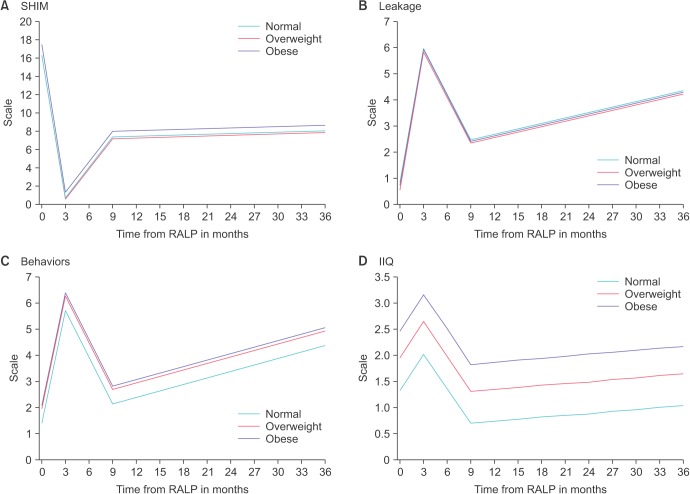
We reviewed preoperative and postoperative surveys from 691 men who underwent RALP from 2004-2014 in an integrated healthcare delivery system. Survey instruments included: sexual health inventory for men (SHIM), urinary behavior, leakage, and incontinence impact questionnaire (IIQ). A repeated measures analysis with autoregressive covariance structure was employed with linear splines with 2 knots for the time factor. We fit unadjusted and adjusted models and stratified by BMI (under/normal weight, overweight, and obese). Adjusted models included age, race/ethnicity, smoking status, diabetes, operation length, prostate-specific antigen, pathologic stage, nerve-sparing status, and surgery year.
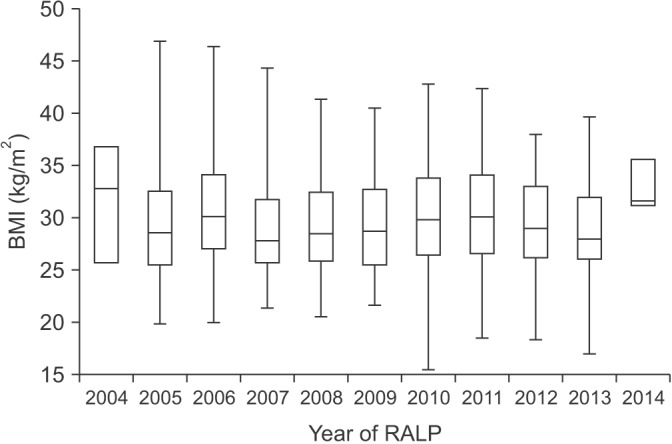
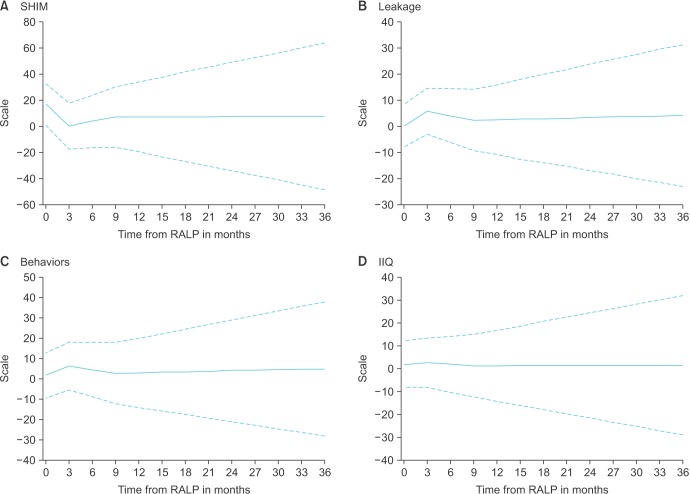
Mean age was 59 years. Most men were overweight (43%) and obese (42%). There were no significant differences in mean baseline SHIM, urinary behavior, leakage, and IIQ scores by BMI category. All groups had initial steep declines in urinary and sexual function in the first 3 months after RALP. There were no significant differences in postoperative urinary and sexual function score curves by BMI category.
The pattern of urinary and sexual function recovery was similar across all BMI categories. Overweight and obese men may be counseled that urinary and sexual function recovery curves after surgery is similar to that of normal weight men.
评估体重指数(BMI)对机器人辅助腹腔镜前列腺切除术(RALP)后尿功能和性功能恢复曲线的影响。我们假设超重和肥胖男性与正常体重男性的恢复曲线不同。
我们回顾了在一个综合性医疗服务系统中,2004 年至 2014 年间接受 RALP 的 691 名男性的术前和术后调查。调查工具包括:男性性功能健康问卷(SHIM)、尿行为、漏尿和尿失禁影响问卷(IIQ)。采用自回归协方差结构的重复测量分析,时间因素采用 2 个结的线性样条。我们拟合了未调整和调整模型,并按 BMI(低/正常体重、超重和肥胖)进行分层。调整模型包括年龄、种族/民族、吸烟状况、糖尿病、手术时间、前列腺特异性抗原、病理分期、神经保留状况和手术年份。
平均年龄为 59 岁。大多数男性超重(43%)和肥胖(42%)。BMI 类别之间,SHIM、尿行为、漏尿和 IIQ 评分的平均基线无显著差异。所有组在 RALP 后 3 个月内,尿功能和性功能均急剧下降。BMI 类别之间,术后尿功能和性功能评分曲线无显著差异。
所有 BMI 类别中,尿功能和性功能恢复模式相似。超重和肥胖男性可能需要被告知,手术后的尿功能和性功能恢复曲线与正常体重男性相似。