Institute of Microbiology, Zhejiang University, Hangzhou, China.
Department of Entomology, University of Maryland, College Park, Maryland, USA.
mBio. 2017 Sep 5;8(5):e01284-17. doi: 10.1128/mBio.01284-17.
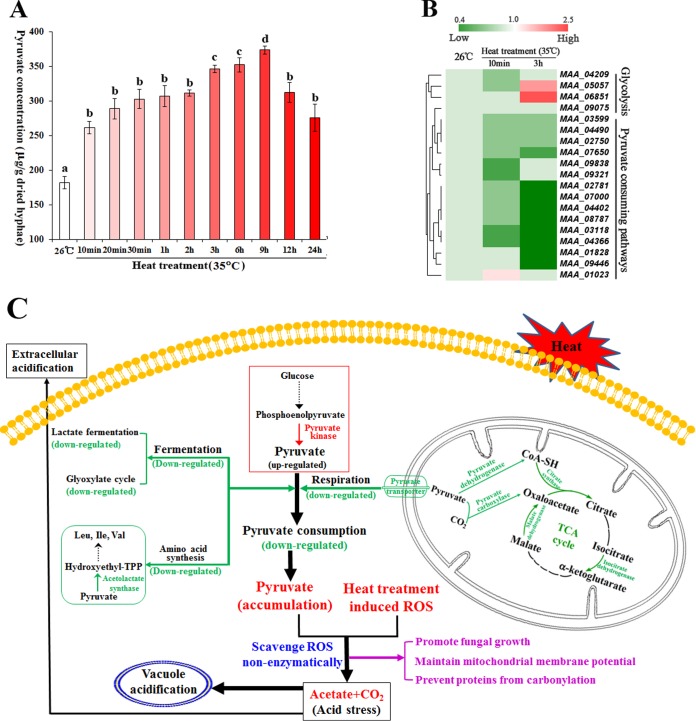
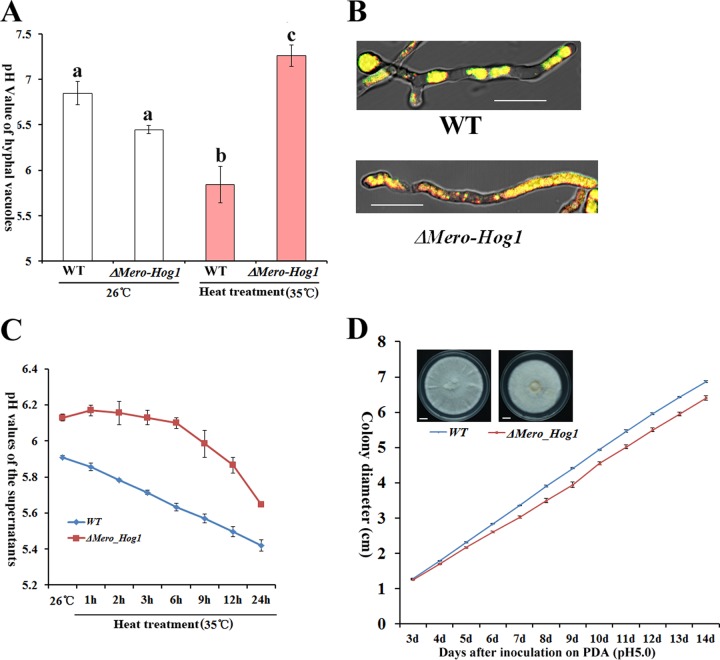
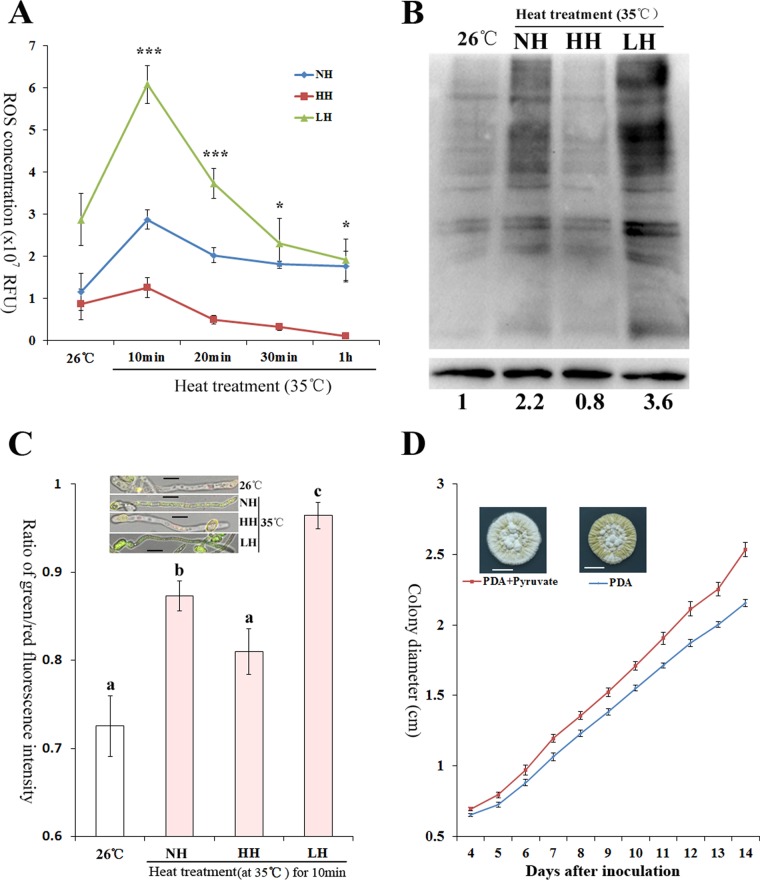
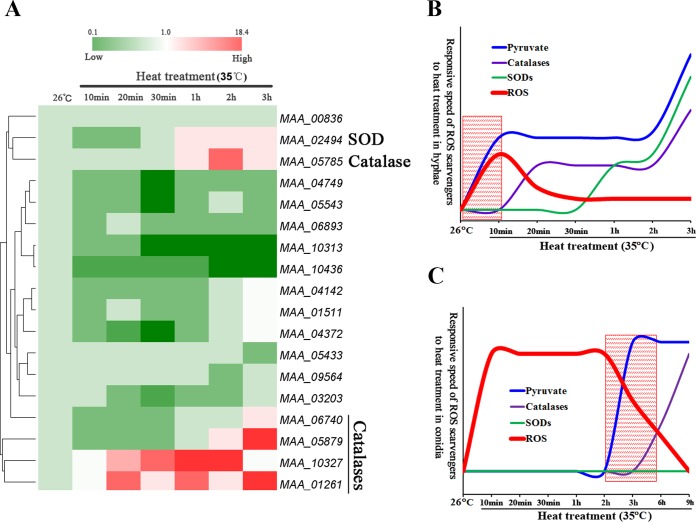
Heat tolerance is well known to be key to fungal survival in many habitats, but our mechanistic understanding of how organisms adapt to heat stress is still incomplete. Using , an emerging model organism for assessing evolutionary processes, we report that pyruvate is in the vanguard of molecules that scavenge heat-induced reactive oxygen species (ROS). We show that, as well as inducing a rapid burst of ROS production, heat stress also downregulates genes for pyruvate consumption. The accumulating pyruvate is the fastest acting of several ROS scavengers, efficiently reducing protein carbonylation, stabilizing mitochondrial membrane potential, and promoting fungal growth. The acetate produced from pyruvate-ROS reactions itself causes acid stress, tolerance to which is regulated by Hog1 mitogen-activated protein kinase. Heat stress also induces pyruvate accumulation in several other fungi, suggesting that scavenging of heat-induced ROS by pyruvate is widespread. Heat is a dangerous challenge for most organisms, as it denatures proteins and induces the production of ROS that inactivate proteins, lipid membranes, and DNA. How organisms respond to this stress is not fully understood. Using the experimentally tractable insect pathogen as a model organism, we show for the first time that heat stress induces pyruvate production and that this functions as the first line of defense against heat-induced ROS. Heat stress also induces rapid pyruvate accumulation in other fungi, suggesting that pyruvate is a common but unappreciated defense against stress.
耐热性是许多生物生存的关键,这是众所周知的,但我们对生物体如何适应热应激的机制理解还不完全。利用作为评估进化过程的新兴模式生物,我们报告说丙酮酸是清除热诱导活性氧(ROS)的分子中的先锋。我们表明,热应激不仅会诱导 ROS 产生的快速爆发,还会下调丙酮酸消耗的基因。积累的丙酮酸是几种 ROS 清除剂中作用最快的一种,可有效减少蛋白质羰基化、稳定线粒体膜电位并促进真菌生长。由丙酮酸-ROS 反应产生的乙酸本身会导致酸应激,而 Hog1 丝裂原活化蛋白激酶调节其对酸应激的耐受性。热应激还会在其他几种真菌中诱导丙酮酸积累,这表明丙酮酸清除热诱导的 ROS 是广泛存在的。热对大多数生物来说是一种危险的挑战,因为它会使蛋白质变性并诱导 ROS 的产生,从而使蛋白质、脂质膜和 DNA 失活。生物体如何应对这种压力还不完全清楚。我们使用实验上易于处理的昆虫病原体作为模式生物,首次表明热应激会诱导丙酮酸的产生,而丙酮酸是抵御热诱导 ROS 的第一道防线。热应激还会在其他真菌中诱导快速的丙酮酸积累,这表明丙酮酸是一种常见但未被充分认识的应激防御机制。