Backhausen Mette G, Tabor Ann, Albert Hanne, Rosthøj Susanne, Damm Peter, Hegaard Hanne K
Department of Obstetrics, Copenhagen University Hospital (Rigshospitalet), Copenhagen, Denmark.
Department of Gynecology and Obstetrics, Zealand University Hospital, Roskilde, Denmark.
PLoS One. 2017 Sep 6;12(9):e0182114. doi: 10.1371/journal.pone.0182114. eCollection 2017.
Low back pain is highly prevalent among pregnant women, but evidence of an effective treatment are still lacking. Supervised exercise-either land or water based-has shown benefits for low back pain, but no trial has investigated the evidence of an unsupervised water exercise program on low back pain. We aimed to assess the effect of an unsupervised water exercise program on low back pain intensity and days spent on sick leave among healthy pregnant women.
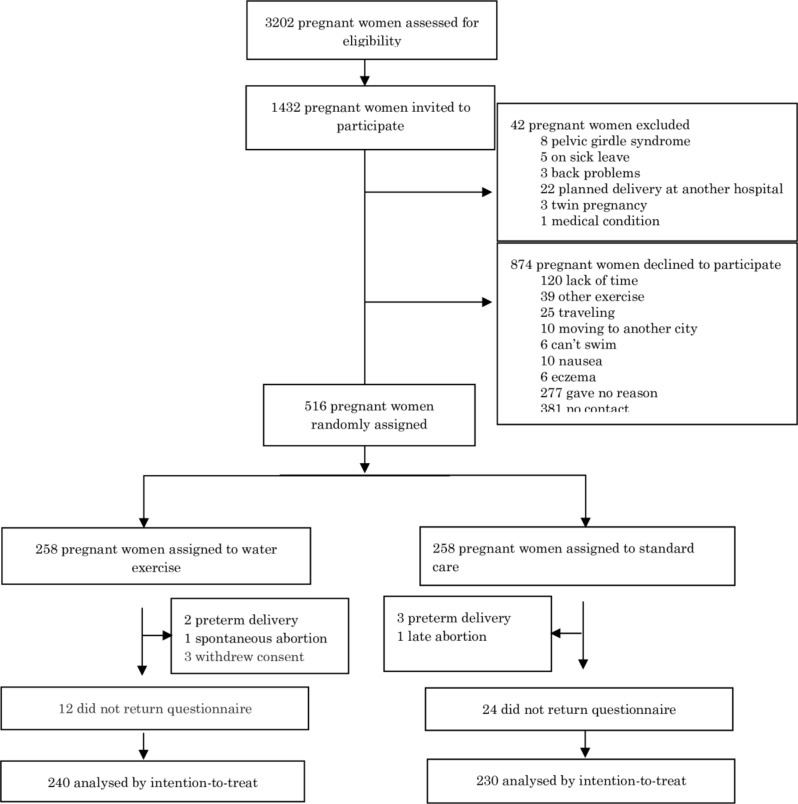
In this randomised, controlled, parallel-group trial, 516 healthy pregnant women were randomly assigned to either unsupervised water exercise twice a week for a period of 12 weeks or standard prenatal care. Healthy pregnant women aged 18 years or older, with a single fetus and between 16-17 gestational weeks were eligible. The primary outcome was low back pain intensity measured by the Low Back Pain Rating scale at 32 weeks. The secondary outcomes were self-reported days spent on sick leave, disability due to low back pain (Roland Morris Disability Questionnaire) and self-rated general health (EQ-5D and EQ-VAS).
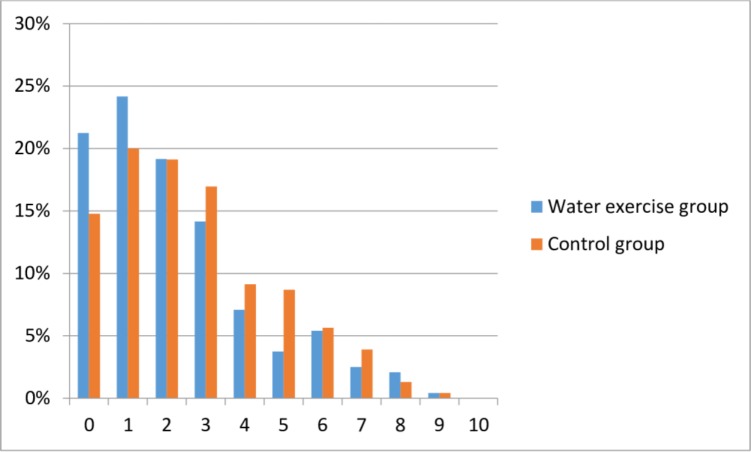
Low back pain intensity was significantly lower in the water exercise group, with a score of 2.01 (95% CI 1.75-2.26) vs. 2.38 in the control group (95% CI 2.12-2.64) (mean difference = 0.38, 95% CI 0.02-0.74 p = 0.04). No difference was found in the number of days spent on sick leave (median 4 vs. 4, p = 0.83), disability due to low back pain nor self-rated general health. There was a trend towards more women in the water exercise group reporting no low back pain at 32 weeks (21% vs. 14%, p = 0.07).
Unsupervised water exercise results in a statistically significant lower intensity of low back pain in healthy pregnant women, but the result was most likely not clinically significant. It did not affect the number of days on sick leave, disability due to low back pain nor self-rated health.
ClinicalTrials.gov NCT02354430.
腰痛在孕妇中非常普遍,但仍缺乏有效治疗的证据。有监督的运动——无论是陆上运动还是水上运动——已显示对腰痛有益,但尚无试验研究无监督水上运动计划对腰痛的证据。我们旨在评估无监督水上运动计划对健康孕妇腰痛强度和病假天数的影响。
在这项随机、对照、平行组试验中,516名健康孕妇被随机分配到每周进行两次无监督水上运动,为期12周,或接受标准产前护理。年龄18岁及以上、单胎且妊娠周数在16 - 17周之间的健康孕妇符合条件。主要结局是在32周时通过腰痛评定量表测量的腰痛强度。次要结局是自我报告的病假天数、因腰痛导致的残疾(罗兰·莫里斯残疾问卷)和自我评定的总体健康状况(EQ - 5D和EQ - VAS)。
水上运动组的腰痛强度显著更低,评分为2.01(95%可信区间1.75 - 2.26),而对照组为2.38(95%可信区间2.12 - 2.64)(平均差异 = 0.38,95%可信区间0.02 - 0.74,p = 0.04)。在病假天数(中位数4对4,p = 0.83)、因腰痛导致的残疾或自我评定的总体健康状况方面未发现差异。在水上运动组中,有更多女性在32周时报告无腰痛的趋势(21%对14%,p = 0.07)。
无监督水上运动使健康孕妇的腰痛强度在统计学上显著降低,但该结果很可能在临床上无显著意义。它并未影响病假天数、因腰痛导致的残疾或自我评定的健康状况。
ClinicalTrials.gov NCT02354430。