Shinzaki Hazuki, Sunada Katsuhisa
Department of Dental Anesthesiology, The Nippon Dental University, School of Life Dentistry at Tokyo, Tokyo, Japan.
J Dent Anesth Pain Med. 2015 Jun;15(2):63-68. doi: 10.17245/jdapm.2015.15.2.63. Epub 2015 Jun 30.
Conventional anesthetic nerve block injections into the mandibular foramen risk causing nerve damage. This study aimed to compare the efficacy and safety of the anterior technique (AT) of inferior alveolar nerve block using felypressin-propitocaine with a conventional nerve block technique (CT) using epinephrine and lidocaine for anesthesia via the mandibular foramen.
Forty healthy university students with no recent dental work were recruited as subjects and assigned to two groups: right side CT or right side AT. Anesthesia was evaluated in terms of success rate, duration of action, and injection pain. These parameters were assessed at the first incisor, premolar, and molar, 60 min after injection. Chi-square and unpaired t-tests were used for statistical comparisons, with a P value of < 0.05 designating significance.
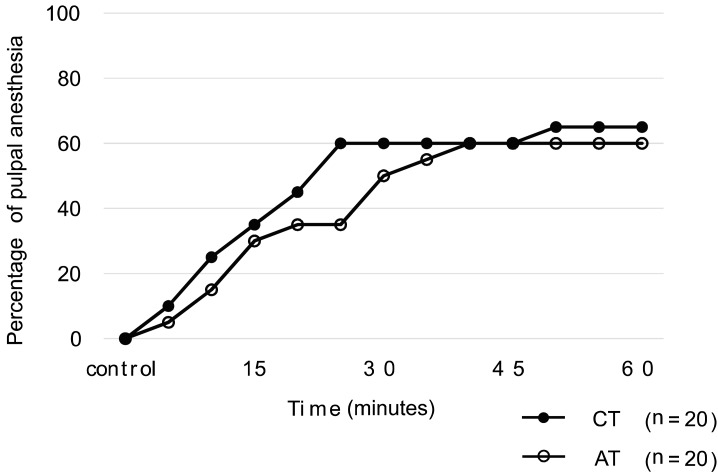
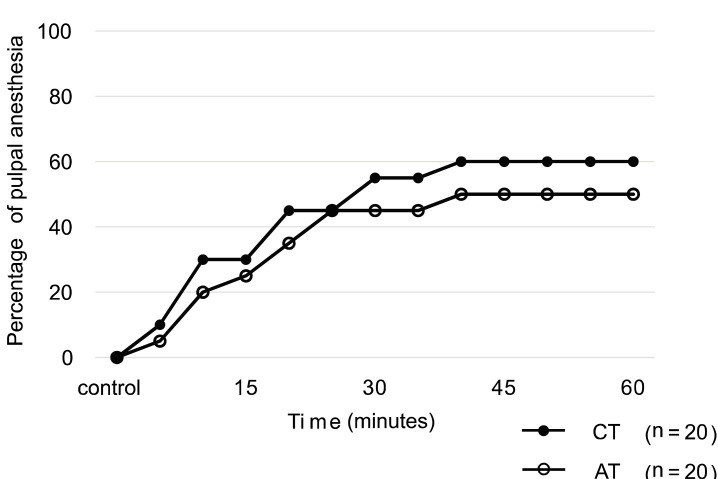
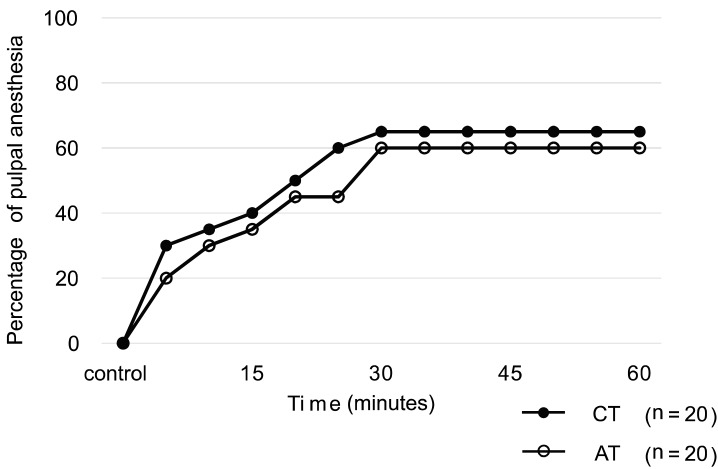
The two nerve block techniques generated comparable success rates for the right mandible, with rates of 65% (CT) and 60% (AT) at both the first molar and premolar, and rates of 60% (CT) and 50% (AT) at the lateral incisor. The duration of anesthesia using the CT was 233 ± 37 min, which was approximately 40 min shorter than using the AT. This difference was statistically significant (P < 0.05). Injection pain using the AT was rated as milder compared with the CT. This difference was also statistically significant (P < 0.05).
The AT is no less successful than the CT for inducing anesthesia, and has the added benefits of a significantly longer duration of action and significantly less pain.
传统的将麻醉神经阻滞注射入下颌孔有导致神经损伤的风险。本研究旨在比较使用去甲肾上腺素-丙胺卡因的下牙槽神经阻滞前入路技术(AT)与使用肾上腺素和利多卡因通过下颌孔进行麻醉的传统神经阻滞技术(CT)的疗效和安全性。
招募40名近期未进行牙科治疗的健康大学生作为受试者,并分为两组:右侧CT组或右侧AT组。从成功率、作用持续时间和注射疼痛方面评估麻醉效果。在注射后60分钟,于第一切牙、前磨牙和磨牙处评估这些参数。采用卡方检验和非配对t检验进行统计学比较,P值<0.05表示有统计学意义。
两种神经阻滞技术在下颌右侧产生的成功率相当,第一磨牙和前磨牙处CT组和AT组的成功率分别为65%和60%,侧切牙处CT组和AT组的成功率分别为60%和50%。使用CT的麻醉持续时间为233±37分钟,比使用AT的大约短40分钟。这种差异具有统计学意义(P<0.05)。与CT相比,使用AT的注射疼痛程度较轻。这种差异也具有统计学意义(P<0.05)。
AT在诱导麻醉方面的成功率不低于CT,并且具有作用持续时间显著更长和疼痛显著更少的额外优势。