Mateen Farrah J, Manalo Natalie C, Grundy Sara J, Houghton Melissa A, Hotan Gladia C, Erickson Hans, Videnovic Aleksandar
Neurological Clinical Research Institute, Department of Neurology, Massachusetts General Hospital Harvard Medical School, Boston, MA Department of Brain and Cognitive Sciences, Massachusetts Institute of Technology, Cambridge, MA.
Medicine (Baltimore). 2017 Sep;96(36):e8037. doi: 10.1097/MD.0000000000008037.
Fatigue is the most commonly reported symptom among multiple sclerosis (MS) patients, more than a quarter of whom consider fatigue to be their most disabling symptom. However, there are few effective treatment options for fatigue. We aim to investigate whether supplemental exposure to bright white light will reduce MS-associated fatigue.
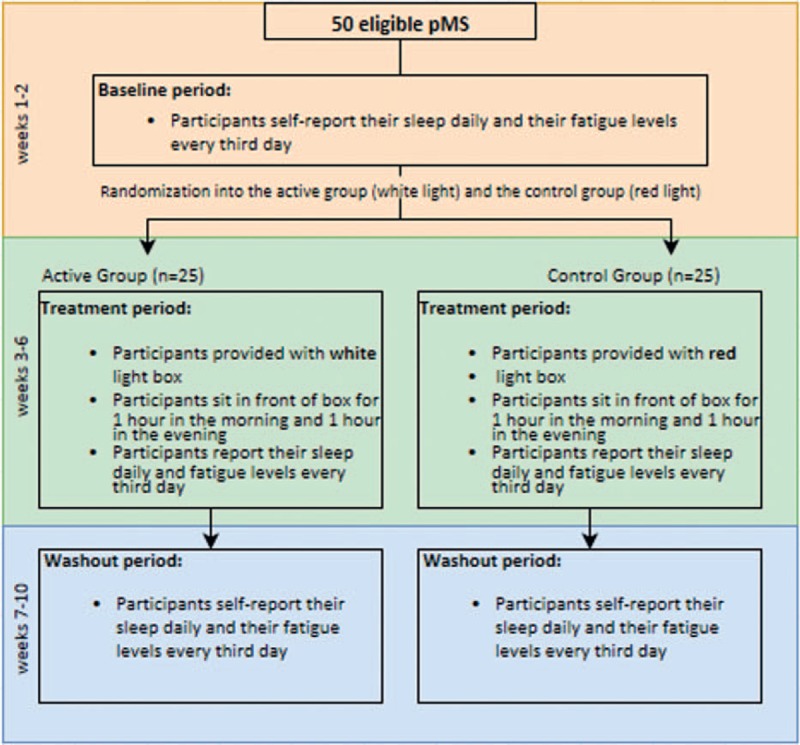
Eligible participants will have clinically confirmed multiple sclerosis based on the revised McDonald criteria (2010) and a score ≥36 on the Fatigue Severity Scale (FSS). Participants will be randomized 1:1 to bright white light (10,000 lux; active condition) or dim red light (<300 lux; control condition) self-administered for 1 hour twice daily. The study will include a 2-week baseline period, a 4-week treatment period, and a 4-week washout period. Participants will record their sleep duration, exercise, caffeine, and medication intake daily. Participants will record their fatigue using the Visual Analogue Fatigue Scale (VAFS) 4 times every third day, providing snapshots of their fatigue level at different times of day. Participants will self-report their fatigue severity using FSS on 3 separate visits: at baseline (week 0), following completion of the treatment phase (week 6), and at study completion (week 10). The primary outcome will be the change in the average FSS score after light therapy. We will perform an intention-to-treat analysis, comparing the active and control groups to assess the postintervention difference in fatigue levels reported on FSS. Secondary outcome measures include change in global VAFS scores during the light therapy and self-reported quality of life in the Multiple Sclerosis Quality of Life-54.
We present a study design and rationale for randomizing a nonpharmacological intervention for MS-associated fatigue, using bright light therapy. The study limitations relate to the logistical issues of a self-administered intervention requiring frequent participant self-report in a relapsing condition. Ultimately, light therapy for the treatment of MS-associated fatigue may provide a low-cost, noninvasive, self-administered treatment for one of the most prevalent and burdensome symptoms experienced by people with MS.
疲劳是多发性硬化症(MS)患者中最常报告的症状,超过四分之一的患者认为疲劳是最致残的症状。然而,针对疲劳的有效治疗选择很少。我们旨在研究补充暴露于明亮白光是否会减轻与MS相关的疲劳。
符合条件的参与者将根据修订的麦克唐纳标准(2010年)临床确诊为多发性硬化症,且疲劳严重程度量表(FSS)得分≥36分。参与者将按1:1随机分为明亮白光组(10000勒克斯;活性组)或暗红色光组(<300勒克斯;对照组),每天自行照射1小时,共两次。该研究将包括一个为期2周的基线期、一个为期4周的治疗期和一个为期4周的洗脱期。参与者将每天记录他们的睡眠时间、运动量、咖啡因摄入量和药物摄入量。参与者将每三天使用视觉模拟疲劳量表(VAFS)记录4次疲劳情况,提供一天中不同时间的疲劳水平快照。参与者将在3次单独就诊时使用FSS自我报告疲劳严重程度:基线期(第0周)、治疗阶段结束后(第6周)和研究结束时(第10周)。主要结局将是光疗后平均FSS得分的变化。我们将进行意向性分析,比较活性组和对照组,以评估干预后FSS报告的疲劳水平差异。次要结局指标包括光疗期间全球VAFS得分的变化以及多发性硬化症生活质量-54中自我报告的生活质量。
我们提出了一项研究设计和基本原理,即对与MS相关的疲劳进行非药物干预的随机分组,采用强光疗法。该研究的局限性与自我管理干预的后勤问题有关,这种干预在复发情况下需要参与者频繁自我报告。最终,用于治疗与MS相关疲劳的光疗可能为MS患者经历的最普遍和最繁重的症状之一提供一种低成本、非侵入性的自我管理治疗方法。