Department of Neurology, FLENI, Buenos Aires, Argentina.
Hospital Italiano de Buenos Aires (HIBA), Buenos Aires, Argentina.
BMC Neurol. 2019 Aug 27;19(1):209. doi: 10.1186/s12883-019-1441-0.
The Treatment Burden Questionnaire (TBQ) is a self-reported measure of the effect of treatment workload on patient wellbeing. We sought to validate the TBQ in Spanish and use it to estimate the burden of treatment in Argentinian patients with multiple sclerosis (MS).
The TBQ was forward-backward translated into Spanish. Two focus groups and 25 semi-structured interviews focused on wording and possible item exclusion. Validation was performed in 2 steps. First, 162 patients across a range of MS severity completed the questionnaire. Confirmatory factor analysis assessed the dimensional structure of the TBQ. Construct validity was assessed by studying correlations with fatigue and quality of life (QoL). Then, in a second cohort of 171 patients, we evaluated the association between TBQ scores and patients' sex, age, education level, employment status, type of MS, disease duration, comorbidities, EDSS, pharmacological treatment and medication adherence.
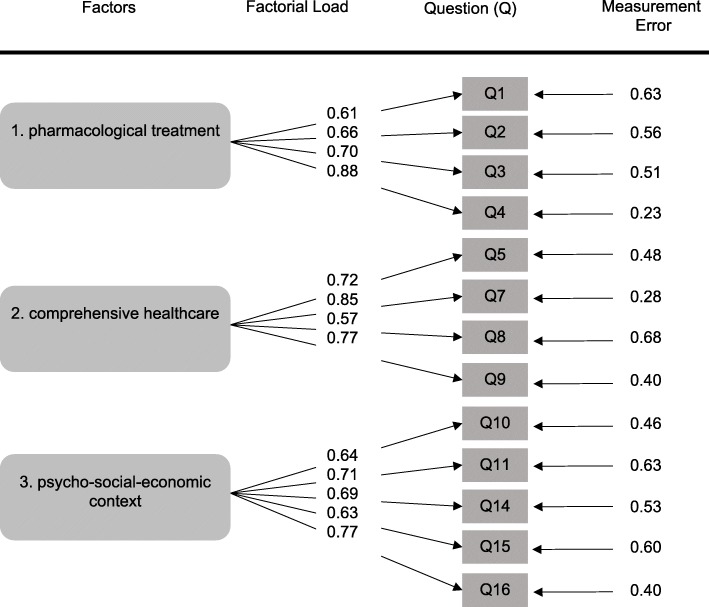
The questionnaire presented a 3-factor structure in which burden was related to pharmacological treatment; comprehensive health assistance; and psycho-social-economic context. Composite reliability was > 0.8 for all factors. TBQ showed positive correlation with fatigue (r = 0.467, p = 0.006), negative correlation with QoL (r - 0.446, p = 0.009). For the second cohort, total TBQ score was 43 (SD 29). Lowest scores were observed on self-monitoring (0.53, SD 1.3) and highest for administrative load (4.2, SD 3.4). Inverse association was found between the TBQ score and medication adherence (r 0.243 p = 0.001). TBQ scores also correlated with daily patient pill/injection requirements (r 0.175 p = 0.020). Individuals receiving injectable treatment scored higher than patients on oral drugs (total TBQ 51 (SD 32) vs 39 (SD 27) p = 0.002).
The TBQ in Spanish is a reliable instrument and showed adequate correlation with QoL and adherence scales in MS patients. TBQ may benefit health resources allocation and provide tailor therapeutic interventions to construct a minimally disruptive care.
治疗负担问卷(TBQ)是一种自我报告的衡量治疗工作量对患者健康影响的工具。我们旨在验证 TBQ 在西班牙语中的适用性,并使用它来评估阿根廷多发性硬化症(MS)患者的治疗负担。
TBQ 被正向和反向翻译成西班牙语。两个焦点小组和 25 次半结构化访谈集中在措辞和可能的项目排除上。验证分两步进行。首先,162 名不同严重程度的 MS 患者完成了问卷。验证性因子分析评估了 TBQ 的维度结构。通过研究与疲劳和生活质量(QoL)的相关性来评估结构效度。然后,在第二组 171 名患者中,我们评估了 TBQ 评分与患者性别、年龄、教育水平、就业状况、MS 类型、疾病持续时间、合并症、EDSS、药物治疗和药物依从性之间的关联。
问卷呈现出 3 个因子结构,其中负担与药物治疗、全面的健康援助和心理-社会-经济背景有关。所有因子的复合信度均大于 0.8。TBQ 与疲劳呈正相关(r=0.467,p=0.006),与生活质量呈负相关(r=-0.446,p=0.009)。对于第二组,TBQ 总分为 43(SD 29)。自我监测得分最低(0.53,SD 1.3),行政负担得分最高(4.2,SD 3.4)。TBQ 评分与药物依从性呈负相关(r=0.243,p=0.001)。TBQ 评分还与患者每天服用的药物数量呈正相关(r=0.175,p=0.020)。接受注射治疗的个体得分高于口服药物的患者(TBQ 总分 51(SD 32)比 39(SD 27),p=0.002)。
西班牙语版的 TBQ 是一种可靠的工具,与 MS 患者的生活质量和依从性量表具有良好的相关性。TBQ 可能有助于医疗资源的分配,并提供定制的治疗干预措施,以构建最小干扰的护理。