Lane Kevin J, Stokes Eleanor C, Seto Karen C, Thanikachalam Sadagopan, Thanikachalam Mohan, Bell Michelle L
School of Forestry and Environmental Studies, Yale University , New Haven, Connecticut, USA.
Cardiac Care Centre, Sri Ramachandra University , Chennai, India.
Environ Health Perspect. 2017 Aug 2;125(8):087003. doi: 10.1289/EHP541.
India is undergoing rapid urbanization with simultaneous increases in the prevalence of cardiovascular disease (CVD). As urban areas become home to an increasing share of the world's population, it is important to understand relationships between the built environment and progression towards CVD.
We assessed associations between multiple measures of the built environment and biomarkers of early vascular aging (EVA) in the Population Study of Urban, Rural and Semiurban Regions for the Detection of Endovascular Disease and Prevalence of Risk Factors and Holistic Intervention Study (PURSE-HIS) in Chennai, India.
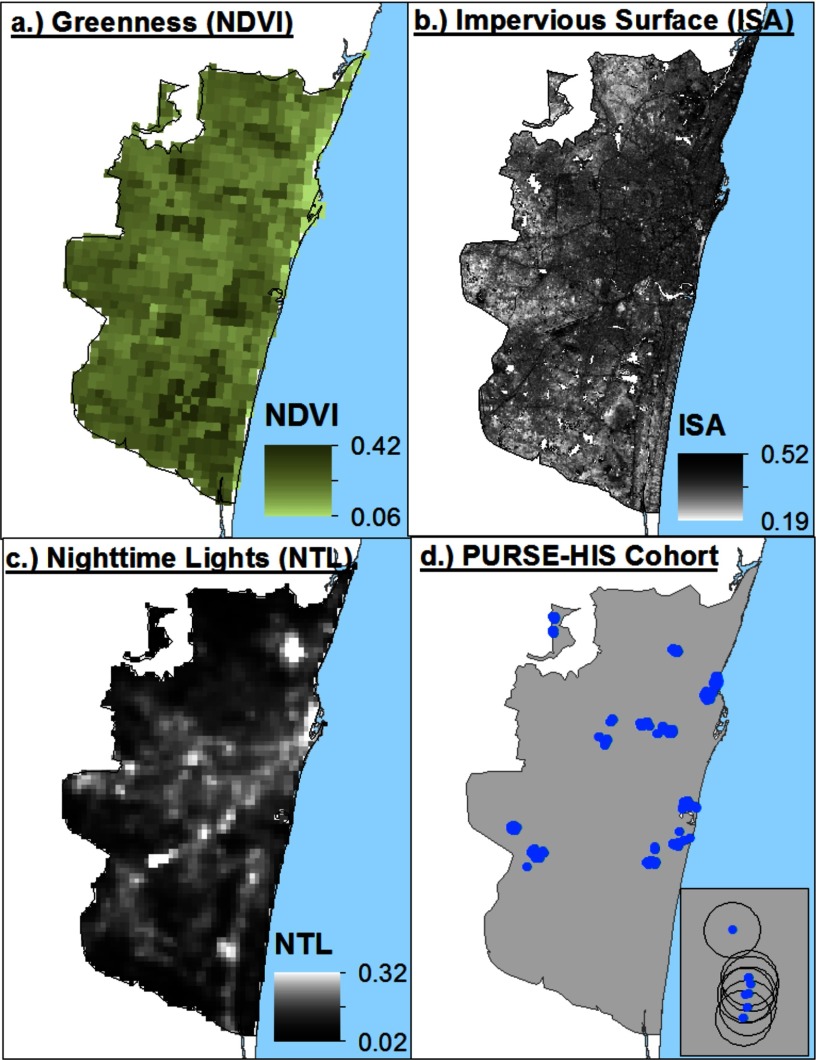
We performed a cross-sectional analysis of 3,150 study participants. EVA biomarkers included systolic and diastolic blood pressure (SBP and DBP), central pulse pressure (cPP) and flow-mediated dilatation (FMD). Multiple approaches were used to assign residential exposure to factors of the built environment: Moderate Resolution Imaging Spectroradiometer (MODIS)-derived normalized difference vegetation index (NDVI), a measure of vegetation health and greenness; Landsat-derived impervious surface area (ISA); and Visible Infrared Imaging Radiometer Suite (VIIRS)-derived nighttime lights (NTL). Multivariable regression models were used to assess associations between each built environment measure and biomarkers of EVA, adjusting for age, body mass index (BMI), cooking fuel type, energy intake, sex, physical activity, smoking, socioeconomic status, and stress.
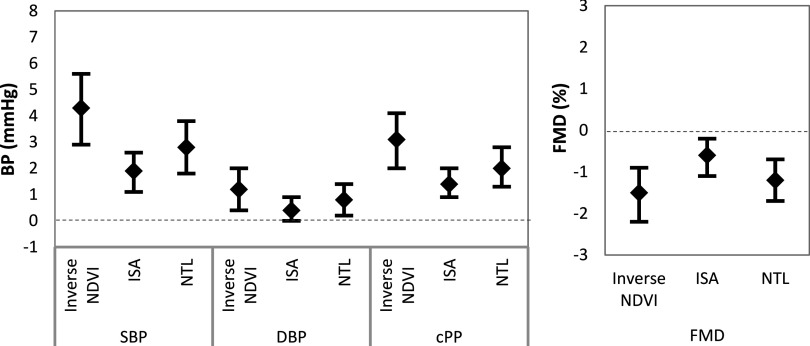
Residing in areas with higher ISA or NTL, or lower greenness, was significantly associated with elevated SBP, DBP, and cPP, and with lower FMD, adjusting for age, BMI, sex, smoking status, and other CVD risk factors. An interquartile range decrease in greenness had the largest increase in SBP [4.3 mmHg (95% CI: 2.9, 5.6)], DBP [1.2 mmHg (95% CI: 0.4, 2.0)] and cPP [3.1 mmHg (95% CI: 2.0, 4.1)], and the largest decrease in FMD [-1.5% (95%CI: -2.2%, -0.9%].
Greenness, ISA, and NTL were associated with increased SBP, DBP, and cPP, and with reduced FMD, suggesting a possible additional EVA pathway for the relationship between urbanization and increased CVD prevalence in urban India. https://doi.org/10.1289/EHP541.
印度正在经历快速城市化,同时心血管疾病(CVD)患病率也在上升。随着城市地区成为世界人口中越来越大的一部分,了解建筑环境与心血管疾病进展之间的关系很重要。
在印度金奈进行的城市、农村和半城市地区血管内疾病检测、危险因素患病率及综合干预研究(PURSE-HIS)中,我们评估了建筑环境的多种测量指标与早期血管衰老(EVA)生物标志物之间的关联。
我们对3150名研究参与者进行了横断面分析。EVA生物标志物包括收缩压和舒张压(SBP和DBP)、中心脉压(cPP)和血流介导的血管舒张(FMD)。采用多种方法将居住暴露归因于建筑环境因素:中分辨率成像光谱仪(MODIS)得出的归一化植被指数(NDVI),这是一种衡量植被健康和绿化程度的指标;陆地卫星得出的不透水表面积(ISA);以及可见红外成像辐射计套件(VIIRS)得出的夜间灯光(NTL)。多变量回归模型用于评估每种建筑环境测量指标与EVA生物标志物之间的关联,并对年龄、体重指数(BMI)、烹饪燃料类型、能量摄入、性别、身体活动、吸烟、社会经济地位和压力进行了调整。
在调整年龄、BMI、性别、吸烟状况和其他心血管疾病危险因素后,居住在ISA或NTL较高或绿化程度较低的地区与SBP、DBP和cPP升高以及FMD降低显著相关。绿化程度每降低四分位数间距,SBP升高幅度最大[4.3 mmHg(95%CI:2.9,5.6)],DBP升高[1.2 mmHg(95%CI:0.4,2.0)],cPP升高[3.1 mmHg(95%CI:2.0,4.1)],FMD降低幅度最大[-1.5%(95%CI:-2.2%,-0.9%)]。
绿化程度、ISA和NTL与SBP、DBP升高以及FMD降低有关,这表明在印度城市中,城市化与心血管疾病患病率增加之间的关系可能存在另一条EVA途径。https://doi.org/10.1289/EHP541 。