Degneh Efrem, Shibeshi Workineh, Terefe Getachew, Asres Kaleab, Ashenafi Hagos
Department of Pathology and Parasitology, College of Veterinary Medicine and Agriculture, Addis Ababa University, P.O.Box 34, Debre Zeit, Ethiopia.
Department of Pharmacology and Clinical Pharmacy, School of Pharmacy, College of Health Sciences, Addis Ababa University, P.O.Box 9086, Addis Ababa, Ethiopia.
Acta Vet Scand. 2017 Sep 11;59(1):59. doi: 10.1186/s13028-017-0327-7.
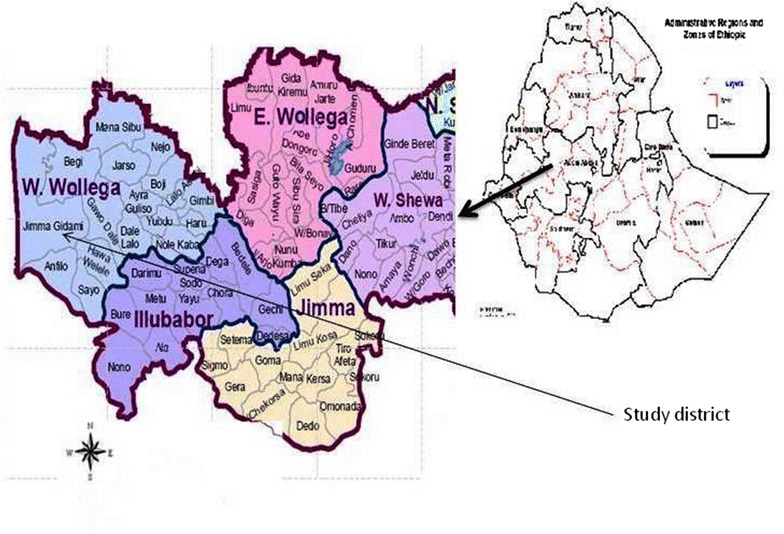
Animal trypanosomosis is one of the major disease problems affecting agricultural productivity in Ethiopia. The impact of the disease is believed to vary with season and agro-ecologies in line with fly vector distribution. A cross-sectional study on bovine trypanosomosis was conducted from November 2015 to June 2016, in seven selected villages of Gidami district, Oromia Regional State, western Ethiopia. A total of 930 blood samples were collected and subjected to parasitological and hematological analysis.
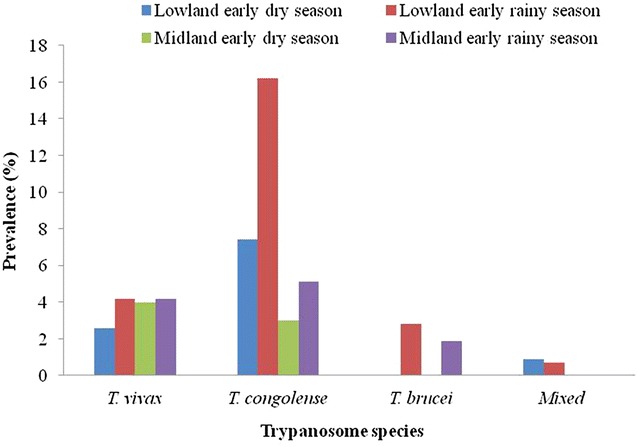
The overall prevalence of bovine trypanosomosis was 14.1%. The seasonal prevalence shows 9.06% in early dry and 18.4% in early rainy seasons. Three trypanosome species, Trypanosoma congolense, Trypanosoma vivax and Trypanosoma brucei were identified in the examined animals. T. congolense followed by T. vivax were the predominant species (respectively 59.0 and 35.9% in early dry season and 62.0 and 22.8% in early rainy season). The prevalence of T. vivax remained similar in both early dry and early rainy seasons in both lowland and midland agroecologies whereas T. congolense was more dominant in the lowland area in both seasons compared to mid land study sites. The disease was more prevalent in lowland (23.9%) compared to midland (11.1%) during early rainy season (P < 0.001) whereas no significant difference was observed between the two agroecologies during early dry season (P = 0.165). Packed cell volume (PCV) was much lower in parasitemic animals than in aparasitemic cattle whereas the mean PCV value for parasitemic animals (20.36%; 95% CI 19.56 to 21.16) in early dry season was similar to values in early rainy season (20.46%, 95% CI 18.84 to 21.08%). A similar situation was noticed for animals in both low land and mid land study sites.
Overall, the detection of trypanosomes in blood was significantly affected by agro-ecology, season and body condition of the animals. Special emphasis should be given to integrated trypanosomosis management in early rainy months where fly population is believed to start increasing.
动物锥虫病是影响埃塞俄比亚农业生产力的主要疾病问题之一。据信,该疾病的影响会随着季节和农业生态的变化而有所不同,这与蝇类传播媒介的分布情况一致。2015年11月至2016年6月,在埃塞俄比亚西部奥罗米亚州吉达米区的7个选定村庄开展了一项关于牛锥虫病的横断面研究。共采集了930份血样,并进行了寄生虫学和血液学分析。
牛锥虫病的总体患病率为14.1%。季节性患病率显示,旱季初期为9.06%,雨季初期为18.4%。在所检查的动物中鉴定出三种锥虫,即刚果锥虫、活泼锥虫和布氏锥虫。刚果锥虫是主要种类,其次是活泼锥虫(旱季初期分别为59.0%和35.9%,雨季初期分别为62.0%和22.8%)。在低地和中部农业生态区,活泼锥虫在旱季初期和雨季初期的患病率均相似,而在两个季节中,刚果锥虫在低地地区的占比均高于中部研究地点。在雨季初期,该疾病在低地地区(23.9%)的患病率高于中部地区(11.1%)(P < 0.001),而在旱季初期,两个农业生态区之间未观察到显著差异(P = 0.165)。感染寄生虫的动物的红细胞压积(PCV)远低于未感染寄生虫的牛,而旱季初期感染寄生虫的动物的平均PCV值(20.36%;95%置信区间为19.56至21.16)与雨季初期的值(20.46%,95%置信区间为18.84至21.08%)相似。在低地和中部研究地点的动物中也发现了类似情况。
总体而言,血液中锥虫的检测受到农业生态、季节和动物身体状况的显著影响。应特别重视在雨季初期开展锥虫病综合管理,因为据信此时蝇类数量开始增加。