Abbring Suzanne, Verheijden Kim A T, Diks Mara A P, Leusink-Muis Athea, Hols Gert, Baars Ton, Garssen Johan, van Esch Betty C A M
Division of Pharmacology, Faculty of Science, Utrecht Institute for Pharmaceutical Sciences, Utrecht University, Utrecht, Netherlands.
Nutricia Research, Utrecht, Netherlands.
Front Immunol. 2017 Aug 28;8:1045. doi: 10.3389/fimmu.2017.01045. eCollection 2017.
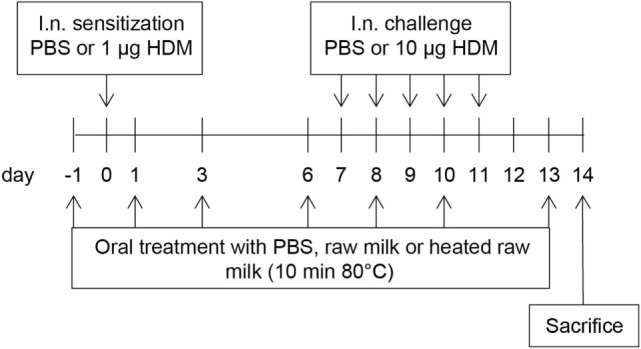
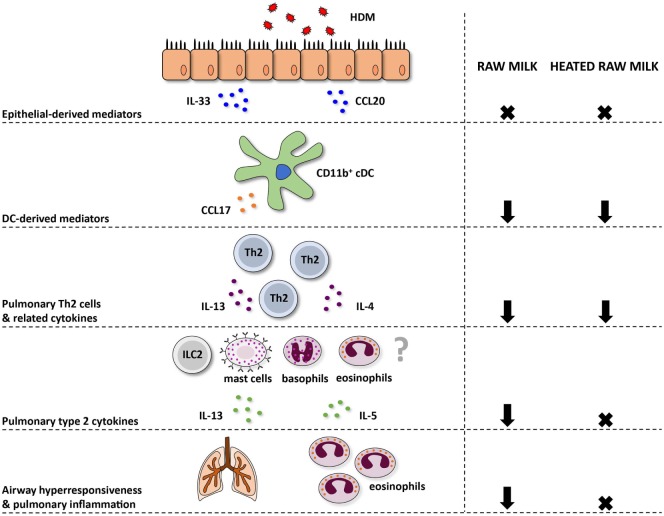
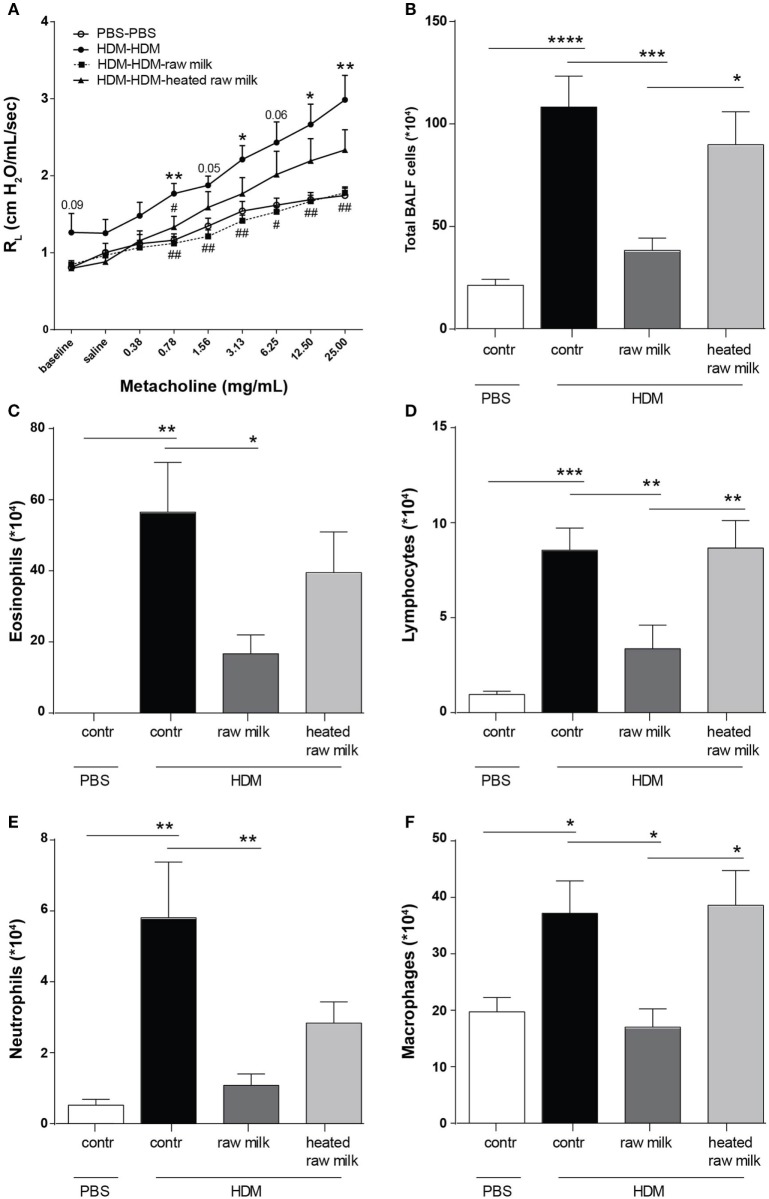
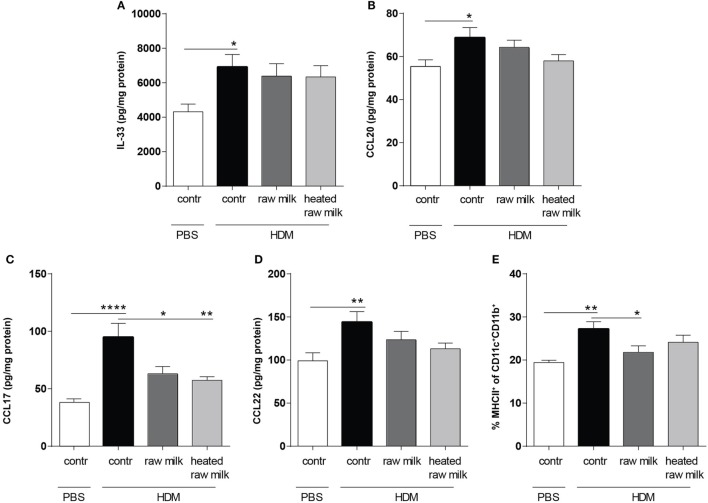
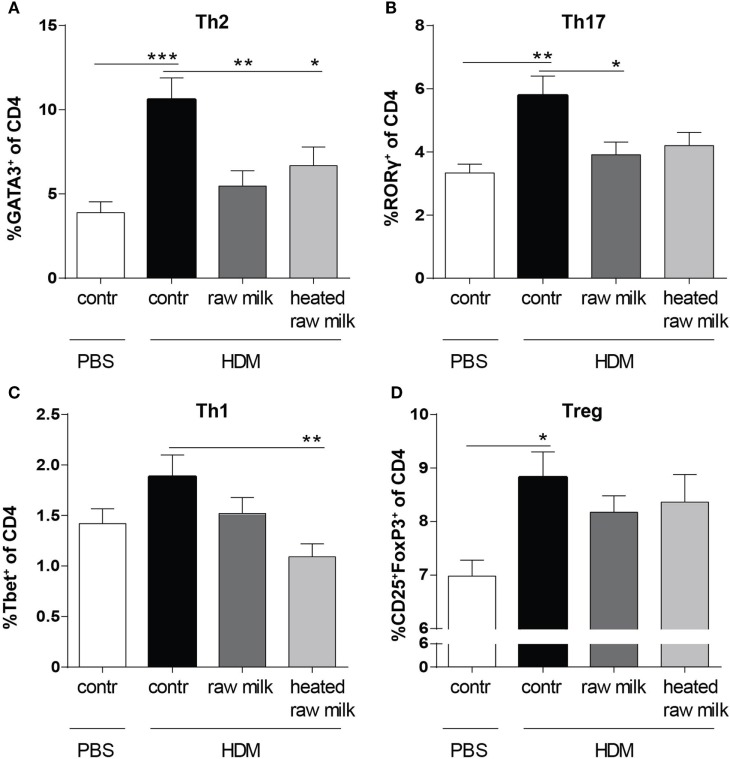
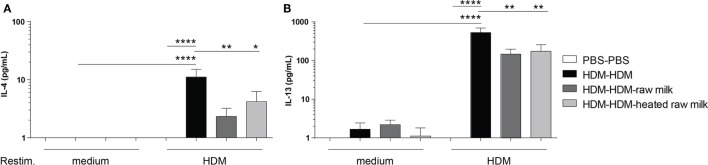
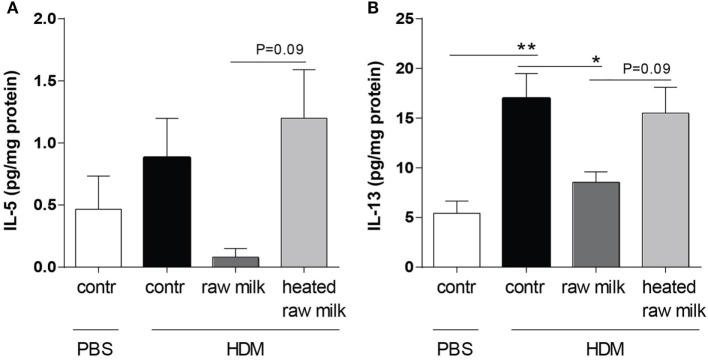
Epidemiological studies show an inverse relation between raw cow's milk consumption and the development of asthma. This protective effect seems to be abolished by milk processing. However, evidence for a causal relationship is lacking, and direct comparisons between raw and processed milk are hardly studied. Therefore, this study investigated the preventive capacity of raw and heated raw milk on the development of house dust mite (HDM)-induced allergic asthma in mice. Six- to seven-week-old male BALB/c mice were intranasally (i.n.) sensitized with 1 µg HDM or PBS on day 0, followed by an i.n. challenge with 10 µg HDM or PBS on days 7-11. In addition, mice were fed 0.5 mL raw cow's milk, heated raw cow's milk, or PBS three times a week throughout the study, starting 1 day before sensitization. On day 14, airway hyperresponsiveness (AHR) in response to increasing doses of methacholine was measured to assess lung function. Bronchoalveolar lavage fluid (BALF) and lungs were furthermore collected to study the extent of airway inflammation. Raw milk prevented both HDM-induced AHR and pulmonary eosinophilic inflammation, whereas heated raw milk did not. Both milk types suppressed the Th2-polarizing chemokine CCL17 in lung homogenates and reduced lung Th2 and Th17 cell frequency. IL-4 and IL-13 production after restimulation of lung T cells with HDM was also reduced by both milk types. However, local IL-5 and IL-13 concentrations were only suppressed by raw milk. These findings support the asthma-protective capacity of raw cow's milk and show the importance of reduced local type 2 cytokine levels. Heated raw milk did not show an asthma-protective effect, which indicates the involvement of heat-sensitive components. Besides causal evidence, this study provides the basis for further mechanistic studies.
流行病学研究表明,饮用生牛奶与哮喘的发生呈负相关。这种保护作用似乎会因牛奶加工而消失。然而,缺乏因果关系的证据,并且对生牛奶和加工牛奶之间的直接比较研究很少。因此,本研究调查了生牛奶和加热后的生牛奶对屋尘螨(HDM)诱导的小鼠过敏性哮喘的预防能力。6至7周龄的雄性BALB/c小鼠在第0天经鼻(i.n.)用1μg HDM或PBS致敏,随后在第7至11天经鼻用10μg HDM或PBS激发。此外,在整个研究过程中,从致敏前1天开始,每周给小鼠喂食3次0.5mL生牛奶、加热后的生牛奶或PBS。在第14天,测量对递增剂量乙酰甲胆碱的气道高反应性(AHR)以评估肺功能。此外,收集支气管肺泡灌洗液(BALF)和肺组织以研究气道炎症程度。生牛奶可预防HDM诱导的AHR和肺部嗜酸性粒细胞炎症,而加热后的生牛奶则不能。两种类型的牛奶均抑制肺匀浆中Th2极化趋化因子CCL17,并降低肺中Th2和Th17细胞频率。用HDM再次刺激肺T细胞后,两种类型的牛奶也均降低了IL-4和IL-13的产生。然而,局部IL-5和IL-13浓度仅被生牛奶抑制。这些发现支持了生牛奶对哮喘的保护能力,并表明降低局部2型细胞因子水平的重要性。加热后的生牛奶未显示出哮喘保护作用,这表明热敏成分的参与。除了因果证据外,本研究还为进一步的机制研究提供了基础。