Institute of Asthma and Allergy Prevention, Helmholtz Zentrum München, German Research Center for Environmental Health, Neuherberg, Germany.
Institute of Asthma and Allergy Prevention, Helmholtz Zentrum München, German Research Center for Environmental Health, Neuherberg, Germany.
J Allergy Clin Immunol Pract. 2023 Feb;11(2):591-601. doi: 10.1016/j.jaip.2022.10.035. Epub 2022 Nov 7.
An important window of opportunity for early-life exposures has been proposed for the development of atopic eczema and asthma.
However, it is unknown whether hay fever with a peak incidence around late school age to adolescence is similarly determined very early in life.
In the Protection against Allergy-Study in Rural Environments (PASTURE) birth cohort potentially relevant exposures such as farm milk consumption and exposure to animal sheds were assessed at multiple time points from infancy to age 10.5 years and classified by repeated measure latent class analyses (n = 769). Fecal samples at ages 2 and 12 months were sequenced by 16S rRNA. Hay fever was defined by parent-reported symptoms and/or physician's diagnosis of hay fever in the last 12 months using questionnaires at 10.5 years.
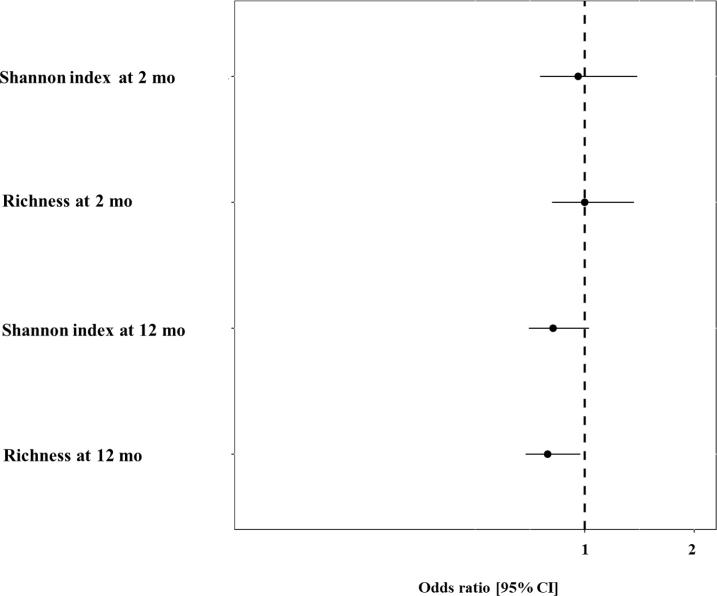
Farm children had half the risk of hay fever at 10.5 years (adjusted odds ratio [aOR] 0.50; 95% CI 0.31-0.79) than that of nonfarm children. Whereas early life events such as gut microbiome richness at 12 months (aOR 0.66; 95% CI 0.46-0.96) and exposure to animal sheds in the first 3 years of life (aOR 0.26; 95% CI 0.06-1.15) were determinants of hay fever, the continuous consumption of farm milk from infancy up to school age was necessary to exert the protective effect (aOR 0.35; 95% CI 0.17-0.72).
While early life events determine the risk of subsequent hay fever, continuous exposure is necessary to achieve protection. These findings argue against the notion that only early life exposures set long-lasting trajectories.
人们提出,生命早期的暴露是发生特应性皮炎和哮喘的重要机会窗口。
然而,尚不清楚发病高峰在学龄期至青春期的花粉热是否也在生命早期就已确定。
在农村环境中预防过敏研究(PASTURE)出生队列中,在婴儿期到 10.5 岁期间,通过多次重复测量潜在相关暴露(如农场牛奶的摄入和动物棚舍的暴露)进行评估,并通过重复测量潜在类别分析进行分类(n=769)。在 2 个月和 12 个月时,通过 16S rRNA 对粪便样本进行测序。在 10.5 岁时,通过问卷调查,根据父母报告的花粉热症状和/或医生诊断的花粉热来定义花粉热。
与非农场儿童相比,农场儿童在 10.5 岁时花粉热的风险降低了一半(调整后的优势比[aOR]0.50;95%置信区间[CI]0.31-0.79)。而生命早期事件,如 12 个月时的肠道微生物组丰富度(aOR 0.66;95%CI 0.46-0.96)和生命前 3 年接触动物棚舍(aOR 0.26;95%CI 0.06-1.15),是花粉热的决定因素,从婴儿期到学龄期持续摄入农场牛奶是发挥保护作用所必需的(aOR 0.35;95%CI 0.17-0.72)。
虽然生命早期的事件决定了随后花粉热的风险,但持续的暴露是实现保护的必要条件。这些发现反对了只有生命早期的暴露才能确定长期轨迹的观点。