Kessing Dionne, Denollet Johan, Widdershoven Jos, Kupper Nina
1 Center of Research on Psychology in Somatic diseases (C oRPS), Tilburg University, Tilburg, The Netherlands.
2 Department of Cardiology, Elisabeth-TweeSteden Hospital, Tilburg, The Netherlands.
Eur J Cardiovasc Nurs. 2017 Oct;16(7):605-613. doi: 10.1177/1474515117702021. Epub 2017 Mar 23.
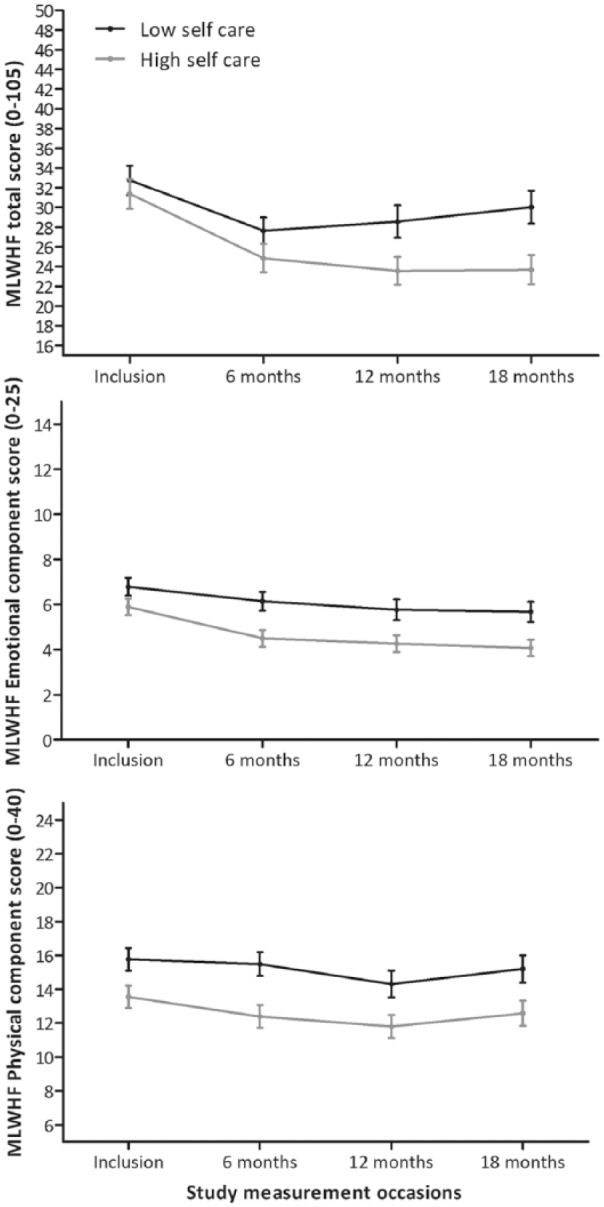
Self-care is assumed to benefit health outcomes in patients with chronic heart failure (HF), but the evidence is conflicting for health-related quality of life (HRQOL). The aim of this study was to examine the association of (changes in) self-care with HRQOL while adjusting for psychological distress.
In total, 459 patients (mean age = 66.1 ± 10.5 years, 73% male) with chronic HF completed questionnaires at baseline and at 6, 12 and 18 months of follow-up. Self-care and HF-specific HRQOL were quantified with the European Heart Failure Self-care Behaviour scale and the Minnesota Living with Heart Failure Questionnaire.
Using general linear models, multivariable between-subject (estimate = -0.14, p = 0.005) and no within-subject effects of self-care were found for better HRQOL over time. Associations between self-care and HRQOL were fully explained by depression (estimate = 1.77, p < 0.001). Anxiety (estimate = 4.49, p < 0.001) and Type D personality (estimate = 13.3, p < 0.001) were associated with poor HRQOL, but only partially accounted for the relationship between self-care and emotional HRQOL.
Self-care was prospectively associated with better disease-specific HRQOL in patients with HF, which was fully accounted for by depression, and partially accounted for by anxiety and Type D personality. Changes in self-care within a person did not affect HRQOL. Psychological distress should be considered in future efforts to address self-care and HRQOL.
自我护理被认为有益于慢性心力衰竭(HF)患者的健康结局,但在与健康相关的生活质量(HRQOL)方面,证据存在矛盾。本研究的目的是在调整心理困扰因素的同时,检验自我护理(的变化)与HRQOL之间的关联。
共有459例慢性HF患者(平均年龄=66.1±10.5岁,73%为男性)在基线以及随访的6个月、12个月和18个月时完成问卷调查。使用欧洲心力衰竭自我护理行为量表和明尼苏达心力衰竭生活问卷对自我护理和特定于HF的HRQOL进行量化。
使用一般线性模型,未发现自我护理的多变量受试者间效应(估计值=-0.14,p=0.005),且随着时间推移,自我护理对改善HRQOL无受试者内效应。自我护理与HRQOL之间的关联完全由抑郁所解释(估计值=1.77,p<0.001)。焦虑(估计值=4.49,p<0.001)和D型人格(估计值=13.3,p<0.001)与较差的HRQOL相关,但仅部分解释了自我护理与情绪HRQOL之间的关系。
自我护理与HF患者更好的疾病特异性HRQOL呈前瞻性关联,这完全由抑郁所解释,部分由焦虑和D型人格所解释。个体自我护理的变化并未影响HRQOL。在未来解决自我护理和HRQOL问题的努力中,应考虑心理困扰因素。