Roger Adams Laboratory, Department of Chemistry, University of Illinois , Urbana, Illinois 61801, United States.
J Am Chem Soc. 2017 Oct 4;139(39):13624-13627. doi: 10.1021/jacs.7b07602. Epub 2017 Sep 22.
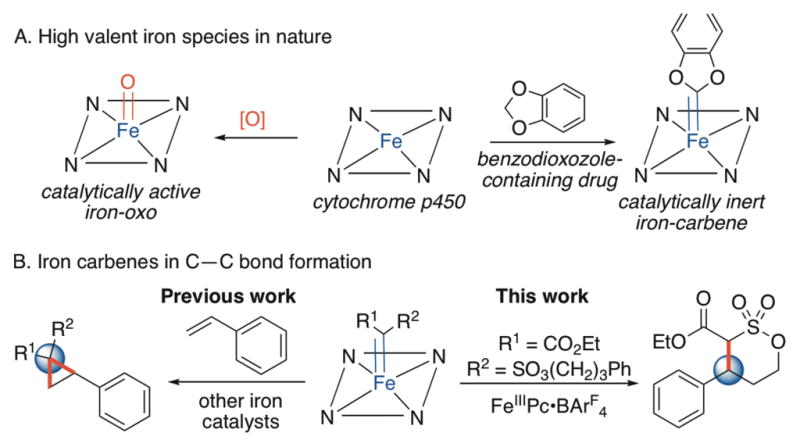
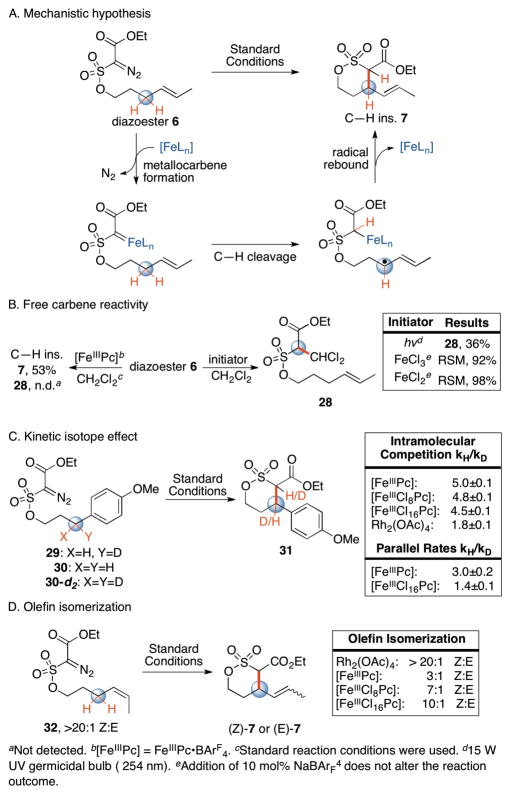
The catalytic transformation of a C(sp)-H bond to a C(sp)-C bond via an iron carbene intermediate represents a long-standing challenge. Despite the success of enzymatic and small molecule iron catalysts mediating challenging C(sp)-H oxidations and aminations via high-valent iron oxos and nitrenes, C(sp)-H alkylations via isoelectronic iron carbene intermediates have thus far been unsuccessful. Iron carbenes have been inert, or shown to favor olefin cyclopropanation and heteroatom-hydrogen insertion. Herein we report an iron phthalocyanine-catalyzed alkylation of allylic and benzylic C(sp)-H bonds. Mechanistic investigations support that an electrophilic iron carbene mediates homolytic C-H cleavage and rebounds from the resulting organoiron intermediate to form the C-C bond; both steps are tunable via catalyst modifications. These studies suggest that for iron carbenes, distinct from other late metal carbenes, C-H cleavage is partially rate-determining and must be promoted to effect reactivity.
通过铁卡宾中间体实现 C(sp)-H 键到 C(sp)-C 键的催化转化是一个长期存在的挑战。尽管酶和小分子铁催化剂通过高价铁氧和氮烯成功介导了具有挑战性的 C(sp)-H 氧化和胺化,但通过等电子铁卡宾中间体的 C(sp)-H 烷基化迄今为止尚未成功。铁卡宾一直是惰性的,或者显示出有利于烯烃环丙烷化和杂原子-氢键插入。在此,我们报告了铁酞菁催化的烯丙基和苄基 C(sp)-H 键的烷基化。机理研究支持亲电铁卡宾介导均裂 C-H 裂解,并从生成的有机铁中间体反弹,形成 C-C 键;这两个步骤都可以通过催化剂修饰进行调节。这些研究表明,对于铁卡宾来说,与其他后过渡金属卡宾不同,C-H 裂解部分是速率决定步骤,必须促进其裂解以实现反应性。