Netsi Elena, Santos Ina S, Stein Alan, Barros Fernando C, Barros Aluísio J D, Matijasevich Alicia
Department of Psychiatry, University of Oxford, Oxford, UK.
Postgraduate Program in Epidemiology, Federal University of Pelotas, Pelotas, Brazil.
Sleep Med. 2017 Sep;37:77-87. doi: 10.1016/j.sleep.2017.06.001. Epub 2017 Jun 22.
Sleep is an important marker of healthy development and has been associated with emotional, behavioral, and cognitive development. There is limited longitudinal data on children's sleep with only a few reports from low- and middle-income countries (LMICs). We investigate sleep parameters and associated sociodemographic characteristics in a population-based longitudinal study in Pelotas, Brazil.
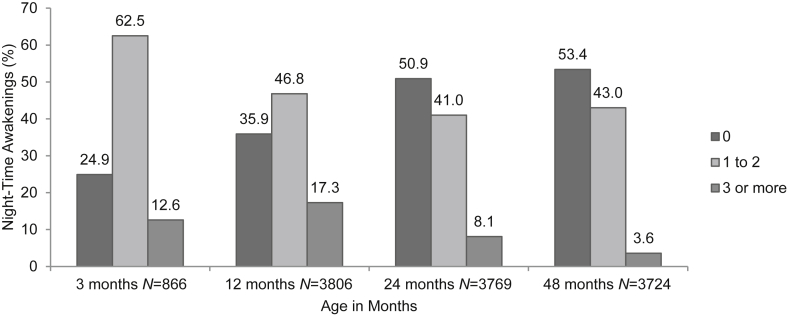
Data from the Pelotas 2004 Birth Cohort were used (N = 3842). Infant sleep was collected through maternal report at 3, 12, 24, and 48 months: sleep duration, bed and wake time, nighttime awakenings, co-sleeping and sleep disturbances (24 and 48 months).
Compared to children in high-income countries (HICs), children in Brazil showed a substantial shift in rhythms with later bed and wake times by approximately 2 hours. These remain stable throughout the first 4 years of life. This population also shows high levels of co-sleeping which remain stable throughout (49.0-52.2%). Later bedtime was associated with higher maternal education and family income. Higher rates of co-sleeping were seen in families with lower income and maternal education and for children who were breastfed. All other sleep parameters were broadly similar to data previously reported from HICs.
The shift in biological rhythms in this representative community sample of children in Brazil challenges our understanding of optimal sleep routine and recommendations.
睡眠是健康发育的重要标志,且与情绪、行为和认知发展相关。关于儿童睡眠的纵向数据有限,低收入和中等收入国家(LMICs)仅有少数报告。我们在巴西佩洛塔斯开展的一项基于人群的纵向研究中,调查睡眠参数及相关社会人口学特征。
使用了佩洛塔斯2004年出生队列的数据(N = 3842)。通过母亲报告收集婴儿在3、12、24和48个月时的睡眠情况:睡眠时间、上床和起床时间、夜间醒来次数、同床睡眠和睡眠障碍(24和48个月时)。
与高收入国家(HICs)的儿童相比,巴西儿童的节律有显著变化,上床和起床时间晚约2小时。在生命的前4年中这些时间保持稳定。该人群同床睡眠的比例也很高,且始终保持稳定(49.0 - 52.2%)。较晚的上床时间与母亲较高的教育水平和家庭收入相关。在收入和母亲教育水平较低的家庭以及母乳喂养的儿童中,同床睡眠的比例更高。所有其他睡眠参数与先前HICs报告的数据大致相似。
巴西这个具有代表性的儿童社区样本的生物节律变化,挑战了我们对最佳睡眠习惯和建议的理解。