• 文献检索
  • 文档翻译
  • 深度研究
  • 学术资讯
  • Suppr Zotero 插件Zotero 插件
  • 邀请有礼
  • 套餐&价格
  • 历史记录
应用&插件
Suppr Zotero 插件Zotero 插件浏览器插件Mac 客户端Windows 客户端微信小程序
定价
高级版会员购买积分包购买API积分包
服务
文献检索文档翻译深度研究API 文档MCP 服务
关于我们
关于 Suppr公司介绍联系我们用户协议隐私条款
关注我们

Suppr 超能文献

核心技术专利:CN118964589B侵权必究
粤ICP备2023148730 号-1Suppr @ 2026

文献检索

告别复杂PubMed语法,用中文像聊天一样搜索,搜遍4000万医学文献。AI智能推荐,让科研检索更轻松。

立即免费搜索

文件翻译

保留排版,准确专业,支持PDF/Word/PPT等文件格式,支持 12+语言互译。

免费翻译文档

深度研究

AI帮你快速写综述,25分钟生成高质量综述,智能提取关键信息,辅助科研写作。

立即免费体验

针对与伯氏考克斯氏体转座酶基因相关的重复元件IS1111的巢式PCR在临床和流行病学中的应用。

Clinical and epidemiological use of nested PCR targeting the repetitive element IS1111 associated with the transposase gene from Coxiella burnetii.

作者信息

Mares-Guia Maria Angélica M M, Guterres Alexandro, Rozental Tatiana, Ferreira Michelle Dos Santos, Lemos Elba R S

机构信息

Oswaldo Cruz Institute, Laboratory of Hantavirus and Rickettsioses, Fiocruz, RJ, Brazil.

Oswaldo Cruz Institute, Laboratory of Hantavirus and Rickettsioses, Fiocruz, RJ, Brazil.

出版信息

Braz J Microbiol. 2018 Jan-Mar;49(1):138-143. doi: 10.1016/j.bjm.2017.04.009. Epub 2017 Aug 24.

DOI:10.1016/j.bjm.2017.04.009
PMID:28899604
原文链接:https://pmc.ncbi.nlm.nih.gov/articles/PMC5790644/
Abstract

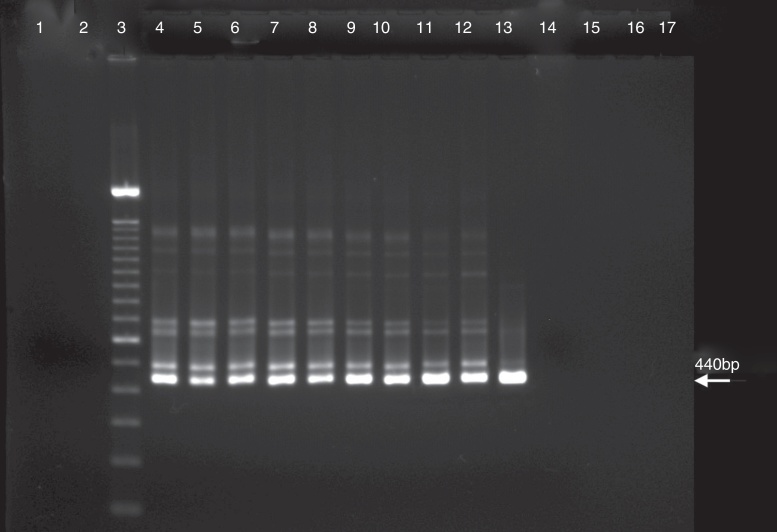
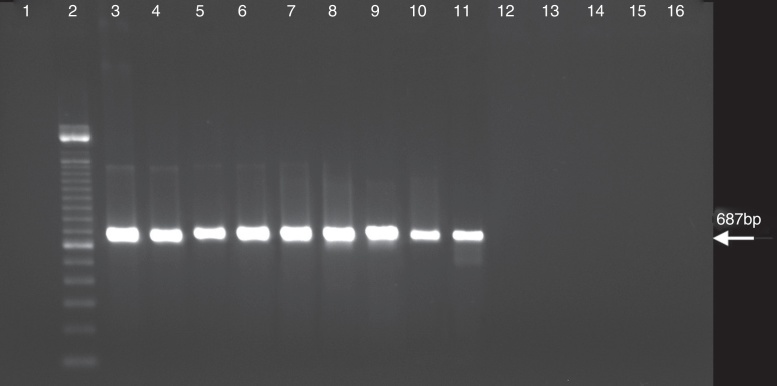
Q fever is a worldwide zoonosis caused by Coxiella burnetii-a small obligate intracellular Gram-negative bacterium found in a variety of animals. It is transmitted to humans by inhalation of contaminated aerosols from urine, feces, milk, amniotic fluid, placenta, abortion products, wool, and rarely by ingestion of raw milk from infected animals. Nested PCR can improve the sensitivity and specificity of testing while offering a suitable amplicon size for sequencing. Serial dilutions were performed tenfold to test the limit of detection, and the result was 10× detection of C. burnetti DNA with internal nested PCR primers relative to trans-PCR. Different biological samples were tested and identified only in nested PCR. This demonstrates the efficiency and effectiveness of the primers. Of the 19 samples, which amplify the partial sequence of C. burnetii, 12 were positive by conventional PCR and nested PCR. Seven samples-five spleen tissue samples from rodents and two tick samples-were only positive in nested PCR. With these new internal primers for trans-PCR, we demonstrate that our nested PCR assay for C. burnetii can achieve better results than conventional PCR.

摘要

Q热是一种由伯氏考克斯体引起的全球性人畜共患病,伯氏考克斯体是一种小型专性细胞内革兰氏阴性细菌,存在于多种动物体内。它通过吸入来自尿液、粪便、牛奶、羊水、胎盘、流产产物、羊毛的受污染气溶胶传播给人类,很少通过摄入受感染动物的生奶传播。巢式PCR可以提高检测的灵敏度和特异性,同时提供适合测序的扩增子大小。进行了十倍系列稀释以测试检测限,结果是相对于反式PCR,使用内部巢式PCR引物对伯氏考克斯体DNA的检测灵敏度提高了10倍。对不同的生物样本进行了检测,只有在巢式PCR中才能鉴定出来。这证明了引物的效率和有效性。在19个扩增伯氏考克斯体部分序列的样本中,12个通过常规PCR和巢式PCR呈阳性。7个样本——5个来自啮齿动物的脾脏组织样本和2个蜱虫样本——仅在巢式PCR中呈阳性。使用这些用于反式PCR的新内部引物,我们证明我们的伯氏考克斯体巢式PCR检测方法比常规PCR能获得更好的结果。
https://cdn.ncbi.nlm.nih.gov/pmc/blobs/1d9b/5790644/8e1bcdf07d8d/gr2.jpg
https://cdn.ncbi.nlm.nih.gov/pmc/blobs/1d9b/5790644/03d0f3910781/gr1.jpg
https://cdn.ncbi.nlm.nih.gov/pmc/blobs/1d9b/5790644/8e1bcdf07d8d/gr2.jpg
https://cdn.ncbi.nlm.nih.gov/pmc/blobs/1d9b/5790644/03d0f3910781/gr1.jpg
https://cdn.ncbi.nlm.nih.gov/pmc/blobs/1d9b/5790644/8e1bcdf07d8d/gr2.jpg

相似文献

1
Clinical and epidemiological use of nested PCR targeting the repetitive element IS1111 associated with the transposase gene from Coxiella burnetii.针对与伯氏考克斯氏体转座酶基因相关的重复元件IS1111的巢式PCR在临床和流行病学中的应用。
Braz J Microbiol. 2018 Jan-Mar;49(1):138-143. doi: 10.1016/j.bjm.2017.04.009. Epub 2017 Aug 24.
2
Highly sensitive real-time PCR for specific detection and quantification of Coxiella burnetii.用于特异性检测和定量伯纳特立克次体的高灵敏度实时聚合酶链反应
BMC Microbiol. 2006 Jan 19;6:2. doi: 10.1186/1471-2180-6-2.
3
IS1111 insertion sequences of Coxiella burnetii: characterization and use for repetitive element PCR-based differentiation of Coxiella burnetii isolates.伯氏考克斯氏体的IS1111插入序列:特性及用于基于重复元件PCR的伯氏考克斯氏体分离株鉴别
BMC Microbiol. 2007 Oct 18;7:91. doi: 10.1186/1471-2180-7-91.
4
Evaluation of a real-time PCR assay to detect Coxiella burnetii.用于检测伯氏考克斯氏体的实时聚合酶链反应检测法的评估
Ann N Y Acad Sci. 2006 Oct;1078:563-5. doi: 10.1196/annals.1374.111.
5
[Multiplex PCR for the diagnostic detection of Coxiella burnetii in cow's milk].[用于牛奶中伯氏考克斯氏体诊断检测的多重聚合酶链反应]
Berl Munch Tierarztl Wochenschr. 1999 Jan;112(1):5-9.
6
The IS1111 insertion sequence used for detection of Coxiella burnetii is widespread in Coxiella-like endosymbionts of ticks.用于检测伯氏考克斯氏体的IS1111插入序列广泛存在于蜱的类考克斯氏体共生菌中。
FEMS Microbiol Lett. 2015 Sep;362(17):fnv132. doi: 10.1093/femsle/fnv132. Epub 2015 Aug 12.
7
Coxiella burnetii, the agent of Q fever in Brazil: its hidden role in seronegative arthritis and the importance of molecular diagnosis based on the repetitive element IS1111 associated with the transposase gene.巴西柯克斯体,Q 热的病原体:其在血清阴性关节炎中的隐匿作用,以及基于与转座酶基因相关的重复元件 IS1111 的分子诊断的重要性。
Mem Inst Oswaldo Cruz. 2012 Aug;107(5):695-7. doi: 10.1590/s0074-02762012000500021.
8
Development of a method for detecting Coxiella burnetii in cheese samples.一种检测奶酪样本中伯氏考克斯氏体方法的开发。
J Vet Med Sci. 2012 Feb;74(2):175-80. doi: 10.1292/jvms.11-0023. Epub 2011 Oct 7.
9
Coxiella-like endosymbiont associated to the "Anatolian brown tick" Rhipicephalus bursa in Southern Italy.与意大利南部“安纳托利亚棕蜱”(璃眼蜱属)相关的类柯克斯体共生菌。
Microbes Infect. 2015 Nov-Dec;17(11-12):799-805. doi: 10.1016/j.micinf.2015.09.011. Epub 2015 Sep 30.
10
Comparison of PCR, immunofluorescence assay, and pathogen isolation for diagnosis of q fever in humans with spontaneous abortions.聚合酶链反应(PCR)、免疫荧光测定法和病原体分离法在诊断自然流产患者Q热中的比较
J Clin Microbiol. 2008 Jun;46(6):2038-44. doi: 10.1128/JCM.01874-07. Epub 2008 Apr 30.

引用本文的文献

1
Multiple spacer sequence typing of carried by ticks in Gansu, China.中国甘肃蜱携带的多重间隔序列分型
Front Vet Sci. 2024 Nov 27;11:1470242. doi: 10.3389/fvets.2024.1470242. eCollection 2024.
2
Frequency of co-seropositivities for certain pathogens and their relationship with clinical and histopathological changes and parasite load in dogs infected with Leishmania infantum.感染利什曼原虫的犬某些病原体的共血清阳性率及其与临床和组织病理学变化及寄生虫负荷的关系。
PLoS One. 2021 Mar 11;16(3):e0247560. doi: 10.1371/journal.pone.0247560. eCollection 2021.
3
High prevalence of infection in humans and livestock in Assiut, Egypt: A serological and molecular survey.

本文引用的文献

1
False detection of Coxiella burnetii-what is the risk?伯氏考克斯氏体的错误检测——风险是什么?
FEMS Microbiol Lett. 2016 May;363(10). doi: 10.1093/femsle/fnw088. Epub 2016 Apr 7.
2
Molecular Identification of Q Fever in Patients with a Suspected Diagnosis of Dengue in Brazil in 2013-2014.2013 - 2014年巴西疑似登革热患者中Q热的分子鉴定
Am J Trop Med Hyg. 2016 May 4;94(5):1090-4. doi: 10.4269/ajtmh.15-0575. Epub 2016 Feb 29.
3
The IS1111 insertion sequence used for detection of Coxiella burnetii is widespread in Coxiella-like endosymbionts of ticks.
埃及艾斯尤特人畜感染的高流行率:一项血清学和分子学调查。
Vet World. 2020 Dec;13(12):2578-2586. doi: 10.14202/vetworld.2020.2578-2586. Epub 2020 Dec 5.
4
Could Cognitive Behavioural Therapy Be an Effective Treatment for Long COVID and Post COVID-19 Fatigue Syndrome? Lessons from the Qure Study for Q-Fever Fatigue Syndrome.认知行为疗法能否有效治疗新冠长期症状和新冠后疲劳综合征?来自Q热疲劳综合征Qure研究的经验教训。
Healthcare (Basel). 2020 Dec 11;8(4):552. doi: 10.3390/healthcare8040552.
5
Molecular detection of Coxiella burnetii in horse sera in Iran.伊朗马血清中柯克斯体的分子检测。
Comp Immunol Microbiol Infect Dis. 2020 Oct;72:101521. doi: 10.1016/j.cimid.2020.101521. Epub 2020 Jul 23.
6
First molecular detection of Coxiella burnetii in Brazilian artisanal cheese: a neglected food safety hazard in ready-to-eat raw-milk product.首次在巴西手工奶酪中检测到柯克斯体:一种被忽视的即食生乳产品食品安全危害因子。
Braz J Infect Dis. 2020 May-Jun;24(3):208-212. doi: 10.1016/j.bjid.2020.05.003. Epub 2020 Jun 18.
7
Coxiella and Bartonella spp. in bats (Chiroptera) captured in the Brazilian Atlantic Forest biome.在巴西大西洋森林生物群落中捕获的蝙蝠(翼手目)体内的柯克斯体属和巴尔通体属细菌。
BMC Vet Res. 2018 Sep 10;14(1):279. doi: 10.1186/s12917-018-1603-0.
用于检测伯氏考克斯氏体的IS1111插入序列广泛存在于蜱的类考克斯氏体共生菌中。
FEMS Microbiol Lett. 2015 Sep;362(17):fnv132. doi: 10.1093/femsle/fnv132. Epub 2015 Aug 12.
4
Development of loop-mediated isothermal amplification assays for rapid and easy detection of Coxiella Burnetii.用于快速简便检测伯氏考克斯体的环介导等温扩增检测方法的开发。
J Microbiol Methods. 2014 Dec;107:176-81. doi: 10.1016/j.mimet.2014.07.039.
5
Molecular identification of the agent of Q fever - Coxiella burnetii - in domestic animals in State of Rio de Janeiro, Brazil.巴西里约热内卢州家畜中 Q 热病原体 - 贝纳柯克斯体的分子鉴定。
Rev Soc Bras Med Trop. 2014 Mar-Apr;47(2):231-4. doi: 10.1590/0037-8682-0076-2013.
6
MEGA6: Molecular Evolutionary Genetics Analysis version 6.0.MEGA6:分子进化遗传学分析版本 6.0。
Mol Biol Evol. 2013 Dec;30(12):2725-9. doi: 10.1093/molbev/mst197. Epub 2013 Oct 16.
7
Detection of Coxiella burnetii in complex matrices by using multiplex quantitative PCR during a major Q fever outbreak in The Netherlands.采用多重实时定量 PCR 技术在荷兰一次大规模 Q 热爆发中对复杂基质中的柯克斯体进行检测。
Appl Environ Microbiol. 2011 Sep;77(18):6516-23. doi: 10.1128/AEM.05097-11. Epub 2011 Jul 22.
8
Diagnosis of acute Q fever with emphasis on enzyme-linked immunosorbent assay and nested polymerase chain reaction regarding the time of serum collection.急性 Q 热的诊断,重点介绍酶联免疫吸附试验和巢式聚合酶链反应,以及采集血清的时间。
Diagn Microbiol Infect Dis. 2010 Oct;68(2):110-6. doi: 10.1016/j.diagmicrobio.2010.06.001.
9
Q fever as a cause of fever of unknown origin and thrombocytosis: first molecular evidence of Coxiella burnetii in Brazil.Q 热作为不明原因发热和血小板增多症的病因:巴西首次发现柯克斯体的分子证据。
Vector Borne Zoonotic Dis. 2011 Jan;11(1):85-7. doi: 10.1089/vbz.2009.0261. Epub 2010 Jun 23.
10
Q Fever.Q 热。
Vet Microbiol. 2010 Jan 27;140(3-4):297-309. doi: 10.1016/j.vetmic.2009.07.016. Epub 2009 Aug 8.