Jia Shiyu, Zhang Rui, Li Ziyang, Li Jinming
Peking University Fifth School of Clinical Medicine, Beijing, People's Republic of China.
National Center for Clinical Laboratories, Beijing Hospital, National Center of Gerontology, Beijing, People's Republic of China.
Oncotarget. 2017 Apr 18;8(33):55632-55645. doi: 10.18632/oncotarget.17184. eCollection 2017 Aug 15.
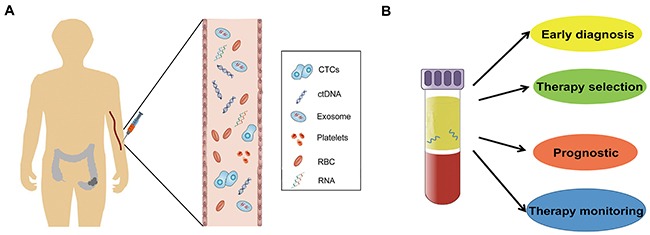
Colorectal cancer (CRC) has been the fourth leading cause of cancer-related mortality worldwide. Owing to clonal evolution and selection, CRC treatment needs multimodal therapeutic approaches and due monitoring of tumor progression and therapeutic efficacy. Liquid biopsy, involving the use of circulating tumor cells (CTCs), circulating tumor DNA (ctDNA), and exosomes, may offer a promising noninvasive alternative for diagnosis and for real-time monitoring of tumor evolution and therapeutic response compared to traditional tissue biopsy. Monitoring of the disease processes can enable clinicians to readily adopt a strategy based on optimal therapeutic decision-making. This article provides an overview of the significant advances and the current clinical and biological significance of CTCs, ctDNA, and exosomes in CRC, as well as a comparison of the main merits and demerits of these three components. The hurdles that need to be resolved and potential directions to be followed with respect to liquid biopsies for detection and therapy of CRC are also discussed.
结直肠癌(CRC)一直是全球癌症相关死亡的第四大主要原因。由于克隆进化和选择,CRC治疗需要多模式治疗方法以及对肿瘤进展和治疗效果的适当监测。与传统组织活检相比,液体活检涉及使用循环肿瘤细胞(CTC)、循环肿瘤DNA(ctDNA)和外泌体,可能为诊断以及肿瘤演变和治疗反应的实时监测提供一种有前景的非侵入性替代方法。对疾病过程的监测可以使临床医生能够基于最佳治疗决策轻松采用一种策略。本文概述了CTCs、ctDNA和外泌体在CRC中的重大进展以及当前的临床和生物学意义,还比较了这三种成分的主要优缺点。还讨论了CRC检测和治疗的液体活检需要解决的障碍以及潜在的发展方向。