Jeng Toong Long, Lai Chia Chi, Liao Ting Chen, Lin Su Yue, Sung Jih Min
Division of Biotechnology, Agricultural Research Institute, Wufong, Taichung, Taiwan.
Department of Food Science and Technology, Hungkuang University, Shalu, Taichung, Taiwan.
J Food Drug Anal. 2015 Dec;23(4):701-708. doi: 10.1016/j.jfda.2014.07.002. Epub 2014 Aug 3.
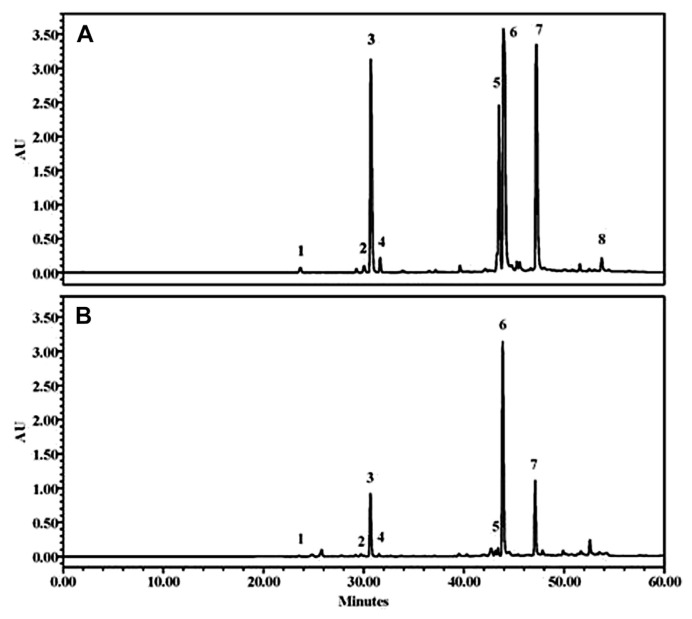
Caffeoylquinic acid (CQA) derivatives are known to possess antioxidative potential and have many beneficial effects on human health. The present study compared the CQA contents and antioxidant activities of aerial parts of sweet potato plants. The effects of drying methods (freeze drying, and drying at 30°C, 70°C, and 100°C) on these two parameters of the first fully expanded leaves were also assessed. The results indicated that the CQA derivatives were detectable in leaves, stem, and flowers of sweet potato plants (varied from 39.34 mg/g dry weight to 154.05 mg/g dry weight), with the leaves (particularly expanding and first fully expanded leaves) containing more CQA derivatives than other aerial plant parts. The expanding and first fully expanded leaves also exhibited greater antioxidant activities than other aerial plant parts, possibly due to their higher contents of CQA derivatives. Drying method significantly affected the content of CQA derivatives in dried sweet potato leaf tissues. Drying treatments at both 70°C and 100°C significantly reduced the CQA derivative content and antioxidant activity in the first fully expanded leaves. Among the tested drying methods, the freeze-drying method demonstrated the preservation of the highest amount of CQA derivatives (147.84 mg/g) and antioxidant property. However, 30°C cool air drying was also a desirable choice (total CQA derivative content was reduced to only 129.52 mg/g), compared to 70°C and 100°C hot air drying, for commercial-scale processing of sweet potato leaves, if the higher operation cost of freeze drying was a major concern.
咖啡酰奎宁酸(CQA)衍生物具有抗氧化潜力,对人体健康有诸多益处。本研究比较了甘薯植株地上部分的CQA含量和抗氧化活性。还评估了干燥方法(冷冻干燥以及在30℃、70℃和100℃下干燥)对第一片完全展开叶片这两个参数的影响。结果表明,在甘薯植株的叶片、茎和花中均可检测到CQA衍生物(干重从39.34毫克/克至154.05毫克/克不等),其中叶片(尤其是正在展开和第一片完全展开的叶片)含有的CQA衍生物比其他地上部分更多。正在展开和第一片完全展开的叶片也比其他地上部分表现出更强的抗氧化活性,这可能是由于它们含有更高含量的CQA衍生物。干燥方法对干燥甘薯叶组织中CQA衍生物的含量有显著影响。70℃和100℃的干燥处理均显著降低了第一片完全展开叶片中CQA衍生物的含量和抗氧化活性。在测试的干燥方法中,冷冻干燥法能保留最高量的CQA衍生物(147.84毫克/克)和抗氧化性能。然而,如果冷冻干燥的较高运营成本是主要考虑因素,那么与70℃和100℃的热风干燥相比,30℃冷风干燥也是甘薯叶商业化规模加工的理想选择(总CQA衍生物含量仅降至129.52毫克/克)。