Ha Go Eun, Cheong Eunji
Department of Biotechnology, College of Life Science and Biotechnology, Yonsei University, Seoul 03722, Korea.
Exp Neurobiol. 2017 Aug;26(4):179-185. doi: 10.5607/en.2017.26.4.179. Epub 2017 Aug 29.
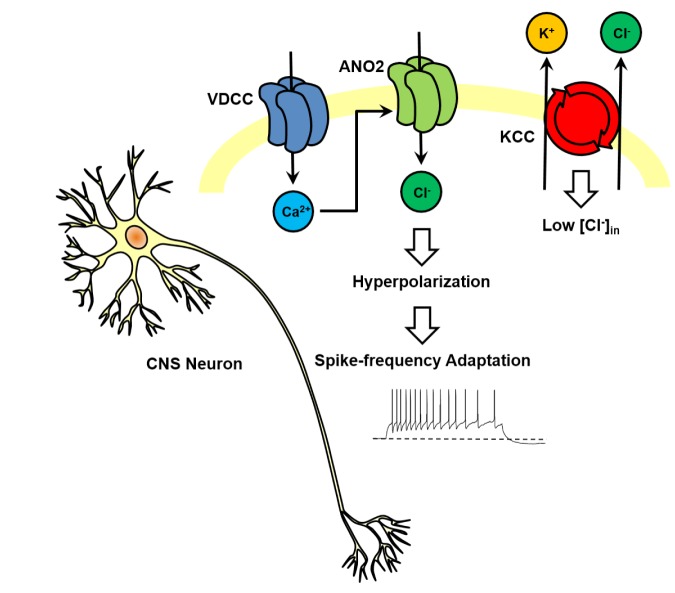
Neuronal firing patterns and frequencies determine the nature of encoded information of the neurons. Here we discuss the molecular identity and cellular mechanisms of spike-frequency adaptation in central nervous system (CNS) neurons. Calcium-activated potassium (K) channels such as BK and SK channels have long been known to be important mediators of spike adaptation via generation of a large afterhyperpolarization when neurons are hyper-activated. However, it has been shown that a strong hyperpolarization via these K channels would cease action potential generation rather than reducing the frequency of spike generation. In some types of neurons, the strong hyperpolarization is followed by oscillatory activity in these neurons. Recently, spike-frequency adaptation in thalamocortical (TC) and CA1 hippocampal neurons is shown to be mediated by the Ca-activated Cl- channel (CACC), anoctamin-2 (ANO2). Knockdown of ANO2 in these neurons results in significantly reduced spike-frequency adaptation accompanied by increased number of spikes without shifting the firing mode, which suggests that ANO2 mediates a genuine form of spike adaptation, finely tuning the frequency of spikes in these neurons. Based on the finding of a broad expression of this new class of CACC in the brain, it can be proposed that the ANO2-mediated spike-frequency adaptation may be a general mechanism to control information transmission in the CNS neurons.
神经元的放电模式和频率决定了神经元编码信息的性质。在此,我们讨论中枢神经系统(CNS)神经元中动作电位频率适应性的分子特性和细胞机制。长期以来,人们一直认为钙激活钾(K)通道,如BK和SK通道,是动作电位适应性的重要介导因子,当神经元过度激活时,它们会产生一个大的超极化后电位。然而,研究表明,通过这些K通道产生的强烈超极化会停止动作电位的产生,而不是降低动作电位的产生频率。在某些类型的神经元中,强烈的超极化之后会伴随着这些神经元的振荡活动。最近研究表明,丘脑皮质(TC)和海马CA1神经元中的动作电位频率适应性是由钙激活氯通道(CACC)——八聚体蛋白2(ANO2)介导的。在这些神经元中敲低ANO2会导致动作电位频率适应性显著降低,同时动作电位数量增加,且不改变放电模式,这表明ANO2介导了一种真正的动作电位适应性形式,精细调节这些神经元中的动作电位频率。基于这一新类别的CACC在大脑中广泛表达的发现,可以推测ANO2介导的动作电位频率适应性可能是控制中枢神经系统神经元信息传递的一种普遍机制。