KEMRI, Centre for Geographic Medicine Research, Coast & KEMRI Wellcome Trust Research Programme, Kilifi, Kenya.
School of Biological Sciences, University of Nairobi, Nairobi, Kenya.
Parasit Vectors. 2017 Sep 19;10(1):429. doi: 10.1186/s13071-017-2361-8.
Insecticide resistance has emerged as one of the major challenges facing National Malaria Control Programmes in Africa. A well-coordinated national database on insecticide resistance (IRBase) can facilitate the development of effective strategies for managing insecticide resistance and sustaining the effectiveness of chemical-based vector control measures. The aim of this study was to assemble a database on the current status of insecticide resistance among malaria vectors in Kenya.
Data was obtained from published literature through PubMed, HINARI and Google Scholar searches and unpublished literature from government reports, research institutions reports and malaria control programme reports. Each data source was assigned a unique identification code and entered into Microsoft Excel 2010 datasheets. Base maps on the distribution of insecticide resistance and resistance mechanisms among malaria vectors in Kenya were generated using ArcGIS Desktop 10.1 (ESRI, Redlands, CA, USA).
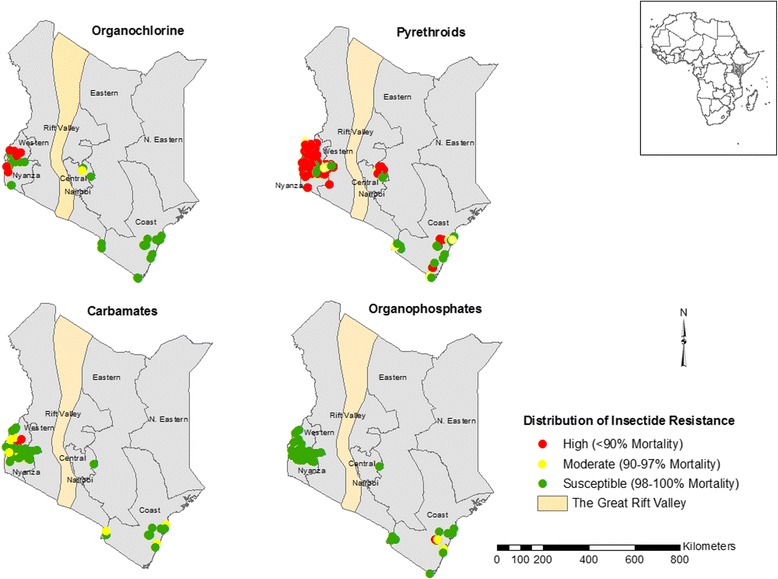
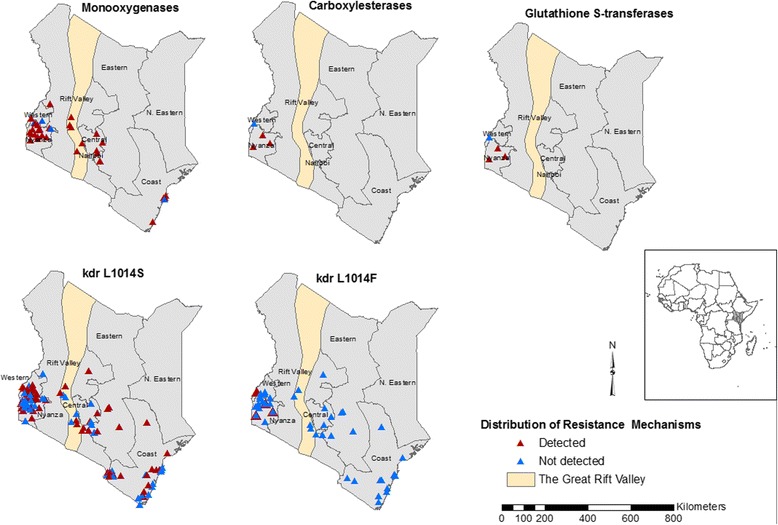
Insecticide resistance status among the major malaria vectors in Kenya was reported in all the four classes of insecticides including pyrethroids, carbamates, organochlorines and organophosphates. Resistance to pyrethroids has been detected in Anopheles gambiae (s.s.), An. arabiensis and An. funestus (s.s.) while resistance to carbamates was limited to An. gambiae (s.s.) and An. arabiensis. Resistance to the organochlorine was reported in An. gambiae (s.s.) and An. funestus (s.s.) while resistance to organophosphates was reported in An. gambiae (s.l.) only. The mechanisms of insecticide resistance among malaria vectors reported include the kdr mutations (L 1014S and L 1014F) and elevated activity in carboxylesterase, glutathione S-transferases (GST) and monooxygenases. The kdr mutations L 1014S and L 1014F were detected in An. gambiae (s.s.) and An. arabiensis populations. Elevated activity of monooxygenases has been detected in both An. arabiensis and An. gambiae (s.s.) populations while the elevated activity of carboxylesterase and GST has been detected only in An. arabiensis populations.
The geographical maps show the distribution of insecticide resistance and resistance mechanisms among malaria vectors in Kenya. The database generated will provide a guide to intervention policies and programmes in the fight against malaria.
杀虫剂耐药性已成为非洲国家疟疾控制规划面临的主要挑战之一。一个协调良好的国家杀虫剂耐药性数据库(IRBase)可以为制定有效管理杀虫剂耐药性和维持基于化学的病媒控制措施的有效性的战略提供便利。本研究旨在汇编肯尼亚疟疾媒介杀虫剂耐药性现状数据库。
通过 PubMed、HINARI 和 Google Scholar 搜索以及政府报告、研究机构报告和疟疾控制规划报告中的未发表文献,从已发表文献中获取数据。每个数据源都被分配了一个唯一的识别码,并输入到 Microsoft Excel 2010 数据表中。使用 ArcGIS Desktop 10.1(ESRI,加利福尼亚州雷德兰兹)生成肯尼亚疟疾媒介中杀虫剂耐药性和耐药机制分布的基础地图。
肯尼亚主要疟疾媒介的杀虫剂耐药性状况报告涵盖了包括拟除虫菊酯、氨基甲酸酯、有机氯和有机磷在内的所有四类杀虫剂。已在冈比亚按蚊(s.s.)、阿蚊和芬尼斯(s.s.)中检测到对拟除虫菊酯的耐药性,而对氨基甲酸酯的耐药性仅限于冈比亚按蚊(s.s.)和阿蚊。报告了对有机氯的耐药性,仅在冈比亚按蚊(s.l.)中报告了对有机磷的耐药性。报告的疟疾媒介杀虫剂耐药机制包括 kdr 突变(L1014S 和 L1014F)和羧酸酯酶、谷胱甘肽 S-转移酶(GST)和单加氧酶活性升高。在冈比亚按蚊(s.s.)和阿蚊种群中检测到 kdr 突变 L1014S 和 L1014F。在阿蚊和冈比亚按蚊(s.s.)种群中均检测到单加氧酶活性升高,而仅在阿蚊种群中检测到羧酸酯酶和 GST 活性升高。
地理地图显示了肯尼亚疟疾媒介中杀虫剂耐药性和耐药机制的分布。生成的数据库将为抗击疟疾的干预政策和规划提供指导。