Chen Brian H, Carty Cara L, Kimura Masayuki, Kark Jeremy D, Chen Wei, Li Shengxu, Zhang Tao, Kooperberg Charles, Levy Daniel, Assimes Themistocles, Absher Devin, Horvath Steve, Reiner Alexander P, Aviv Abraham
Longitudinal Studies Section, Translational Gerontology Branch, Intramural Research Program, National Institute on Aging, National Institutes of Health, Baltimore, MD 21224, USA.
Framingham Heart Study, National Heart, Lung, and Blood Institute, Framingham, MA 01702, USA.
Aging (Albany NY). 2017 Sep 20;9(9):1983-1995. doi: 10.18632/aging.101293.
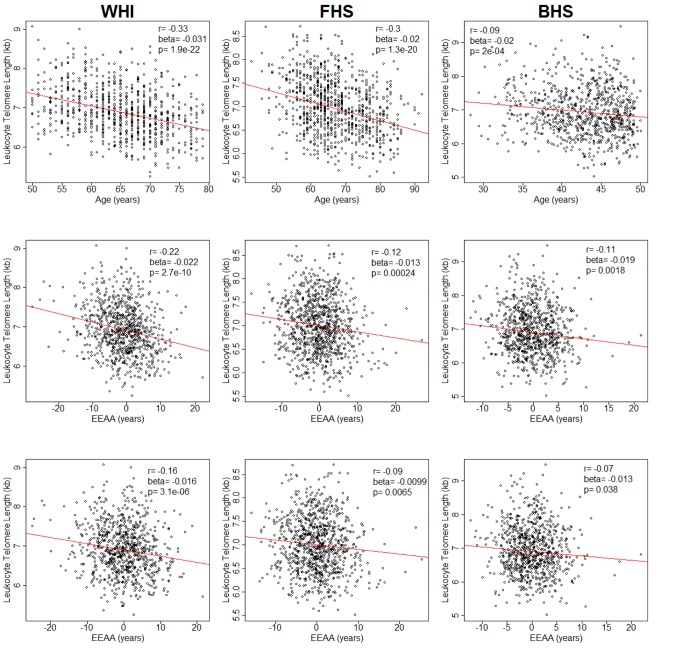
Both leukocyte telomere length (LTL) and DNA methylation age are strongly associated with chronological age. One measure of DNA methylation age─ the extrinsic epigenetic age acceleration (EEAA)─ is highly predictive of all-cause mortality. We examined the relation between LTL and EEAA. LTL was measured by Southern blots and leukocyte DNA methylation was determined using Illumina Infinium HumanMethylation450 BeadChip in participants in the Women's Health Initiative (WHI; n=804), the Framingham Heart Study (FHS; n=909) and the Bogalusa Heart study (BHS; n=826). EEAA was computed using 71 DNA methylation sites, further weighted by proportions of naïve CD8 T cells, memory CD8 T cells, and plasmablasts. Shorter LTL was associated with increased EEAA in participants from the WHI (=-0.16, =3.1x10). This finding was replicated in the FHS (=-0.09, =6.5x10) and the BHS (=-0.07, =3.8x 10). LTL was also inversely related to proportions of memory CD8 T cells (=4.04x10) and positively related to proportions of naive CD8 T cells (=3.57x10). These findings suggest that for a given age, an individual whose blood contains comparatively more memory CD8 T cells and less naive CD8 T cells would display a relatively shorter LTL and an older DNA methylation age, which jointly explain the striking ability of EEAA to predict mortality.
白细胞端粒长度(LTL)和DNA甲基化年龄均与实际年龄密切相关。DNA甲基化年龄的一种衡量指标——外在表观遗传年龄加速(EEAA)——对全因死亡率具有高度预测性。我们研究了LTL与EEAA之间的关系。在女性健康倡议(WHI;n = 804)、弗雷明汉心脏研究(FHS;n = 909)和博加卢萨心脏研究(BHS;n = 826)的参与者中,通过Southern印迹法测量LTL,并使用Illumina Infinium HumanMethylation450 BeadChip测定白细胞DNA甲基化。EEAA使用71个DNA甲基化位点进行计算,并进一步根据初始CD8 T细胞、记忆性CD8 T细胞和成浆细胞的比例进行加权。在WHI的参与者中,较短的LTL与EEAA增加相关(=-0.16,=3.1x10)。这一发现在FHS(=-0.09,=6.5x10)和BHS(=-0.07,=3.8x 10)中得到了重复。LTL也与记忆性CD8 T细胞的比例呈负相关(=4.04x10),与初始CD8 T细胞的比例呈正相关(=3.57x10)。这些发现表明,对于给定年龄,血液中记忆性CD8 T细胞相对较多而初始CD8 T细胞相对较少的个体将表现出相对较短的LTL和较老的DNA甲基化年龄,这共同解释了EEAA预测死亡率的显著能力。