Division of Nuclear Medicine, Department of Biomedical Imaging and Image-guided Therapy, Medical University of Vienna, Währinger Gürtel 18-20, 1090, Vienna, Austria.
Division of Cardiovascular and Interventional Radiology, Department of Biomedical Imaging and Image-guided Therapy, Medical University of Vienna, Vienna, Austria.
Eur J Nucl Med Mol Imaging. 2018 Apr;45(4):558-566. doi: 10.1007/s00259-017-3831-0. Epub 2017 Sep 21.
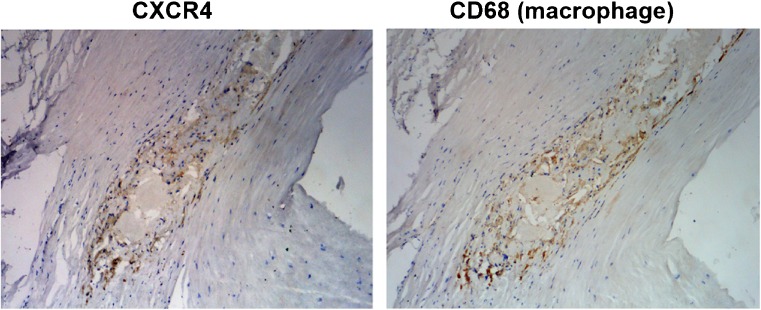
The expression of chemokine receptor type 4 (CXCR4) was found co-localized with macrophages on the atherosclerotic vessel wall and participated in the initial emigration of leukocytes. Gallium-68 [Ga]Pentixafor has recently been introduced for the imaging of atherosclerosis by targeting CXCR4. We sought to evaluate human atherosclerotic lesions using [Ga]Pentixafor PET/MRI.
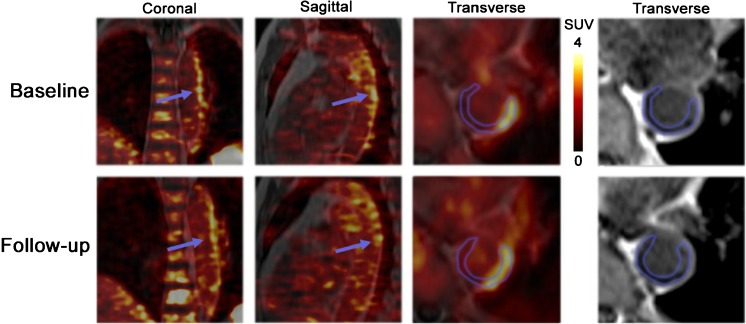
Thirty-eight oncology patients underwent [Ga]Pentixafor PET/MR imaging at baseline. Maximum standardized uptake values (SUV) were derived from hot lesions in seven arterial segments and target-to-blood ratios (TBR) were calculated. ANOVA post-hoc and paired t test were performed for statistical comparison, Spearman's correlation coefficient between uptake ratios and cardiovascular risk factors were assessed. The reproducibility of [Ga]Pentixafor PET/MRI was assessed in seven patients with a follow-up exanimation by Pearson's regression and Bland-Altman plots analysis.
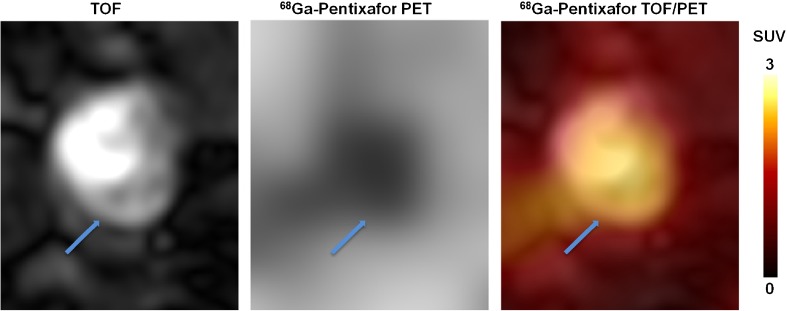
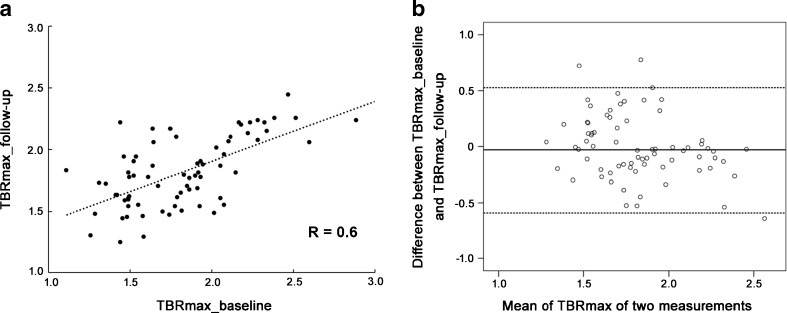
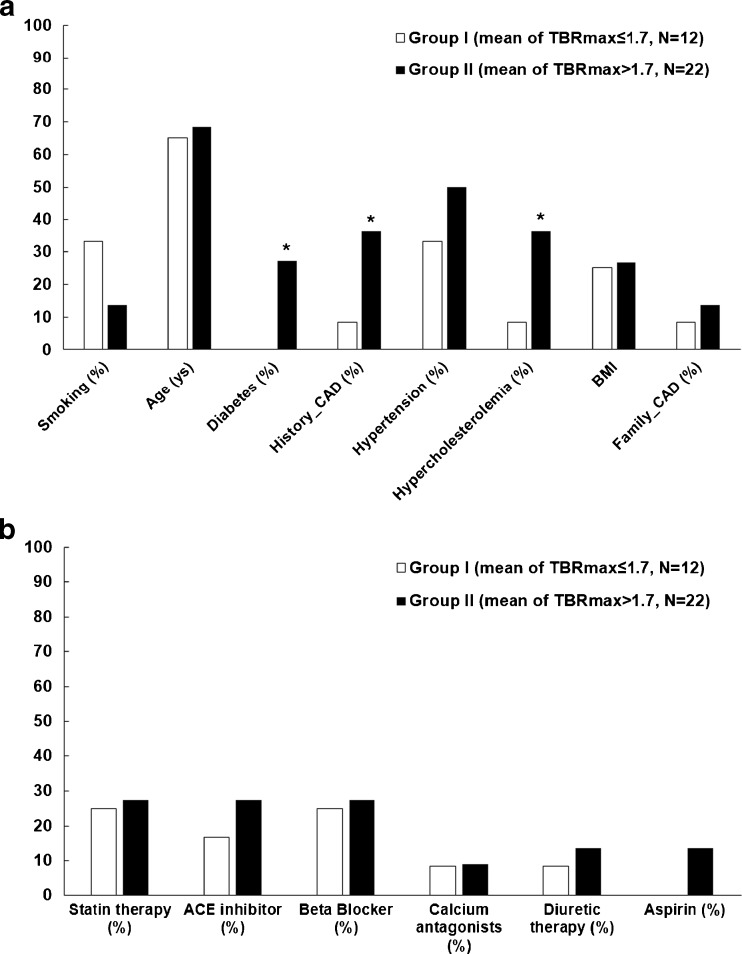
Thirty-four of 38 patients showed 611 focal [Ga]Pentixafor uptake that followed the contours of the large arteries. Both prevalence and mean TBR were highest in the descending aorta. There were significantly higher TBR values found in men (1.9 ± 0.3) as compared to women (1.7 ± 0.2; p < 0.05). Patients with mean TBR > 1.7 showed a significantly higher incidence of diabetes, hypertension hypercholesterolemia and history of cardiovascular disease than patients with mean TBR ≤ 1.7. [Ga]Pentixafor uptake showed a good reproducibility (r = 0.6, p < 0.01), and there was no difference between the mean TBR values of plaque lesions (TBR1.8 ± 0.3 vs TBR1.8 ± 0.3) (p = 0.9).
Patients with high arterial uptake showed increased incidence of cardiovascular risk factors, suggesting a potential role of [Ga]Pentixafor in characterization of atherosclerosis.
趋化因子受体 4 (CXCR4) 的表达被发现与动脉粥样硬化血管壁上的巨噬细胞共存,并参与白细胞的早期迁移。镓-68[Ga]Pentixafor 最近被引入用于通过靶向 CXCR4 来对动脉粥样硬化进行成像。我们试图使用[Ga]Pentixafor PET/MRI 评估人类动脉粥样硬化病变。
38 例肿瘤患者在基线时接受[Ga]Pentixafor PET/MR 成像。从七个动脉段的热点病变中得出最大标准化摄取值 (SUV),并计算靶血比 (TBR)。进行方差分析后检验和配对 t 检验进行统计比较,评估摄取率与心血管危险因素之间的 Spearman 相关系数。对 7 例患者进行了后续检查,采用 Pearson 回归和 Bland-Altman 图分析评估[Ga]Pentixafor PET/MRI 的可重复性。
38 例患者中有 34 例显示 611 个局灶性[Ga]Pentixafor 摄取,这些摄取与大动脉的轮廓一致。降主动脉的患病率和平均 TBR 最高。男性的 TBR 值明显高于女性(1.9±0.3 比 1.7±0.2;p<0.05)。TBR 值>1.7 的患者与 TBR 值≤1.7 的患者相比,糖尿病、高血压、高胆固醇血症和心血管疾病史的发生率明显更高。[Ga]Pentixafor 摄取具有良好的可重复性(r=0.6,p<0.01),斑块病变的平均 TBR 值之间无差异(TBR1.8±0.3 比 TBR1.8±0.3)(p=0.9)。
动脉摄取率高的患者心血管危险因素的发生率增加,表明[Ga]Pentixafor 在动脉粥样硬化特征描述中可能具有潜在作用。