Department of Health Management, Evaluation and Policy, School of Public Health, University of Montreal, Montréal, QC, Canada.
Institute of Public Health Research of University of Montreal (IRSPUM), Montréal, QC, Canada.
Int J Health Policy Manag. 2017 Sep 1;6(9):509-518. doi: 10.15171/ijhpm.2017.11.
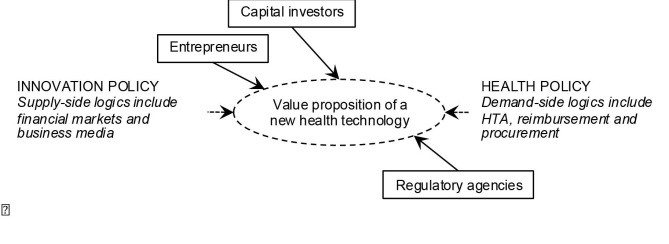
New technologies constitute an important cost-driver in healthcare, but the dynamics that lead to their emergence remains poorly understood from a health policy standpoint. The goal of this paper is to clarify how entrepreneurs, investors, and regulatory agencies influence the value of emerging health technologies.
Our 5-year qualitative research program examined the processes through which new health technologies were envisioned, financed, developed and commercialized by entrepreneurial clinical teams operating in Quebec's (Canada) publicly funded healthcare system.
Entrepreneurs have a direct influence over a new technology's value proposition, but investors actively transform this value. Investors support a technology that can find a market, no matter its intrinsic value for clinical practice or healthcare systems. Regulatory agencies reinforce the "double" value of a new technology-as a health intervention and as an economic commodity-and provide economic worth to the venture that is bringing the technology to market.
Policy-oriented initiatives such as early health technology assessment (HTA) and coverage with evidence may provide technology developers with useful input regarding the decisions they make at an early stage. But to foster technologies that bring more value to healthcare systems, policy-makers must actively support the consideration of health policy issues in innovation policy.
新技术是医疗保健的重要成本驱动因素,但从卫生政策角度来看,其出现的动态机制仍了解甚少。本文的目的是阐明企业家、投资者和监管机构如何影响新兴医疗技术的价值。
我们为期 5 年的定性研究计划研究了在魁北克(加拿大)公共资助的医疗保健系统中运作的创业临床团队如何设想、为新的医疗技术提供资金、开发和商业化的过程。
企业家对新技术的价值主张有直接影响,但投资者积极改变这种价值。投资者支持一种能够找到市场的技术,无论其对临床实践或医疗保健系统的内在价值如何。监管机构加强了新技术的“双重”价值——既是一种健康干预措施,也是一种经济商品,并为将技术推向市场的风险投资提供经济价值。
面向政策的举措,如早期卫生技术评估(HTA)和有证据的覆盖范围,可能为技术开发人员提供在早期阶段做出决策时有用的投入。但是,为了促进为医疗保健系统带来更多价值的技术,政策制定者必须积极支持在创新政策中考虑卫生政策问题。