Lin Cheng-Kuan, Hung Huei-Yang, Christiani David C, Forastiere Francesco, Lin Ro-Ting
Department of Environmental Health, Harvard T.H. Chan School of Public Health, 665 Huntington Avenue, Building 1, Room 1401, Boston, MA, 02115, USA.
Department of General Medicine, Kaohsiung Medical University Hospital, No. 100, Tzyou 1st Road, Kaohsiung, 807, Taiwan.
Environ Health. 2017 Sep 26;16(1):101. doi: 10.1186/s12940-017-0309-2.
Lung cancer, as the leading cause of cancer mortality worldwide, has been linked to environmental factors, such as air pollution. Residential exposure to petrochemicals is considered a possible cause of lung cancer for the nearby population, but results are inconsistent across previous studies. Therefore, we performed a meta-analysis to estimate the pooled risk and to identify possible factors leading to the heterogeneity among studies.
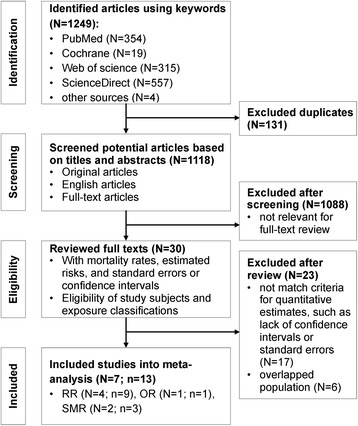
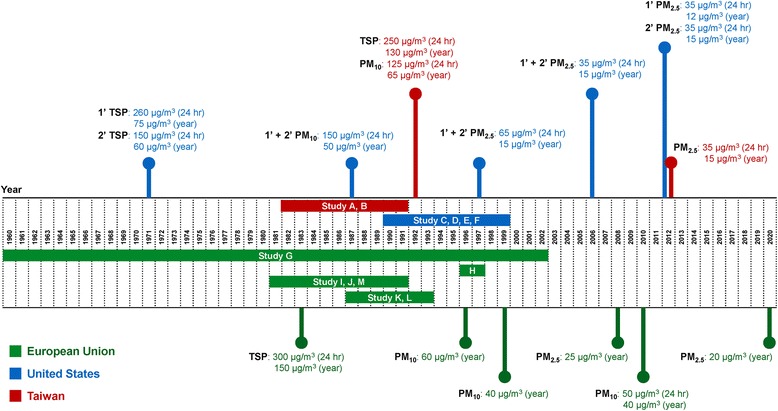
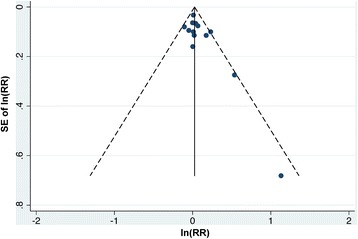
The standard process of selecting studies followed the Cochrane meta-analysis guideline of identification, screening, eligibility, and inclusion. We assessed the quality of selected studies using the Newcastle-Ottawa scale. Reported point estimates and 95% confidence intervals were extracted or calculated to estimate the pooled risk. Air quality standards were summarized and treated as a surrogate of exposure to air pollution in the studied countries. Funnel plots, Begg's test and Egger's test were conducted to diagnose publication bias. Meta-regressions were performed to identify explanatory variables of heterogeneity across studies.
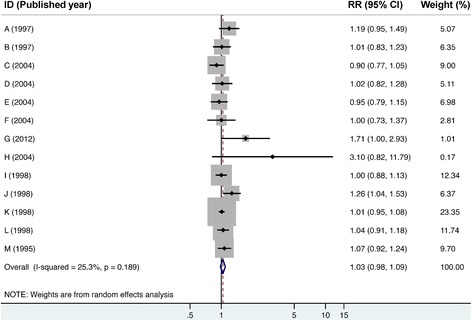
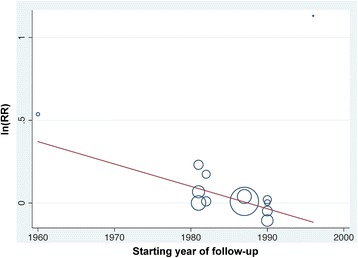
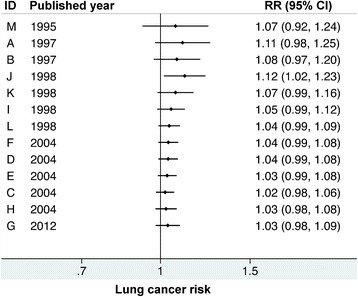
A total of 2,017,365 people living nearby petrochemical industrial complexes (PICs) from 13 independent studied population were included in the analysis. The pooled risk of lung cancer mortality for residents living nearby PICs was 1.03-fold higher than people living in non-PIC areas (95% CI = 0.98-1.09), with a low heterogeneity among studies (I = 25.3%). Such effect was stronger by a factor of 12.6% for the year of follow-up started 1 year earlier (p-value = 0.034).
Our meta-analysis gathering current evidence suggests only a slightly higher risk of lung cancer mortality among residents living nearby PICs, albeit such association didn't receive statistically significance. Reasons for higher risks of early residential exposure to PICs might be attributable to the lack of or less stringent air pollution regulations.
肺癌是全球癌症死亡的主要原因,与空气污染等环境因素有关。居住在石化设施附近被认为可能是附近人群患肺癌的一个原因,但以往研究结果并不一致。因此,我们进行了一项荟萃分析,以估计合并风险,并确定导致研究间异质性的可能因素。
选择研究的标准过程遵循Cochrane荟萃分析的识别、筛选、合格性和纳入指南。我们使用纽卡斯尔-渥太华量表评估所选研究的质量。提取或计算报告的点估计值和95%置信区间以估计合并风险。总结空气质量标准并将其作为所研究国家空气污染暴露的替代指标。进行漏斗图、Begg检验和Egger检验以诊断发表偏倚。进行荟萃回归以识别研究间异质性的解释变量。
分析纳入了来自13个独立研究人群的总共2,017,365名居住在石化工业园区(PICs)附近的人。居住在PICs附近居民的肺癌死亡合并风险比居住在非PICs地区的人高1.03倍(95%CI = 0.98 - 1.09),研究间异质性较低(I² = 25.3%)。随访开始时间早1年,这种效应增强了12.6%(p值 = 0.034)。
我们收集当前证据的荟萃分析表明,居住在PICs附近的居民肺癌死亡风险仅略高,尽管这种关联没有统计学意义。早期居住在PICs附近风险较高的原因可能归因于空气污染法规的缺乏或不严格。