School of Chemical & Biomolecular Engineering, Georgia Institute of Technology, Atlanta, GA, USA.
Lab Chip. 2017 Oct 25;17(21):3634-3642. doi: 10.1039/c7lc00763a.
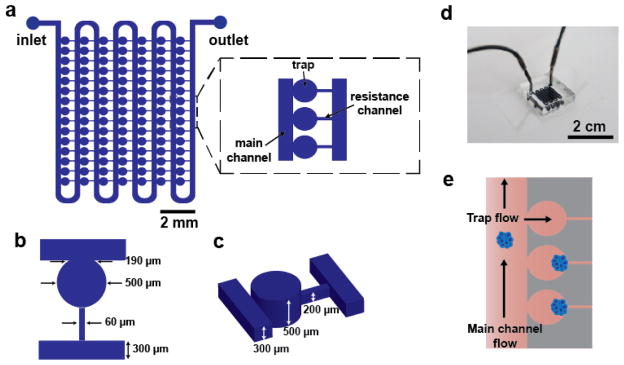
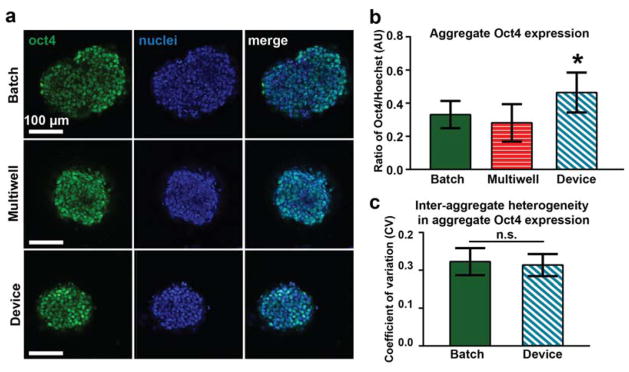
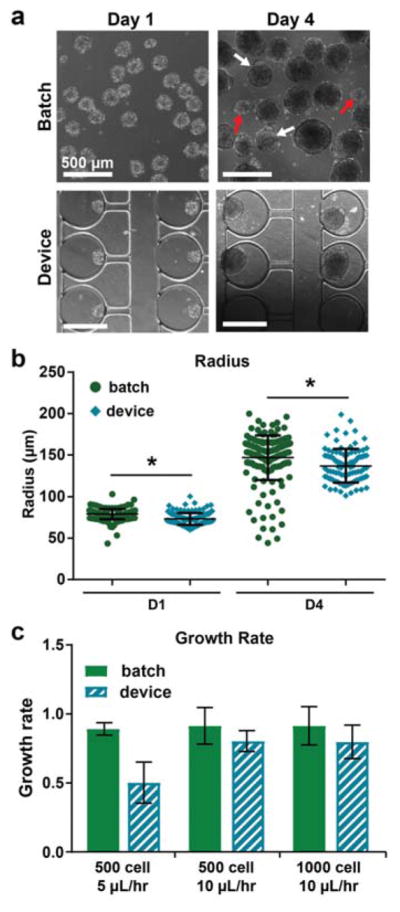
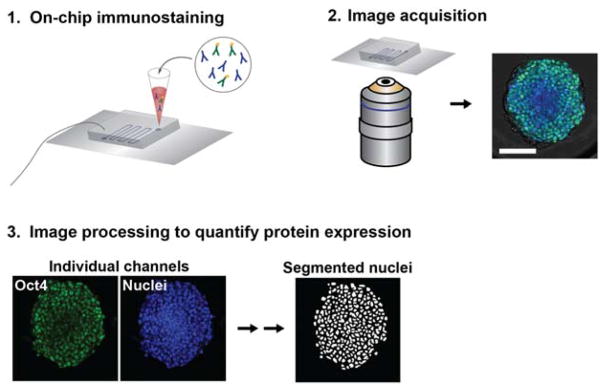
Three-dimensional pluripotent stem cell (PSC) cultures have the ability to undergo differentiation, self-organization, and morphogenesis to yield complex, in vitro tissue models that recapitulate key elements of native tissues. These tissue models offer a system for studying mechanisms of tissue development, investigating disease mechanisms, and performing drug screening. It remains challenging, however, to standardize PSC aggregate differentiation and morphogenesis methods due to heterogeneity stemming from biological and environmental sources. It is also difficult to monitor and assess large numbers of individual samples longitudinally throughout culture using typical batch-based culture methods. To address these challenges, we have developed a microfluidic platform for culture, longitudinal monitoring, and phenotypic analysis of individual stem cell aggregates. This platform uses a hydrodynamic loading principle to capture pre-formed stem cell aggregates in independent traps. We demonstrated that multi-day culture of aggregates in this platform reduces heterogeneity in phenotypic parameters such as size and morphology. Additionally, we showed that culture and analysis steps can be performed sequentially in the same platform, enabling correlation of multiple modes of analysis for individual samples. We anticipate this platform being applied to improve abilities for phenotypic analysis of PSC aggregate tissues and to facilitate research in standardizing culture systems in order to dually increase the yield and reduce the heterogeneity of PSC-derived tissues.
三维多能干细胞(PSC)培养物具有分化、自我组织和形态发生的能力,可产生复杂的体外组织模型,重现天然组织的关键元素。这些组织模型为研究组织发育机制、研究疾病机制和进行药物筛选提供了系统。然而,由于源自生物和环境来源的异质性,标准化 PSC 聚集物分化和形态发生方法仍然具有挑战性。使用典型的批处理培养方法,也很难对大量个体样本进行长期纵向监测和评估。为了解决这些挑战,我们开发了一种用于培养、个体干细胞聚集体的长期监测和表型分析的微流控平台。该平台使用流体动力学加载原理将预先形成的干细胞聚集体捕获在独立的陷阱中。我们证明,在该平台中对聚集体进行多日培养可降低表型参数(如大小和形态)的异质性。此外,我们表明可以在同一平台中顺序进行培养和分析步骤,从而能够对单个样本的多种分析模式进行关联。我们预计该平台将应用于改善 PSC 聚集体组织的表型分析能力,并促进标准化培养系统的研究,以双重提高 PSC 衍生组织的产量并降低其异质性。