Center for Integrative Conservation, Xishuangbanna Tropical Botanical Garden, Chinese Academy of Sciences, Mengla, China.
Southeast Asia Biodiversity Research Institute, Chinese Academy of Sciences, Yezin, Nay Pyi Taw, Myanmar.
Genome Biol Evol. 2017 Sep 1;9(9):2354-2364. doi: 10.1093/gbe/evx180.
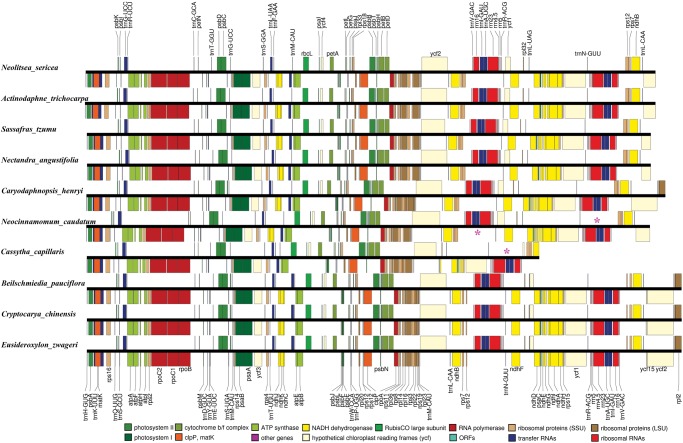
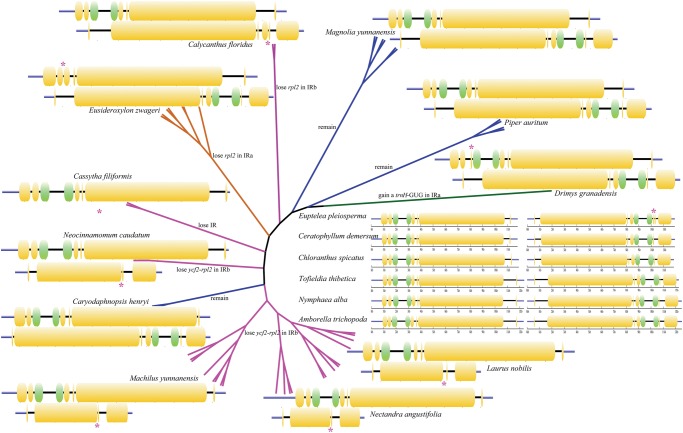
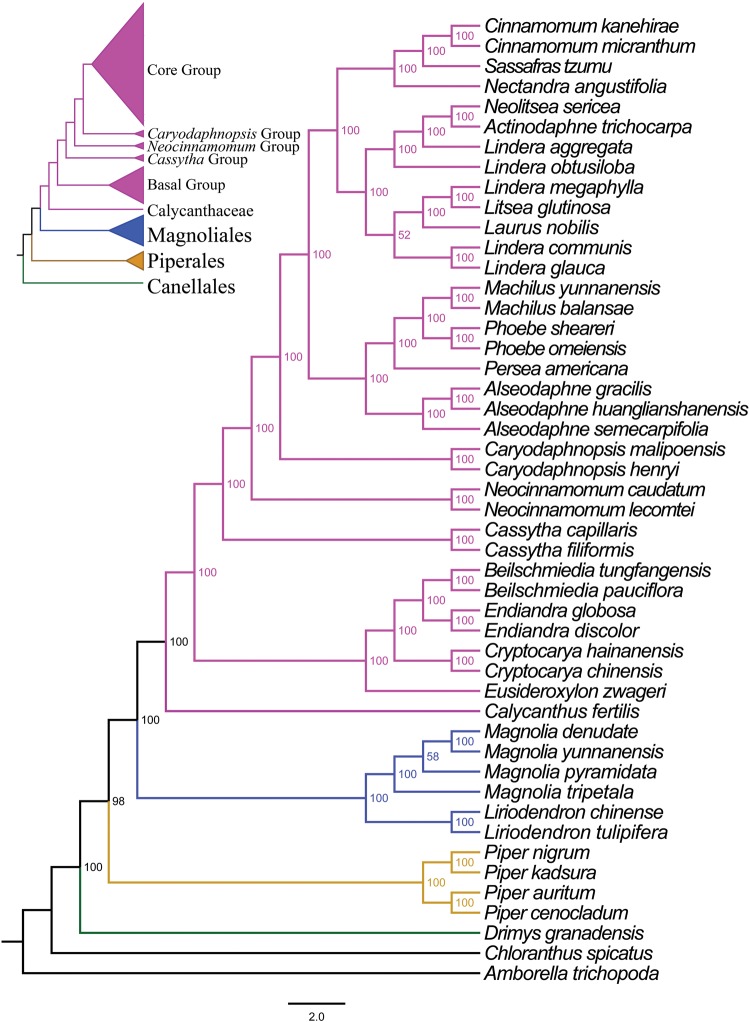
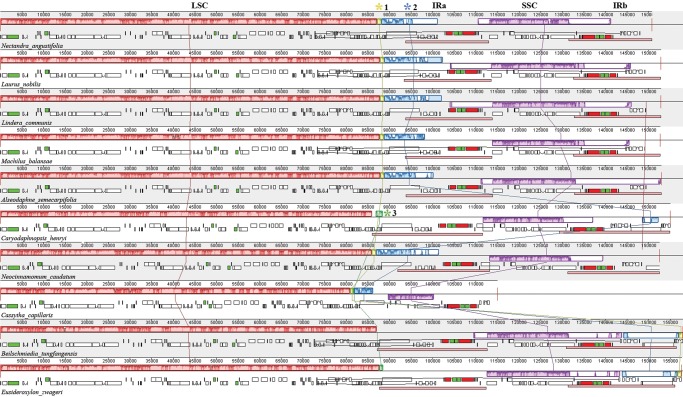
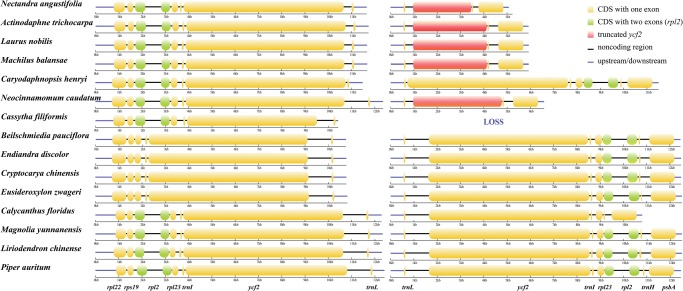
Available plastomes of the Lauraceae show similar structure and varied size, but there has been no systematic comparison across the family. In order to understand the variation in plastome size and structure in the Lauraceae and related families of magnoliids, we here compare 47 plastomes, 15 newly sequenced, from 27 representative genera. We reveal that the two shortest plastomes are in the parasitic Lauraceae genus Cassytha, with lengths of 114,623 (C. filiformis) and 114,963 bp (C. capillaris), and that they have lost NADH dehydrogenase (ndh) genes in the large single-copy region and one entire copy of the inverted repeat (IR) region. The plastomes of the core Lauraceae group, with lengths from 150,749 bp (Nectandra angustifolia) to 152,739 bp (Actinodaphne trichocarpa), have lost trnI-CAU, rpl23, rpl2, a fragment of ycf2, and their intergenic regions in IRb region, whereas the plastomes of the basal Lauraceae group, with lengths from 157,577 bp (Eusideroxylon zwageri) to 158,530 bp (Beilschmiedia tungfangensis), have lost rpl2 in IRa region. The plastomes of Calycanthus (Calycanthaceae, Laurales) have lost rpl2 in IRb region, but the plastome of Caryodaphnopsis henryi (Lauraceae) remain intact, as do those of the nonLaurales magnoliid genera Piper, Liriodendron, and Magnolia. On the basis of our phylogenetic analysis and structural comparisons, different loss events occurred in different lineages of the Laurales, and fragment loss events in the IR regions have largely driven the contraction of the plastome in the Lauraceae. These results provide new insights into the evolution of the Lauraceae as well as the magnoliids as a whole.
已有的樟科植物质体基因组图谱结构相似,大小却各不相同,但尚未对整个樟科植物进行系统比较。为了了解樟科植物及与其亲缘关系较近的木兰类植物科的质体基因组大小和结构的变化,我们对 27 个代表性属的 47 个质体基因组图谱进行了比较,其中 15 个为新测序的图谱。结果表明,两个最短的质体基因组属于寄生性樟科植物属Cassytha,长度分别为 114623bp(C. filiformis)和 114963bp(C. capillaris),并且在大片段单拷贝区和整个反向重复区(IR)中丢失了 NADH 脱氢酶(ndh)基因。核心樟科植物组的质体基因组长度从 150749bp(Nectandra angustifolia)到 152739bp(Actinodaphne trichocarpa)不等,丢失了 trnI-CAU、rpl23、rpl2、ycf2 的一个片段及其 IRb 区的基因间区,而基部樟科植物组的质体基因组长度从 157577bp(Eusideroxylon zwageri)到 158530bp(Beilschmiedia tungfangensis)不等,在 IRa 区丢失了 rpl2。夏蜡梅科(Calycanthaceae,樟目)的质体基因组在 IRb 区丢失了 rpl2,而樟科植物 Caryodaphnopsis henryi 的质体基因组保持完整,非樟目木兰类植物胡椒属、鹅掌楸属和木兰属的质体基因组也是如此。基于我们的系统发育分析和结构比较,不同的缺失事件发生在樟目植物的不同谱系中,而 IR 区的片段缺失事件在很大程度上导致了樟科植物质体的收缩。这些结果为樟科植物以及整个木兰类植物的进化提供了新的见解。