Fernandes Fábio H, da R Guterres Zaira, Violante Ivana M P, Lopes Tiago F S, Garcez Walmir S, Garcez Fernanda R
Instituto de Química, Universidade Federal de Mato Grosso do Sul, Av. Senador Filinto Muller 1555, Campo Grande, MS 79074-460, Brazil.
Universidade Estadual de Mato Grosso do Sul, Unidade Universitária de Mundo Novo, BR163, km 202, Mundo Novo, MS 79980-000, Brazil.
Toxicol Rep. 2015 Dec 1;2:1482-1488. doi: 10.1016/j.toxrep.2015.11.007. eCollection 2015.
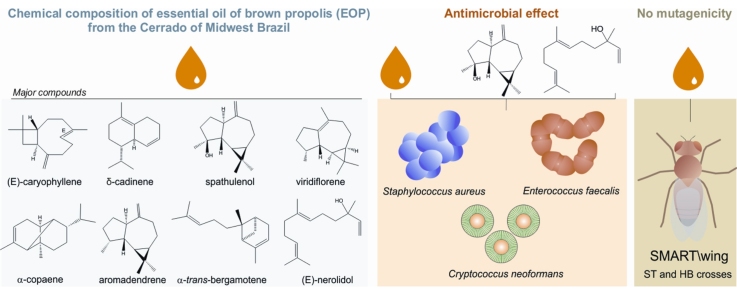
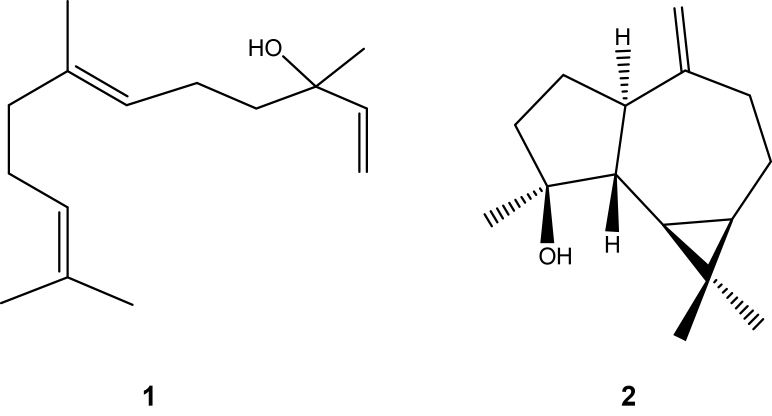
Biological, and particularly antimicrobial, activities have been demonstrated for the essential oil of propolis samples worlwide, yet their mutagenic effects remain unknown. To correlate antimicrobial effects with mutagenic risks, the present study evaluated the antifungal and antibacterial activities of the essential oil obtained from brown propolis collected from the Cerrado biome in Midwest Brazil (EOP), testing it against nine pathogenic microorganisms. Evaluation of mutagenic potential was based on the somatic mutation and recombination test (SMART) performed on wing cells of standard (ST) and high-bioactivation (HB) crosses of . EOP was extracted by hydrodistillation, and sesquiterpenes were characterized by GC⿿MS as its major constituents. The crude oil proved active against and , as did two of its major constituents, spathulenol and ()-nerolidol ⿿ the latter being also active against ⿿ isolated using chromatographic procedures. No significant increase in the number of somatic mutations was observed in the offspring of ST or HB crosses ⿿ the latter exhibiting enhanced levels of metabolizing enzymes of the cytochrome P450 type ⿿ treated with 0.05%, 0.1%, and 0.2% EOP. These findings revealed no mutagenic activity of EOP, even when tested against the HB strain, and demonstrated that its antimicrobial activities are not associated with DNA damage induction (investigated with SMART), suggesting the potential of EOP as a natural preservative.
世界各地的蜂胶样品精油已显示出生物活性,尤其是抗菌活性,但其诱变作用仍不清楚。为了将抗菌作用与诱变风险相关联,本研究评估了从巴西中西部塞拉多生物群落采集的棕色蜂胶中提取的精油(EOP)的抗真菌和抗菌活性,并对9种致病微生物进行了测试。基于对标准(ST)和高生物活化(HB)杂交品系翅细胞进行的体细胞突变和重组试验(SMART)来评估诱变潜力。EOP通过水蒸馏法提取,其主要成分通过气相色谱-质谱联用(GC-MS)鉴定为倍半萜类。原油对[具体微生物1]和[具体微生物2]具有活性,其两种主要成分spathulenol和()-nerolidol也具有活性,后者对通过色谱法分离得到的[具体微生物3]也有活性。在用0.05%、0.1%和0.2%的EOP处理的ST或HB杂交后代中,未观察到体细胞突变数量的显著增加,后者表现出细胞色素P450类型代谢酶水平的提高。这些发现表明EOP没有诱变活性,即使对HB菌株进行测试也是如此,并证明其抗菌活性与DNA损伤诱导无关(通过SMART研究),这表明EOP作为天然防腐剂具有潜力。