Bhuva Dimel K, Vachhani Jitendra H
Department of Immunohaematology and Blood Transfusion, M. P. Shah Government Medical College, Jamnagar, Gujarat, India.
Asian J Transfus Sci. 2017 Jul-Dec;11(2):115-120. doi: 10.4103/0973-6247.214347.
Repeated blood transfusions can result in the production of alloantibodies against one or more red cell antigens, which complicates subsequent transfusions. Aims: The study was done to find incidence of various red cell alloantibodies; to determine the type of alloantibody; to identify the factors such as frequency of transfusion, splenectomy status, donor ethnicity and gender and their association with the development of antibody in repeatedly transfused patients.
This study was carried out in Dept. of IHBT, Shree M. P. Shah Medical College, Jamnagar, Gujarat. Blood was taken from the patients of thalassemia major, sickle cell disease, chronic renal failure, post partum haemorrhage, aplastic anemia, Myelodysplastic syndrome with more than 10 red cell transfusions. The plasma/serum was used for antibody screening and antibody identification test. Three cell antibody screening was performed using antihuman globulin gel cards (ID-Card LISS/Coombs) and three cell panel (ID-DiaCell I, II, III-Asia). Those with positive antibody screening were analyzed further for antibody identification test using eleven cell panel (Set ID-Dia Panel).
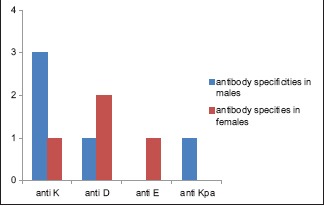
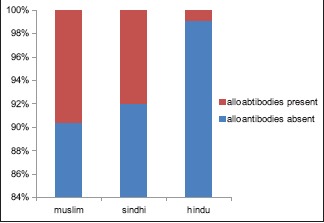
Antibody screening and identification was done in 2 consecutive set of samples ( = 300) which showed, nine (9) patients (3%) were alloimmunized. All repeatedly transfused patients had developed alloantibody before the starting of study period, no patient developed new alloantibody during study period.
Alloantibodies should be identified in repeatedly transfused patients and should be given corresponding antigen negative blood unit which will minimize the antibody mediated destruction of transfused red cells.
反复输血可导致产生针对一种或多种红细胞抗原的同种抗体,这会使后续输血变得复杂。目的:本研究旨在找出各种红细胞同种抗体的发生率;确定同种抗体的类型;识别诸如输血频率、脾切除状态、供者种族和性别等因素及其与反复输血患者抗体产生的关联。
本研究在古吉拉特邦贾姆讷格尔市什里·M·P·沙阿医学院免疫血液学与输血学系开展。采集重型地中海贫血、镰状细胞病、慢性肾衰竭、产后出血、再生障碍性贫血、骨髓增生异常综合征且接受过10次以上红细胞输血的患者的血液。血浆/血清用于抗体筛查和抗体鉴定试验。使用抗人球蛋白凝胶卡(ID卡LISS/抗人球蛋白)和三细胞板(ID-DiaCell I、II、III-亚洲版)进行三细胞抗体筛查。抗体筛查呈阳性的患者进一步使用十一细胞板(Set ID-Dia Panel)进行抗体鉴定试验分析。
对连续两组样本(n = 300)进行了抗体筛查和鉴定,结果显示,9名(3%)患者发生了同种免疫。所有反复输血的患者在研究期开始前就已产生同种抗体,研究期间无患者产生新的同种抗体。
应在反复输血的患者中鉴定同种抗体,并应给予相应的抗原阴性血液单位,这将使抗体介导的输入红细胞破坏降至最低。