Floud S, Barnes I, Verfürden M, Kuper H, Gathani T, Blanks R G, Alison R, Patnick J, Beral V, Green J, Reeves G K
Cancer Epidemiology Unit, Nuffield Department of Population Health, University of Oxford, Roosevelt Drive, Oxford OX3 7LF, UK.
UCL Great Ormond Street Institute of Child Health, 30 Guilford Street, London WC1N 1EH, UK.
Br J Cancer. 2017 Nov 21;117(11):1711-1714. doi: 10.1038/bjc.2017.331. Epub 2017 Oct 3.
There is limited information about participation in organised population-wide screening programmes by people with disabilities.
Data from the National Health Service routine screening programmes in England were linked to information on disability reported by the Million Women Study cohort participants.
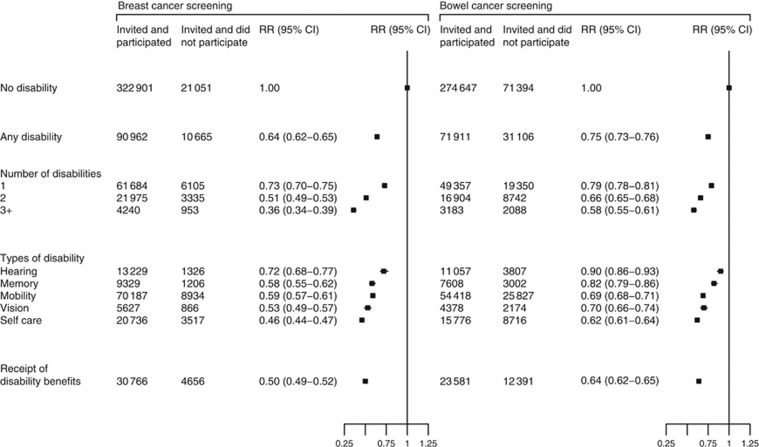
Of the 473 185 women offered routine breast or bowel cancer screening, 23% reported some disability. Women with disabilities were less likely than other women to participate in breast cancer screening (RR=0.64, 95% CI: 0.62-0.65) and in bowel cancer screening (RR=0.75, 0.73-0.76). Difficulties with self-care or vision were associated with the greatest reduction in screening participation.
Participation in routine cancer screening programmes in England is reduced in people with disabilities and participation varies by type of disability.
关于残疾人参与全人群组织的筛查项目的信息有限。
将来自英国国家医疗服务体系常规筛查项目的数据与百万女性研究队列参与者报告的残疾信息相联系。
在473185名接受常规乳腺癌或肠癌筛查的女性中,23%报告有某种残疾。残疾女性比其他女性参与乳腺癌筛查的可能性更低(相对风险=0.64,95%置信区间:0.62-0.65),参与肠癌筛查的可能性也更低(相对风险=0.75,0.73-0.76)。自我护理或视力方面的困难与筛查参与率下降幅度最大有关。
英国残疾人参与常规癌症筛查项目的比例降低,且参与率因残疾类型而异。