Sakr Hany I, Chute Deborah J, Nasr Christian, Sturgis Charles D
Cleveland Clinic, Department of Pathology and Laboratory Medicine, 9500 Euclid Avenue, L25, Cleveland, OH, 44195, USA.
Cleveland Clinic, Department of Endocrinology, Diabetes and Metabolism, Cleveland, USA.
Diagn Pathol. 2017 Oct 3;12(1):71. doi: 10.1186/s13000-017-0661-0.
cMYC regulates approximately 15% of human genes and is involved in up to 20% of all human cancers. Reports discussing cMYC protein expression in thyroid carcinomas are limited, with controversies pertaining to cMYC expression patterns noted in the literature. The aims of the current study were to clarify patterns and intensities of cMYC expression in follicular cell-derived thyroid carcinomas across a spectrum of cancer morphologies and disease aggressivities, to correlate cMYC with BRAF expression, and to evaluate the potential role of cMYC in progression of well-differentiated thyroid carcinomas into less well-differentiated carcinomas.
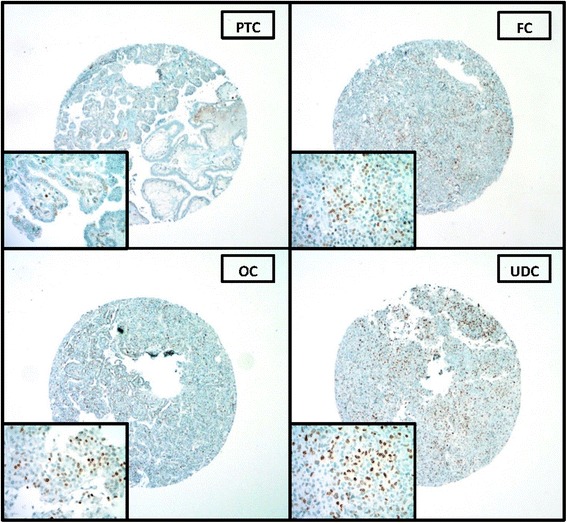
Immunohistochemical studies using specific monoclonal antibodies for cMYC and BRAF were performed on tissue microarrays built from follicular cell-derived thyroid carcinomas (25 papillary, 24 follicular, 24 oncocytic variant of follicular, and 21 undifferentiated). In addition, cMYC IHC testing was also performed on whole tissue tumor sections from a subset of patients. Nodular hyperplasia cases were used as non-neoplastic controls. Appropriate positive and negative controls were included.
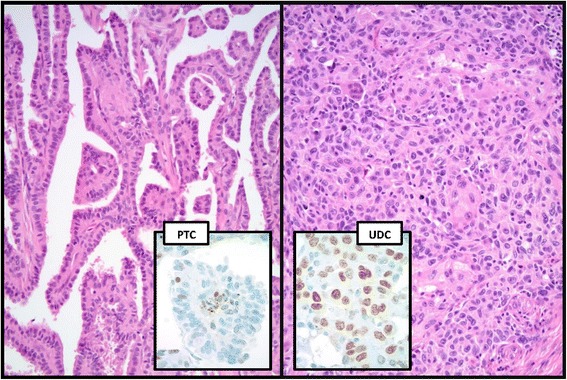
cMYC was expressed almost exclusively in a nuclear fashion in both thyroid carcinomas and nodular hyperplasias. cMYC expression was weakly positive in both nodular hyperplasias and well-differentiated carcinomas. The majority of undifferentiated carcinomas (UDCs) showed strong nuclear cMYC positivity. PTC cases that were positive for cMYC (6/25) harbored the BRAF mutation. A correlation was confirmed between cMYC intensity and tumor size in UDCs. UDC cases that developed out of well-differentiated thyroid carcinomas showed frank overexpression of cMYC in the undifferentiated tumor components.
Our study suggests that nuclear overexpression of cMYC correlates with tumorigenesis / dedifferentiation in follicular cell derived thyroid carcinomas, a concept that has not been shown before on whole tissue sections.
cMYC调控约15%的人类基因,与高达20%的人类癌症相关。关于甲状腺癌中cMYC蛋白表达的报道有限,文献中对cMYC表达模式存在争议。本研究的目的是明确不同癌症形态和疾病侵袭性的滤泡细胞源性甲状腺癌中cMYC表达的模式和强度,将cMYC与BRAF表达相关联,并评估cMYC在高分化甲状腺癌向低分化癌进展中的潜在作用。
使用针对cMYC和BRAF的特异性单克隆抗体对由滤泡细胞源性甲状腺癌构建的组织芯片进行免疫组织化学研究(25例乳头状癌、24例滤泡状癌、24例滤泡状嗜酸细胞变体癌和21例未分化癌)。此外,还对部分患者的全组织肿瘤切片进行了cMYC免疫组化检测。结节性增生病例用作非肿瘤对照。纳入了适当的阳性和阴性对照。
cMYC在甲状腺癌和结节性增生中几乎均以核表达为主。cMYC在结节性增生和高分化癌中均呈弱阳性。大多数未分化癌(UDC)显示核cMYC强阳性。cMYC阳性的PTC病例(6/25)携带BRAF突变。UDC中cMYC强度与肿瘤大小之间存在相关性。由高分化甲状腺癌发展而来的UDC病例在未分化肿瘤成分中显示cMYC明显过表达。
我们的研究表明,cMYC的核过表达与滤泡细胞源性甲状腺癌的肿瘤发生/去分化相关,这一概念在全组织切片上此前尚未得到证实。