Sotgia Federica, Lisanti Michael P
Translational Medicine, School of Environment & Life Sciences, Biomedical Research Centre, University of Salford, Greater Manchester, United Kingdom.
Oncotarget. 2017 Aug 5;8(40):67117-67128. doi: 10.18632/oncotarget.19962. eCollection 2017 Sep 15.
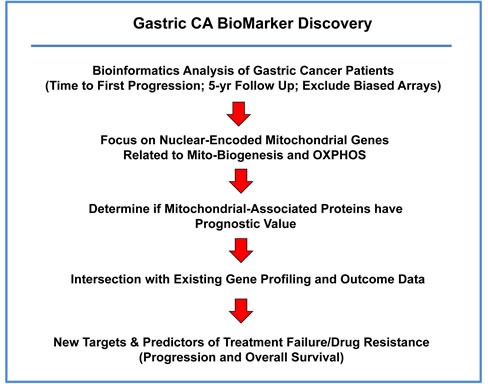
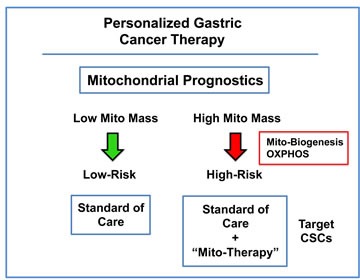
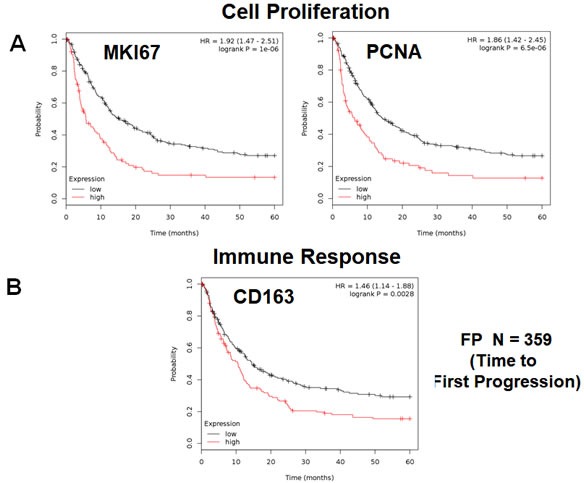
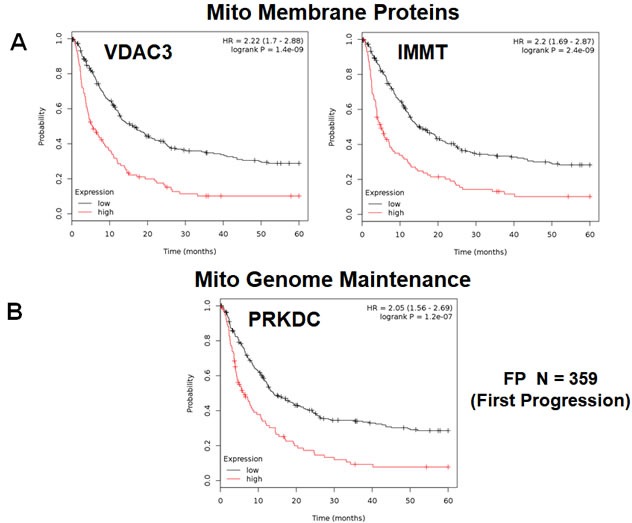
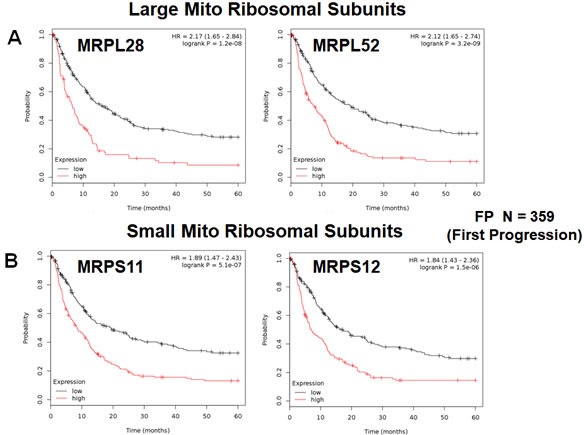
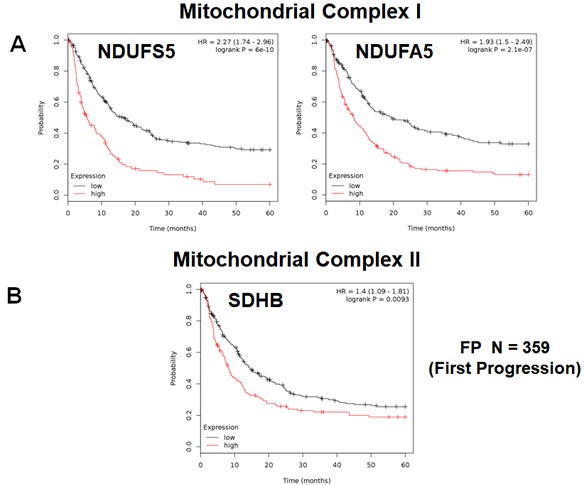
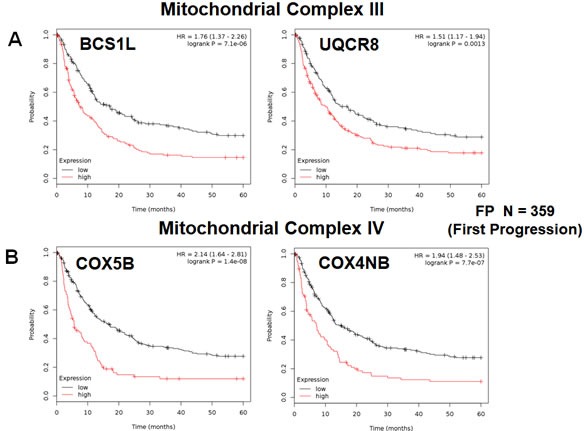
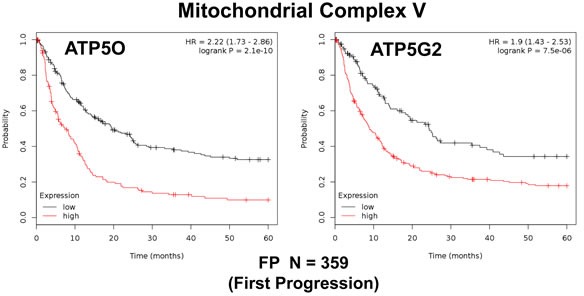
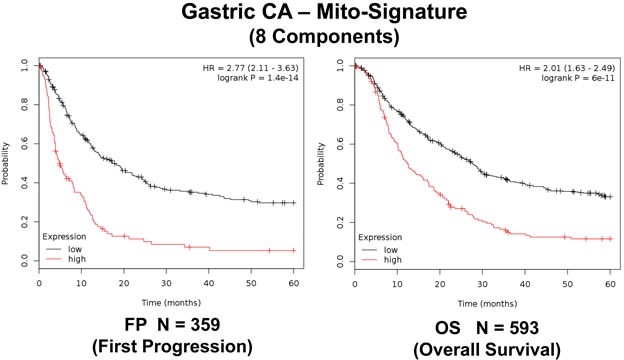
Here, we employed a bioinformatics approach to identify novel molecular determinants to predict tumor progression and overall survival in gastric cancer patients. In particular, we directly assessed whether nuclear-derived mRNA species encoding proteins involved in mitochondrial protein translation and OXPHOS are able to successfully predict clinical outcome in gastric cancer. As such, using validation, we have now established the prognostic value of these mitochondrial biomarkers, in a defined population of gastric cancer patients. In this context, we interrogated 5 year follow-up data collected from a group of N = 359 gastric cancer patients. Importantly, in this group of cancer patients, Ki67 and PCNA (conventional markers of cell proliferation) were associated with tumor progression, as might be expected. Using this simplified informatics approach, we identified ∼75 new individual mitochondrial gene probes that effectively predicted tumor progression, with hazard-ratios (HR) of up to 2.22 ( < 2.1e-10). These mitochondrial mRNA transcripts included heat shock proteins/chaperones, membrane proteins, anti-oxidants, enzymes involved in genome maintenance, as well as mitochondrial ribosomal proteins (MRPs) and numerous members of the OXPHOS complexes. In addition, we combined 8 mitochondrial protein transcripts (NDUFS5, VDAC3, ATP5O, IMMT, MRPL28, COX5B, MRPL52, PRKDC), to generate a compact gastric mitochondrial gene signature, associated with a HR of 2.77 ( = 1.4e-14). As a result of this analysis and validation, we strongly suggest that proteins involved in mitochondrial protein translation and OXPHOS should be considered as targets for new drug discovery, for the treatment of gastric cancers. The mitochondrial markers we identified here could also be used as companion diagnostics, to predict clinical outcomes, as well as the patient response to therapy. This should allow a more successful and personalized approach to gastric cancer diagnosis and therapy.
在此,我们采用生物信息学方法来识别新的分子决定因素,以预测胃癌患者的肿瘤进展和总生存期。具体而言,我们直接评估编码参与线粒体蛋白质翻译和氧化磷酸化的蛋白质的核衍生mRNA种类是否能够成功预测胃癌的临床结果。因此,通过验证,我们现已在特定的胃癌患者群体中确立了这些线粒体生物标志物的预后价值。在此背景下,我们询问了从一组N = 359例胃癌患者收集的5年随访数据。重要的是,在这组癌症患者中,正如预期的那样,Ki67和PCNA(细胞增殖的传统标志物)与肿瘤进展相关。使用这种简化的信息学方法,我们鉴定出约75个新的个体线粒体基因探针,它们能有效预测肿瘤进展,危险比(HR)高达2.22(<2.1e-10)。这些线粒体mRNA转录本包括热休克蛋白/伴侣蛋白、膜蛋白、抗氧化剂、参与基因组维持的酶,以及线粒体核糖体蛋白(MRP)和氧化磷酸化复合物的众多成员。此外,我们将8个线粒体蛋白质转录本(NDUFS5、VDAC3、ATP5O、IMMT、MRPL28、COX5B、MRPL52、PRKDC)组合在一起,生成了一个紧凑的胃癌线粒体基因特征,其HR为2.77(= 1.4e-14)。作为该分析和验证的结果,我们强烈建议将参与线粒体蛋白质翻译和氧化磷酸化的蛋白质视为发现治疗胃癌新药的靶点。我们在此鉴定出的线粒体标志物也可用作伴随诊断,以预测临床结果以及患者对治疗的反应。这将使胃癌的诊断和治疗方法更加成功和个性化。