Concha-Marambio Luis, Maldonado Paula, Lagos Rosalba, Monasterio Octavio, Montecinos-Franjola Felipe
Laboratorio de Biologia Estructural y Molecular/Departamento de Biologia/Facultad de Ciencias, Universidad de Chile, Santiago, Chile.
PLoS One. 2017 Oct 5;12(10):e0185707. doi: 10.1371/journal.pone.0185707. eCollection 2017.
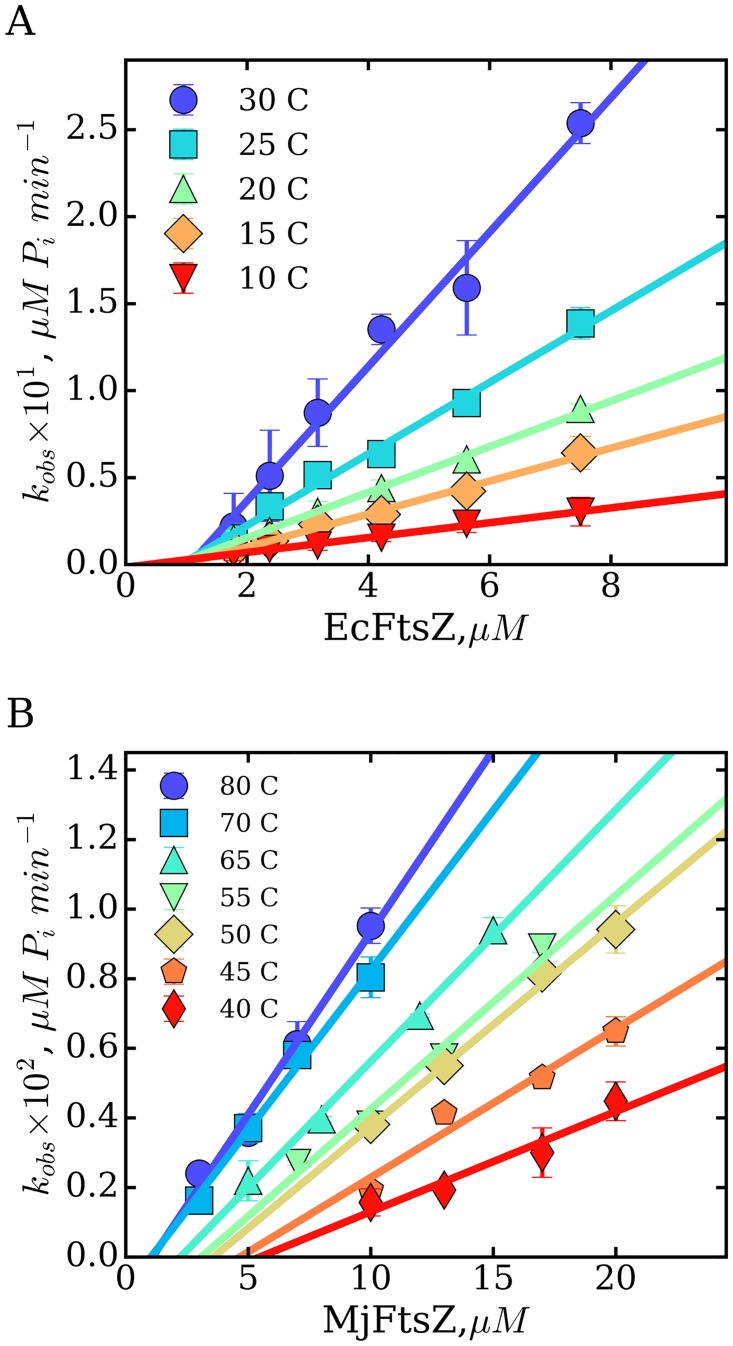
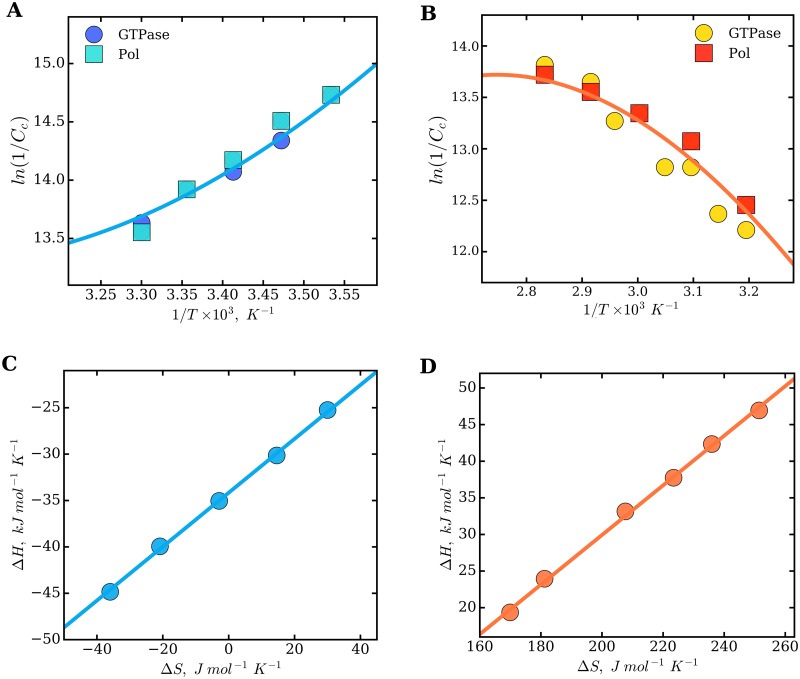
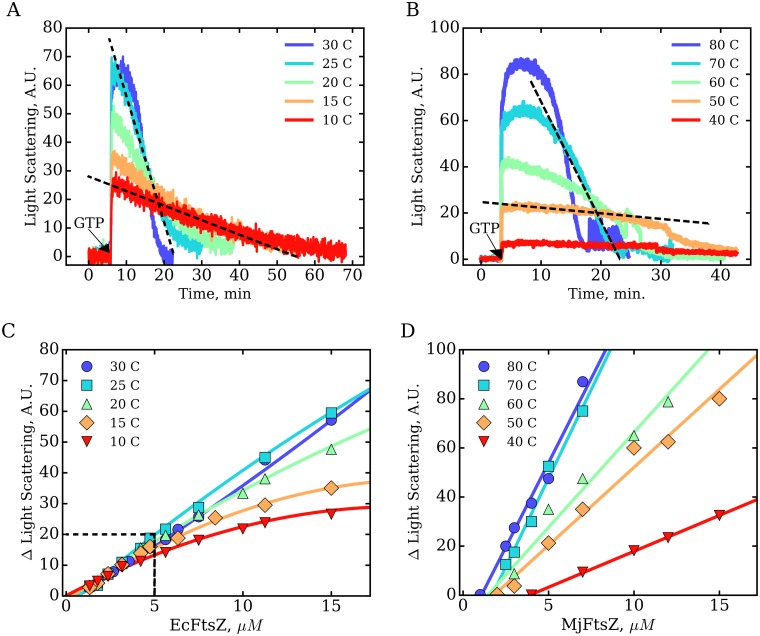
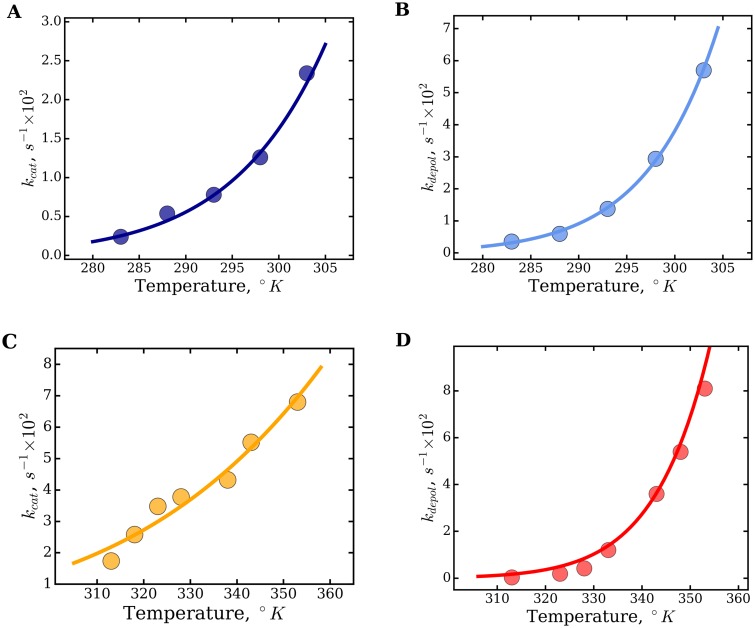
Cytokinesis is the last stage in the cell cycle. In prokaryotes, the protein FtsZ guides cell constriction by assembling into a contractile ring-shaped structure termed the Z-ring. Constriction of the Z-ring is driven by the GTPase activity of FtsZ that overcomes the energetic barrier between two protein conformations having different propensities to assemble into polymers. FtsZ is found in psychrophilic, mesophilic and thermophilic organisms thereby functioning at temperatures ranging from subzero to >100°C. To gain insight into the functional adaptations enabling assembly of FtsZ in distinct environmental conditions, we analyzed the energetics of FtsZ function from mesophilic Escherichia coli in comparison with FtsZ from thermophilic Methanocaldococcus jannaschii. Presumably, the assembly may be similarly modulated by temperature for both FtsZ orthologs. The temperature dependence of the first-order rates of nucleotide hydrolysis and of polymer disassembly, indicated an entropy-driven destabilization of the FtsZ-GTP intermediate. This destabilization was true for both mesophilic and thermophilic FtsZ, reflecting a conserved mechanism of disassembly. From the temperature dependence of the critical concentrations for polymerization, we detected a change of opposite sign in the heat capacity, that was partially explained by the specific changes in the solvent-accessible surface area between the free and polymerized states of FtsZ. At the physiological temperature, the assembly of both FtsZ orthologs was found to be driven by a small positive entropy. In contrast, the assembly occurred with a negative enthalpy for mesophilic FtsZ and with a positive enthalpy for thermophilic FtsZ. Notably, the assembly of both FtsZ orthologs is characterized by a critical concentration of similar value (1-2 μM) at the environmental temperatures of their host organisms. These findings suggest a simple but robust mechanism of adaptation of FtsZ, previously shown for eukaryotic tubulin, by adjustment of the critical concentration for polymerization.
胞质分裂是细胞周期的最后阶段。在原核生物中,FtsZ蛋白通过组装成称为Z环的收缩环状结构来引导细胞缢缩。Z环的缢缩由FtsZ的GTPase活性驱动,该活性克服了两种具有不同组装成聚合物倾向的蛋白质构象之间的能量障碍。FtsZ存在于嗜冷、嗜温和嗜热生物中,因此能在从零下到高于100°C的温度下发挥作用。为了深入了解使FtsZ在不同环境条件下进行组装的功能适应性,我们分析了嗜温大肠杆菌FtsZ与嗜热詹氏甲烷球菌FtsZ功能的能量学。据推测,两种FtsZ直系同源物的组装可能会受到温度的类似调节。核苷酸水解一级速率和聚合物解聚的温度依赖性表明,FtsZ - GTP中间体存在熵驱动的不稳定。这种不稳定对嗜温和嗜热FtsZ都成立,反映了解聚的保守机制。从聚合临界浓度的温度依赖性来看,我们检测到热容量有相反符号的变化,这部分可以通过FtsZ游离态和聚合态之间溶剂可及表面积的特定变化来解释。在生理温度下,发现两种FtsZ直系同源物的组装都由小的正熵驱动。相比之下,嗜温FtsZ的组装发生时焓变为负,嗜热FtsZ的组装发生时焓变为正。值得注意的是,在其宿主生物的环境温度下,两种FtsZ直系同源物的组装都具有相似值(1 - 2μM)的临界浓度。这些发现表明,FtsZ存在一种简单而稳健的适应机制,此前已在真核微管蛋白中得到证明,即通过调节聚合临界浓度来实现。