Beiwinkel Till, Hey Stefan, Bock Olaf, Rössler Wulf
Faculty of Business and Economics, Leuphana University of Lüneburg, Lüneburg, Germany.
Movisens GmbH, Karlsruhe, Germany.
Front Public Health. 2017 Sep 21;5:249. doi: 10.3389/fpubh.2017.00249. eCollection 2017.
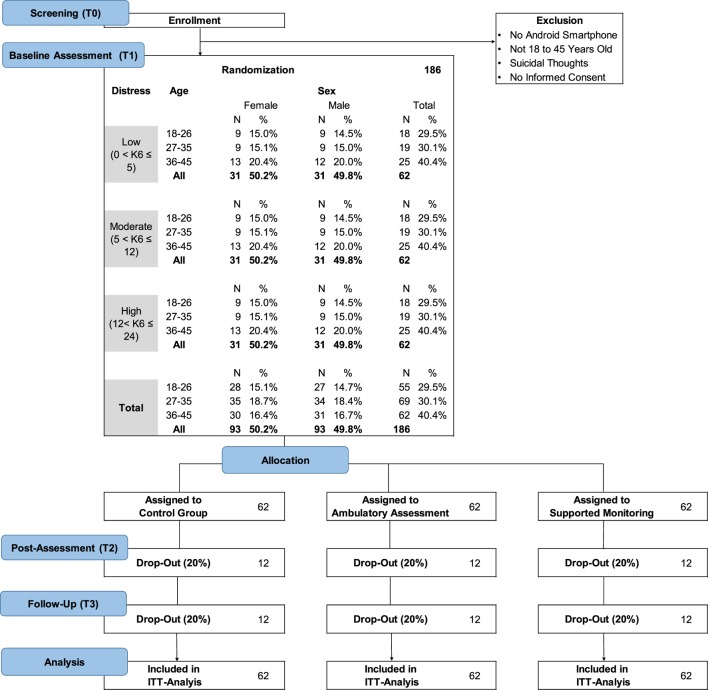
Mobile health (mHealth) could be widely used in the population to improve access to psychological treatment. In this paper, we describe the development of a mHealth intervention on the basis of supportive self-monitoring and describe the protocol for a randomized controlled trial to evaluate its effectiveness among smartphone users with psychological distress. Based on power analysis, a representative quota sample of = 186 smartphone users will be recruited, with an over-sampling of persons with moderate to high distress. Over a 4-week period, the intervention will be compared to a self-monitoring without intervention group and a passive control group. Telephone interviews will be conducted at baseline, post-intervention (4 weeks), and 12-week follow-up to assess study outcomes. The primary outcome will be improvement of mental health. Secondary outcomes will include well-being, intentions toward help-seeking and help-seeking behavior, user activation, attitudes toward mental-health services, perceived stigmatization, smartphone app quality, user satisfaction, engagement, and adherence with the intervention. Additionally, data from the user's daily life as collected during self-monitoring will be used to investigate risk and protective factors of mental health in real-world settings. Therefore, this study will allow us to demonstrate the effectiveness of a smartphone application as a widely accessible and low-cost intervention to improve mental health on a population level. It also allows to identify new assessment approaches in the field of psychiatric epidemiology.
移动健康(mHealth)可在人群中广泛应用,以改善心理治疗的可及性。在本文中,我们描述了基于支持性自我监测的移动健康干预措施的开发,并阐述了一项随机对照试验的方案,以评估其在有心理困扰的智能手机用户中的有效性。基于功效分析,将招募一个代表性配额样本,即186名智能手机用户,对中度至高度困扰者进行过度抽样。在4周的时间内,将该干预措施与无干预的自我监测组和被动对照组进行比较。将在基线、干预后(4周)和12周随访时进行电话访谈,以评估研究结果。主要结果将是心理健康的改善。次要结果将包括幸福感、求助意向和求助行为、用户活跃度、对心理健康服务的态度、感知到的污名化、智能手机应用质量、用户满意度、参与度以及对干预措施的依从性。此外,自我监测期间收集的用户日常生活数据将用于调查现实环境中心理健康的风险和保护因素。因此,本研究将使我们能够证明智能手机应用作为一种广泛可及且低成本的干预措施在人群层面改善心理健康的有效性。它还能在精神疾病流行病学领域确定新的评估方法。