Hess Gaelen T, Tycko Josh, Yao David, Bassik Michael C
Department of Genetics and Stanford University Chemistry, Engineering, and Medicine for Human Health (ChEM-H), Stanford, CA, USA.
Department of Genetics and Stanford University Chemistry, Engineering, and Medicine for Human Health (ChEM-H), Stanford, CA, USA.
Mol Cell. 2017 Oct 5;68(1):26-43. doi: 10.1016/j.molcel.2017.09.029.
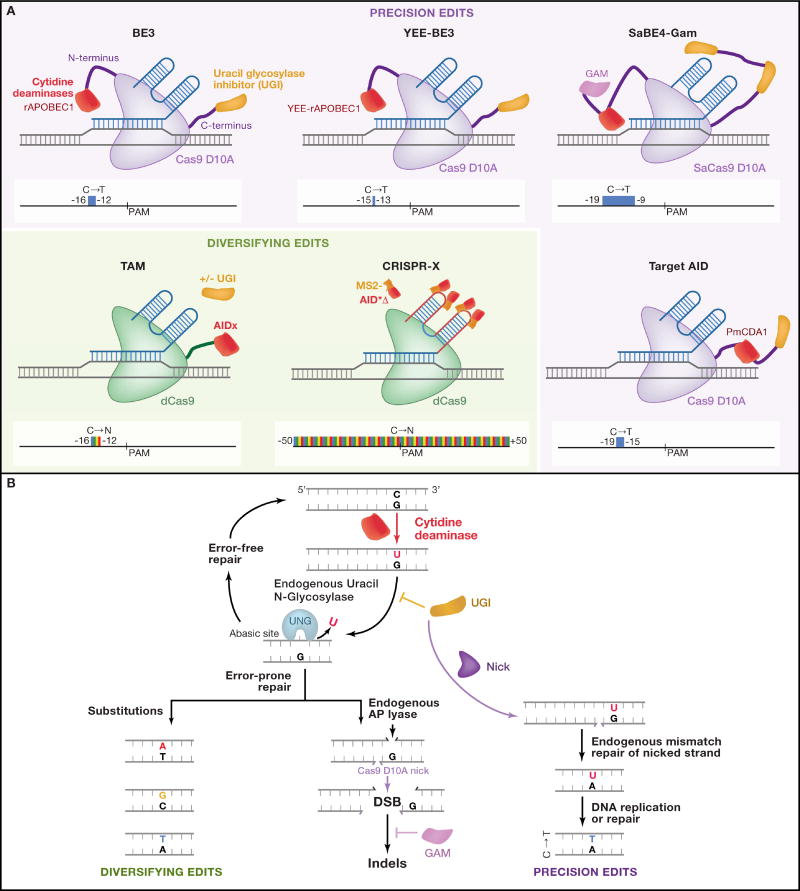
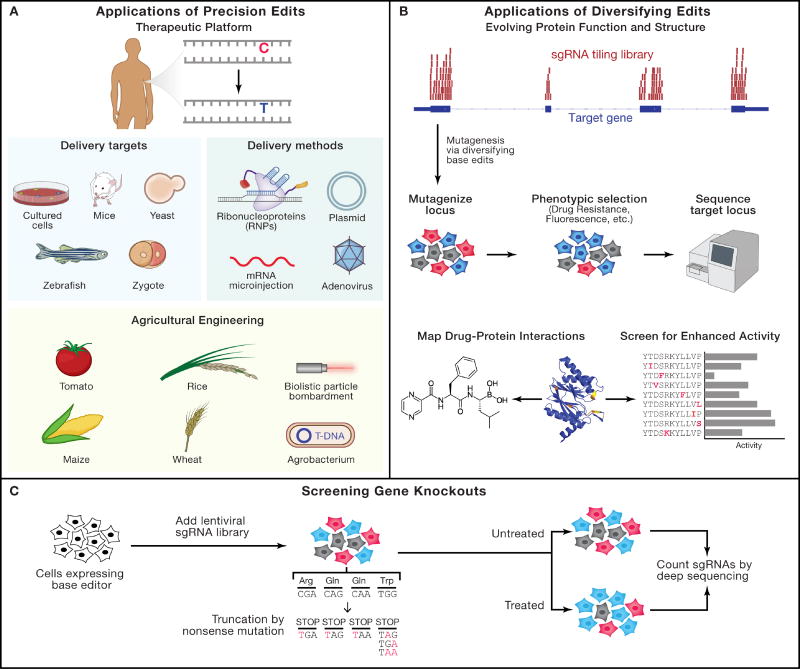
The past several years have seen an explosion in development of applications for the CRISPR-Cas9 system, from efficient genome editing, to high-throughput screening, to recruitment of a range of DNA and chromatin-modifying enzymes. While homology-directed repair (HDR) coupled with Cas9 nuclease cleavage has been used with great success to repair and re-write genomes, recently developed base-editing systems present a useful orthogonal strategy to engineer nucleotide substitutions. Base editing relies on recruitment of cytidine deaminases to introduce changes (rather than double-stranded breaks and donor templates) and offers potential improvements in efficiency while limiting damage and simplifying the delivery of editing machinery. At the same time, these systems enable novel mutagenesis strategies to introduce sequence diversity for engineering and discovery. Here, we review the different base-editing platforms, including their deaminase recruitment strategies and editing outcomes, and compare them to other CRISPR genome-editing technologies. Additionally, we discuss how these systems have been applied in therapeutic, engineering, and research settings. Lastly, we explore future directions of this emerging technology.
在过去几年中,CRISPR-Cas9系统的应用呈爆发式发展,涵盖了从高效基因组编辑、高通量筛选到一系列DNA和染色质修饰酶的招募等多个领域。虽然与Cas9核酸酶切割相结合的同源定向修复(HDR)已成功用于修复和重写基因组,但最近开发的碱基编辑系统为工程化核苷酸替换提供了一种有用的正交策略。碱基编辑依赖于胞嘧啶脱氨酶的招募来引入变化(而非双链断裂和供体模板),在提高效率的同时限制损伤并简化编辑工具的递送。与此同时,这些系统实现了新的诱变策略,以引入用于工程和发现的序列多样性。在此,我们综述了不同的碱基编辑平台,包括它们的脱氨酶招募策略和编辑结果,并将它们与其他CRISPR基因组编辑技术进行比较。此外,我们讨论了这些系统在治疗、工程和研究领域的应用方式。最后,我们探索了这项新兴技术的未来发展方向。