Department of Chemistry and Chemical Biology, Harvard University, Cambridge, MA 02138, USA.
Howard Hughes Medical Institute, Harvard University, Cambridge, MA 02138, USA.
Sci Adv. 2017 Aug 30;3(8):eaao4774. doi: 10.1126/sciadv.aao4774. eCollection 2017 Aug.
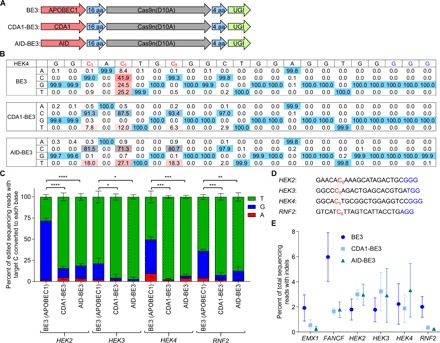
We recently developed base editing, the programmable conversion of target C:G base pairs to T:A without inducing double-stranded DNA breaks (DSBs) or requiring homology-directed repair using engineered fusions of Cas9 variants and cytidine deaminases. Over the past year, the third-generation base editor (BE3) and related technologies have been successfully used by many researchers in a wide range of organisms. The product distribution of base editing-the frequency with which the target C:G is converted to mixtures of undesired by-products, along with the desired T:A product-varies in a target site-dependent manner. We characterize determinants of base editing outcomes in human cells and establish that the formation of undesired products is dependent on uracil N-glycosylase (UNG) and is more likely to occur at target sites containing only a single C within the base editing activity window. We engineered CDA1-BE3 and AID-BE3, which use cytidine deaminase homologs that increase base editing efficiency for some sequences. On the basis of these observations, we engineered fourth-generation base editors (BE4 and SaBE4) that increase the efficiency of C:G to T:A base editing by approximately 50%, while halving the frequency of undesired by-products compared to BE3. Fusing BE3, BE4, SaBE3, or SaBE4 to Gam, a bacteriophage Mu protein that binds DSBs greatly reduces indel formation during base editing, in most cases to below 1.5%, and further improves product purity. BE4, SaBE4, BE4-Gam, and SaBE4-Gam represent the state of the art in C:G-to-T:A base editing, and we recommend their use in future efforts.
我们最近开发了碱基编辑技术,该技术可在不诱导双链 DNA 断裂 (DSB) 的情况下,将目标 C:G 碱基对可编程地转换为 T:A,也无需使用工程化的 Cas9 变体和胞嘧啶脱氨酶融合进行同源定向修复。在过去的一年中,第三代碱基编辑器 (BE3) 和相关技术已被许多研究人员在广泛的生物中成功使用。碱基编辑的产物分布——目标 C:G 被转换为不需要的副产物混合物的频率,以及所需的 T:A 产物——在靶位点依赖性方式上有所不同。我们描述了人类细胞中碱基编辑结果的决定因素,并确定了不需要产物的形成依赖于尿嘧啶 N-糖基化酶 (UNG),并且更有可能发生在碱基编辑活性窗口内仅包含单个 C 的靶位点上。我们设计了 CDA1-BE3 和 AID-BE3,它们使用增加某些序列碱基编辑效率的胞嘧啶脱氨酶同源物。基于这些观察结果,我们设计了第四代碱基编辑器 (BE4 和 SaBE4),它们将 C:G 到 T:A 的碱基编辑效率提高了约 50%,同时与 BE3 相比,不需要的副产物的频率降低了一半。将 BE3、BE4、SaBE3 或 SaBE4 与 Gam 融合,Gam 是一种噬菌体 Mu 蛋白,可结合 DSB,可大大降低碱基编辑过程中的插入缺失形成,在大多数情况下降低到 1.5%以下,进一步提高了产物纯度。BE4、SaBE4、BE4-Gam 和 SaBE4-Gam 代表了 C:G 到 T:A 碱基编辑的最新技术水平,我们建议在未来的研究中使用它们。