Wang Hai-Feng, Wang Da-Ming, Wang Jun-Jie, Wang Li-Jun, Lu Jun, Qi Peng, Hu Shen, Yang Xi-Meng, Chen Kun-Peng
Department of Neurosurgery, Beijing Hospital, National Center of Gerontology, Beijing, China.
Graduate School of Peking Union Medical College, Beijing, China.
Front Neurol. 2017 Sep 25;8:508. doi: 10.3389/fneur.2017.00508. eCollection 2017.
Extracranial internal carotid artery (eICA) tortuosity may trigger cerebral ischemia, and body mass index (BMI) is a measure of body mass based on height and weight. The main purpose of this study is to determine the influence of BMI on the tortuosity of eICA.
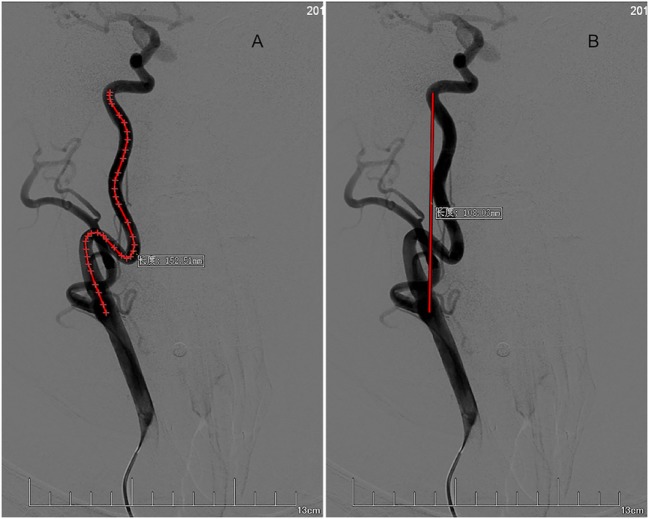
A total of 926 carotid artery angiograms were performed in 513 patients, of which 116 cases and matched controls were selected. Arterial tortuosity was defined as simple tortuosity, kinking, or coiling. The severity of tortuosity was measured by tortuosity index, formula: [(actual length/straight-line length - 1) × 100].
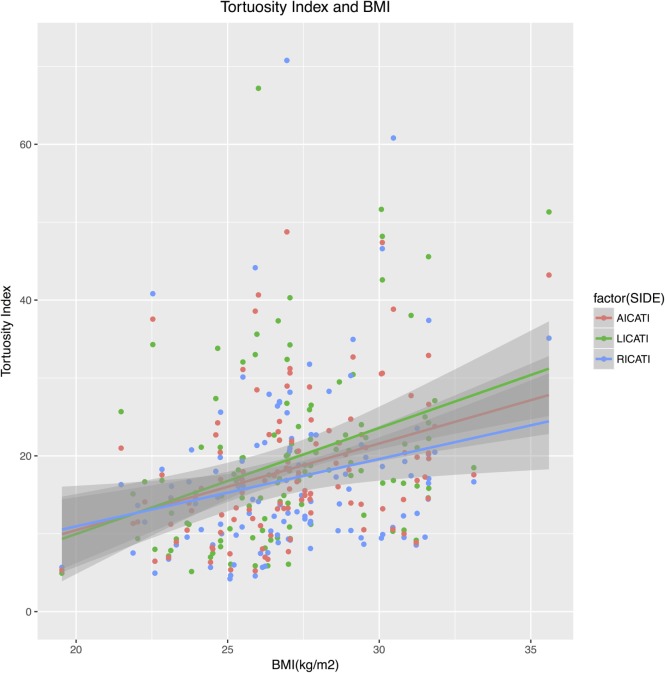
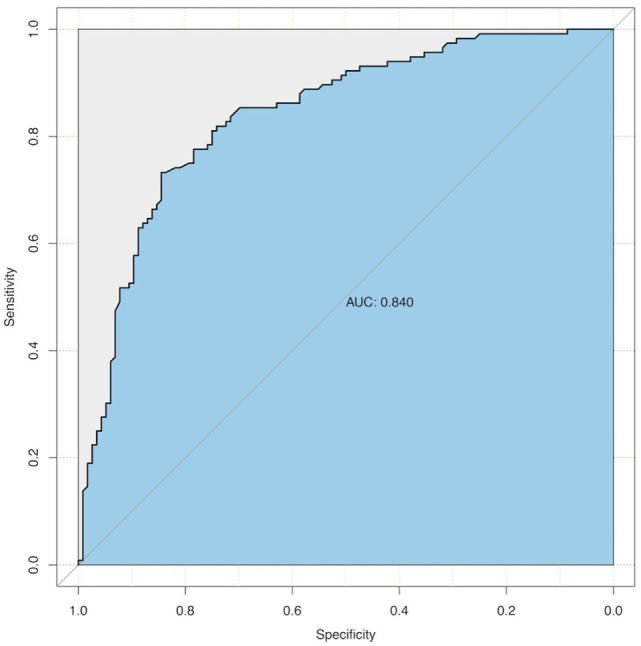
BMIs were different between the two groups [tortuosity: 27.06 kg/m (SD 2.81 kg/m) versus none: 23.3 kg/m (SD 2.78 kg/m); < 0.001]. BMI was independently and significantly associated with eICA tortuosity (odds ratio 1.59; 95% confidence interval, 1.35-1.86; < 0.001). eICA tortuosity index is linearly associated with BMI (exponential coefficient β = 1.067, < 0.001). The optimal predictive threshold of BMI for eICA tortuosity was 25.04 kg/m. The physiological mechanism underlying the reasons why higher BMI has negative influence on extracranial carotid artery tortuosity may be an intra-abdominal hypertension caused by a much higher amount of body fat stored in visceral adipose tissue.
Our result reveals a novel role for greater BMI on the presence of eICA tortuosity. For each increase in BMI of 1 kg/m, there is a corresponding 1.59-fold increase in the risk of developing eICA tortuosity. The severity of eICA tortuosity increases linearly with increased BMI.
颅外颈内动脉(eICA)迂曲可能引发脑缺血,而体重指数(BMI)是基于身高和体重衡量体重的指标。本研究的主要目的是确定BMI对eICA迂曲的影响。
对513例患者共进行了926次颈动脉血管造影,从中选取了116例病例及匹配的对照组。动脉迂曲定义为单纯迂曲、扭结或盘绕。迂曲严重程度通过迂曲指数测量,公式为:[(实际长度/直线长度 - 1)×100]。
两组的BMI不同[迂曲组:27.06 kg/m²(标准差2.81 kg/m²),无迂曲组:23.3 kg/m²(标准差2.78 kg/m²);P < 0.001]。BMI与eICA迂曲独立且显著相关(比值比1.59;95%置信区间,1.35 - 1.86;P < 0.001)。eICA迂曲指数与BMI呈线性相关(指数系数β = 1.067,P < 0.001)。BMI对eICA迂曲的最佳预测阈值为25.04 kg/m²。较高BMI对颅外颈动脉迂曲产生负面影响的潜在生理机制可能是内脏脂肪组织中储存的大量身体脂肪导致的腹内高压。
我们的结果揭示了较高BMI在eICA迂曲存在方面的新作用。BMI每增加1 kg/m²,发生eICA迂曲的风险相应增加1.59倍。eICA迂曲的严重程度随BMI增加呈线性增加。