Pan Ming, Lyu Congcong, Zhao Junlong, Shen Bang
State Key Laboratory of Agricultural Microbiology, College of Veterinary Medicine, Huazhong Agricultural UniversityWuhan, China.
Key Laboratory of Preventive Medicine in Hubei ProvinceWuhan, China.
Front Microbiol. 2017 Sep 25;8:1825. doi: 10.3389/fmicb.2017.01825. eCollection 2017.
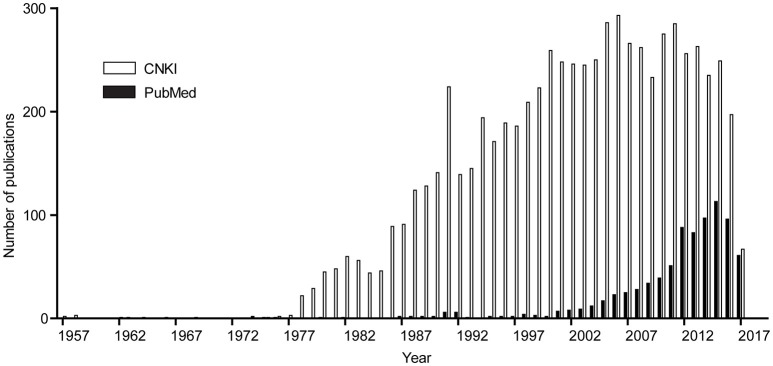
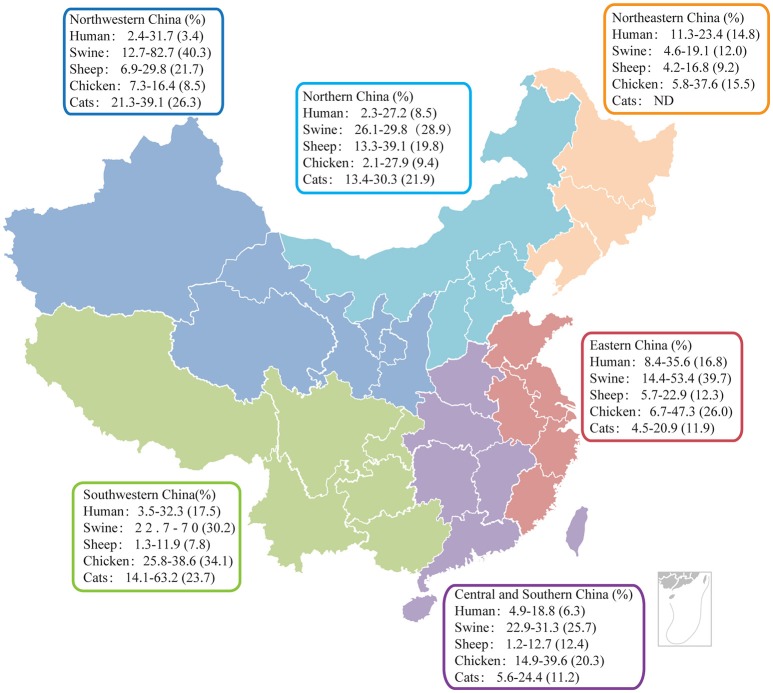
is a ubiquitous zoonotic pathogen belonging to apicomplexan parasites. Infection in humans and animals may cause abortion and other severe symptoms under certain circumstances, leading to great economical losses and public health problems. was first discovered in China in 1955 and the corresponding work was published in 1957. Since then, a lot of work has been done on this parasite and the diseases it causes. This review summarizes the major progress made by Chinese scientists over the last 60 years, and gives our perspectives on what should be done in the near future. A wide variety of diagnostic approaches were designed, including the ones to detect specific antibodies in host sera, and specific antigens or DNA in tissue and environmental samples. Further work will be needed to translate some of the laboratory assays into reliable products for clinic uses. Epidemiological studies were extensively done in China and the sero-prevalence in humans increased over the years, but is still below the world average, likely due to the unique eating and cooking habits. Infection rates were shown to be fairly high in meat producing animals such as, pigs, sheep, and chickens, as well as in the definitive host cats. Numerous subunit vaccines in the form of recombinant proteins or DNA vaccines were developed, but none of them is satisfactory in the current form. Live attenuated parasites using genetically modified strains may be a better option for vaccine design. The strains isolated from China are dominated by the ToxoDB #9 genotype, but it likely contains multiple subtypes since different ToxoDB #9 strains exhibited phenotypic differences. Further studies are needed to understand the general biology, as well as the unique features of strains prevalent in China.
是一种广泛存在的人畜共患病原体,属于顶复门寄生虫。在某些情况下,人和动物感染该病原体可能会导致流产及其他严重症状,从而造成巨大的经济损失和公共卫生问题。该病原体于1955年在中国首次被发现,相关研究成果于1957年发表。自那时起,针对这种寄生虫及其引发的疾病开展了大量研究工作。本综述总结了中国科学家在过去60年中取得的主要进展,并对近期应开展的工作提出了我们的看法。人们设计了多种诊断方法,包括检测宿主血清中特异性抗体、组织和环境样本中特异性抗原或DNA的方法。还需要进一步开展工作,将一些实验室检测方法转化为可靠的临床应用产品。中国广泛开展了流行病学研究,多年来人类血清阳性率有所上升,但仍低于世界平均水平,这可能归因于独特的饮食和烹饪习惯。在猪、羊、鸡等肉类生产动物以及终末宿主猫中,感染率相当高。人们开发了许多重组蛋白或DNA疫苗形式的亚单位疫苗,但目前尚无一种令人满意。使用基因改造菌株的减毒活寄生虫可能是疫苗设计的更好选择。从中国分离出的菌株以ToxoDB #9基因型为主,但由于不同的ToxoDB #9菌株表现出表型差异,因此可能包含多个亚型。需要进一步开展研究,以了解其一般生物学特性以及在中国流行的菌株的独特特征。